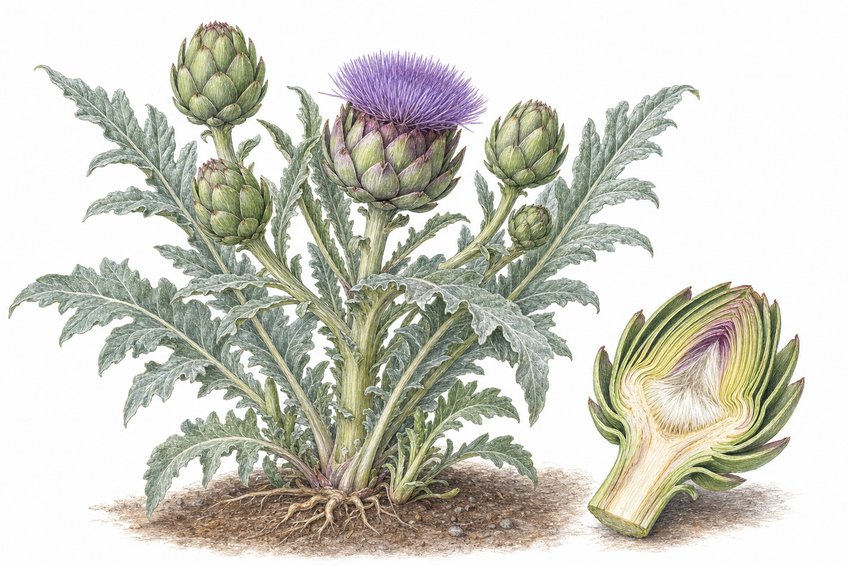
ARTICHOKE (CYNARA SCOLYMUS): MEDITERRANEAN THISTLE
Old kitchen wisdom says an artichoke is eaten leaf by leaf, and that is exactly how this thistle asks to be known. Before it became a vegetable on a supper plate, artichoke was a wild Mediterranean relative of the cardoon, armed with spines, silvered with down, and hiding a tender heart inside a fortress of bracts.
A thistle with a supper-table secret
Artichoke belongs to the daisy family, though it looks more like a noble thistle than a cheerful garden flower. The part most people eat is the unopened flower bud, gathered before the plant lets loose its crown of purple florets.
Picture a sun-baked garden in June: broad leaves arch outward in gray-green waves, softly felted underneath, with ribs as pale as celery. Crush a young leaf between your fingers and it gives off a green, bitter, resinous scent, the kind of aroma that seems to belong beside olive trees and dry stone walls.
| Botanical name | Cynara cardunculus var. scolymus, often listed as Cynara scolymus |
|---|---|
| Family | Asteraceae, the daisy and thistle family |
| Parts used | Unopened flower buds as food; leaves in traditional herbal preparations; stems and roots in some older regional uses |
| Other names | Globe artichoke, French artichoke, green artichoke, alcachofa, carciofo |
| Native region | Mediterranean basin, with close wild relatives around southern Europe and North Africa |
How to recognize the plant
A mature artichoke plant can stand 3 to 6 feet tall, with a wide, architectural shape. Its leaves are deeply cut, silvery green, and often slightly prickly along the edges, especially in older or more thistle-like varieties.
The edible bud forms at the end of a stout stalk. It is made of overlapping bracts, those tight green scales that must be peeled away to reach the pale, fleshy base and the famous heart.
If the bud is left alone, it opens into a large thistle head packed with purple-blue florets. Bees visit eagerly, and the bud that once looked like dinner becomes a shaggy brush of color above the leaves.
The bud, the leaf, and the bitter edge
The artichoke is a good reminder that one plant can have different roles depending on the part in hand. The unopened bud is the kitchen treasure, while the larger leaves have been the main part used in European herbal traditions.
The bud contains a fleshy base, tender inner bracts, and the immature flower parts known as the choke. Garden cooks remove the fuzzy choke from larger buds, though very young artichokes may be tender enough to eat almost whole after trimming.
The leaves taste far more bitter than the bud. In old household herbals, that bitterness mattered: monastery gardeners, apothecaries, and country cooks often valued bitter plants as part of the meal rhythm, especially in preparations served around rich foods.
From Mediterranean thistle to Renaissance delicacy
Artichoke's story begins with the cardoon group, a cluster of thistles shaped by Mediterranean farmers. Greek and Roman writers mentioned thistle-like plants eaten at the table, and Pliny the Elder wrote about cultivated cardoons in the first century AD.
The name carries a long journey of language. Many English words for artichoke trace back through Italian and Spanish to the Arabic al-kharshuf, a sign of how carefully gardeners of the medieval Islamic world tended and spread improved forms.
Renaissance Italy helped turn the globe artichoke into a fashionable vegetable. Catherine de Medici is often linked with its arrival at the French court in the 1500s, where it gained a reputation as a rich person's food, served with butter, oil, and ceremony.
Across the Atlantic, artichokes appeared in the gardens of curious colonists and estate growers rather than the rougher pioneer medicine chest. Thomas Jefferson recorded globe artichokes in his Monticello garden calendar in 1770, proof that this Mediterranean thistle had found a place among the experimental plantings of early America.
Folklore tucked between the leaves
Greek myth gives the plant a memorable name story. Cynara was said to be a beautiful woman whom Zeus turned into an artichoke-like thistle, a tale that may explain why the botanical name Cynara still has a faintly mythic sound.
In Italian kitchen folklore, people sometimes compare life to an artichoke: you take it leaf by leaf to reach the heart. English speakers have a similar fondness for the phrase the heart of the artichoke, meaning the best part after patient work.
Old garden wisdom treats artichoke as a plant for the patient. In mild climates, a well-set crown can return for years, and gardeners often say the best buds come when the roots have settled in and the plant has learned its place.
Did you know?
If an artichoke bud is allowed to bloom, the part usually served with dinner becomes a true thistle flower head. The purple tuft is made of hundreds of tiny florets, each one a small flower packed into the same head.
Where artichokes feel at home
Artichoke is happiest in a Mediterranean pattern of weather: mild, wet winters and dry, sunny summers. That is why it settled so well along the coasts of Italy, Spain, France, and later California.
In North America, California became the center of commercial artichoke growing, especially around Castroville and the cool coastal fields of Monterey County. Foggy mornings, bright afternoons, and well-drained soil help the plants form large buds without harsh summer heat.
Home gardeners grow artichoke as a perennial in mild regions, often USDA zones 7 to 10 depending on variety and winter care. In colder places, it may be started early indoors and grown as an annual, though it needs a long season and rich soil to make full-sized buds.
Planting, tending, and harvest signs
Artichokes like deep soil, steady moisture, and plenty of room. A single plant can spread wider than a bushel basket, so crowded rows soon turn into a prickly quarrel.
Growers usually harvest when the bud is firm, heavy, and still tight. Farmers' almanac style advice would say to cut before the purple tassel shows, because once the flower opens, the bracts toughen and the kitchen moment has passed.
Harvesters cut the bud with a short piece of stem attached. The stem is often peeled and cooked too, carrying a flavor close to the heart, though with a greener bite.
After the main bud is cut, smaller side buds may follow. In perennial plantings, gardeners often cut back old stalks after harvest and let the crown rest before the next flush of growth.
The plant chemistry in plain language
Artichoke leaves and buds contain a family of plant compounds that give them their distinct taste. Among the best known are caffeoylquinic acids, including cynarin and chlorogenic acid.
The leaves also contain flavonoids such as luteolin glycosides, plus bitter sesquiterpene lactones, especially cynaropicrin. That last compound helps explain why the leaf tastes so sharply bitter compared with the mild, nutty heart.
The edible bud contains fiber, minerals, and inulin-type carbohydrates, along with aromatic and phenolic compounds. These chemistry names are part of the plant's natural makeup, the same hidden alphabet that gives herbs their scent, color, and bite.
A few artichoke curiosities
- The globe artichoke and the cardoon are close relatives; cardoon is grown more for its thick leaf stalks than for its buds.
- The word artichoke in English has inspired playful folk explanations, including the old joke that the plant can choke the garden with its size if given rich soil and no boundaries.
- Medieval monastery gardens often kept useful bitter greens and thistle vegetables near the kitchen garden, where cooks and herbal brothers could gather them fresh.
- Small artichokes are not always immature large ones; some varieties naturally produce many smaller buds along side shoots.
One last look
Artichoke rewards close attention: the silver fuzz under a leaf, the armored bud, the purple bloom that appears if supper is postponed. In a garden at dusk, the whole plant looks carved from pewter and green wax, with bees nosing through the flowers that escaped the cook's knife.
References
- Royal Botanic Gardens, Kew. Plants of the World Online: Cynara cardunculus L.
- USDA Agricultural Research Service. GRIN taxonomy records for Cynara cardunculus and related cultivated forms.
- Monticello, Thomas Jefferson Foundation. Garden and plant records for globe artichoke at Monticello.
- University of California Agriculture and Natural Resources. Artichoke production and cultivation resources for California growers.
- European Medicines Agency. Assessment report on Cynara cardunculus, including traditional leaf material and constituent overview.
- Pliny the Elder. Natural History, references to cultivated thistle vegetables in Roman food culture.
Where to Find Artichoke
Explore our Artichoke products in the HawaiiPharm store.