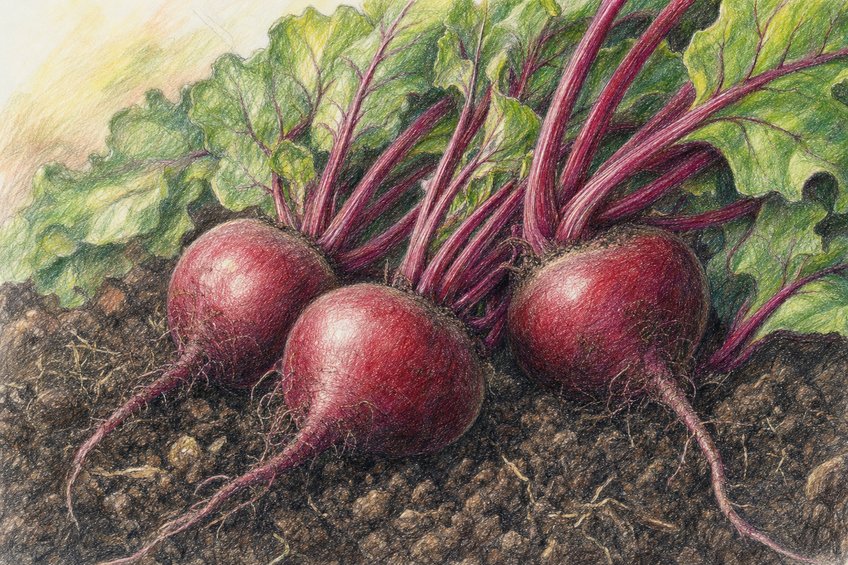
BEET ROOT (BETA VULGARIS) | BOTANY, HISTORY AND LORE
"Red as a beet" is an old saying with a very practical beginning: cut a fresh beet root and its ruby juice can stain your fingertips before you have time to reach for a towel. Few garden vegetables announce themselves so boldly - earthy, sweet, and as bright as a midsummer sunset.
Quick Facts About Beet Root
| Botanical name | Beta vulgaris L., commonly cultivated as garden beet or beet root |
| Family | Amaranthaceae, subfamily Chenopodioideae |
| Genus | Beta |
| Parts used | Root and leaves; seeds are used for planting |
| Other names | Beet, beetroot, garden beet, red beet, table beet |
| Native region | Descended from wild sea beet of coastal Europe, North Africa, and western Asia |
What Is Beet Root?
Beet root is the swollen storage root of Beta vulgaris, a plant with a long agricultural family tree. It is closely related to Swiss chard, sugar beet, and mangel-wurzel, all forms shaped by human selection from the same adaptable species.
In its first season, the plant makes a low rosette of broad leaves, often deep green with crimson stems and veins. Beneath the soil, the root rounds out into a globe, cylinder, or tapered form, depending on the variety.
Fresh beet root has smooth, thin skin and firm flesh that can be dark red, golden yellow, white, or candy-striped. Slice one open and you may notice a cool, mineral scent - like rain on garden soil - along with concentric rings that look almost painted by hand.
A Journey Through Time
Beet's wild ancestor, sea beet, grew along salty shorelines where wind, spray, and poor soil made life hard for softer plants. Early Mediterranean peoples ate the leafy greens first; the plump, sweet root came into greater favor later as gardeners selected for size, tenderness, and color.
In the Greco-Roman world, writers such as Theophrastus and Dioscorides mentioned forms of Beta, while Roman cooks used beet leaves as a familiar kitchen green. By the early Middle Ages, European monastery gardens and royal estates were cultivating beets; Charlemagne's estate ordinance, the Capitulare de villis from around 800, listed plants that administrators were expected to grow, including beta.
In 1597, English herbalist John Gerard described red and white beets in The Herball, paying close attention to their garden forms. Later, colonial American and pioneer households planted beets for sturdy food, winter storage, pickling, and the root-cellar wisdom summed up in the old farm saying, "Waste not, want not."
Beet root itself is an Old World crop, so it was not part of pre-contact Native American food traditions. Still, similar plants in the amaranth family had deep Indigenous roots: Hopi farmers grew a red amaranth, often called Hopi red dye amaranth, whose brilliant color was traditionally used in piki bread.
Where Does It Grow?
The wild sea beet lineage is native to coastal areas of the Mediterranean basin, Atlantic Europe, North Africa, and western Asia. Modern beet root, however, is a citizen of the temperate world, grown in home gardens and farms across North America, Europe, Asia, Australia, and beyond.
Beets prefer cool weather, steady moisture, and loose, well-drained soil that lets the root expand without hitting stones or hard clay. They can tolerate a light frost, which is why many gardeners tuck them into both spring and fall beds.
The Root - A Closer Look
The part we call the beet root is a swollen combination of taproot and lower stem tissue, built to store energy for the plant's second year. If left in the ground, a beet can send up a tall, branching flower stalk with small greenish blossoms and clustered seeds.
Run your thumb over a freshly pulled beet and you feel a satin-smooth skin dusted with soil, with fine root hairs trailing from the tip. The cut surface is moist and dense, and red varieties release a vivid pigment that has colored soups, pickles, hands, and kitchen towels for generations.
What's Inside?
Beet root is famous for betalains, a group of plant pigments that includes red-violet betacyanins such as betanin and yellow-orange betaxanthins. Betanin is so intensely colored that it is used as a natural food color in some settings.
The root also contains natural sugars, fiber, folate, manganese, potassium, organic acids, and plant nitrates. Its earthy aroma is linked in part to geosmin, the same scent compound many people recognize after rain falls on dry soil.
From Garden to Harvest
Gardeners usually sow beet seeds directly in cool soil, then thin the young plants so each root has room to swell. Roots are commonly harvested when they reach about 1.5 to 3 inches across, while the greens are still tender; old farmers' almanac-style lore placed beets among the "root crops" best sown as the moon waned, a seasonal custom more poetic than scientific but still beloved by many kitchen gardeners.
Folklore & Fun Facts
-
The expression "red as a beet" became common in English and American speech for a flushed face. It is one of those sayings that makes perfect sense the moment beet juice touches a cutting board.
-
In Appalachian and Southern kitchens, beet greens often joined the spring "mess of greens," cooked alongside other garden leaves and served with cornbread. Mountain cooks wasted little: the tops went to the pot, the roots to the cellar or pickle crock, and the cooking liquid became part of the meal.
-
British and Irish country kitchens long served pickled beetroot with cold meats, potatoes, and bread. In many households, the sharp-sweet jar of beetroot on the pantry shelf was as ordinary as jam or mustard.
-
Pennsylvania Dutch cooks made red beet eggs by steeping hard-cooked eggs in pickled beet brine, turning the whites a cheerful pink. It remains a beloved picnic and potluck food in parts of the Mid-Atlantic.
-
Old root-cellar wisdom prized vegetables that kept well through cold months. Beets fit that practical tradition beautifully: firm, colorful, and dependable when fresh garden produce was scarce.
Did You Know?
The sugar beet is also Beta vulgaris, but it was bred for a pale, sugar-rich root rather than a red table vegetable. German chemist Andreas Marggraf identified sugar in beet roots in 1747, and his student Franz Carl Achard helped launch beet sugar production in the early 1800s.
Old herbals, tribal ethnobotanical records, seed catalogs, regional cookbooks, and farmers' almanacs each tell a different part of the beet story. Together, they remind us that a humble garden crop can carry shoreline ancestry, monastery history, pioneer thrift, Indigenous plant-color traditions, and kitchen-table beauty all in one rounded root.
The next time beet leaves shine in a garden row after rain, their red veins bright against dark soil, it is worth pausing over the small wonder of it. So much natural history can be tucked quietly beneath the ground.
References
-
Plants of the World Online, Royal Botanic Gardens, Kew: Beta vulgaris L.
-
USDA Germplasm Resources Information Network: Beta vulgaris taxonomy and distribution records.
-
Flora of North America: Beta vulgaris and related cultivated forms.
-
Capitulare de villis, Carolingian estate ordinance, circa 800.
-
Moerman, Daniel E. Native American Ethnobotany. Timber Press, 1998.
-
Marggraf, Andreas Sigismund. Eighteenth-century studies on sugar in beet roots; later beet sugar development by Franz Carl Achard.
Where to Find Beet Root
Explore our Beet Root products in the HawaiiPharm store.