California has a way of turning sunlight into flowers. Each spring, hillsides can glow so brightly with California poppies that old-timers might say they look like the Gold Rush spilled across the grass.
Quick Facts About California Poppy
| Botanical name | Eschscholzia californica |
|---|---|
| Family | Papaveraceae, the poppy family |
| Genus | Eschscholzia |
| Parts used | Flowering aerial parts, leaves, flowers, and seeds in traditional and botanical contexts |
| Other names | California poppy, golden poppy, copa de oro, flame flower |
| Native region | Western North America, especially California and neighboring Pacific regions |
What Is California Poppy?
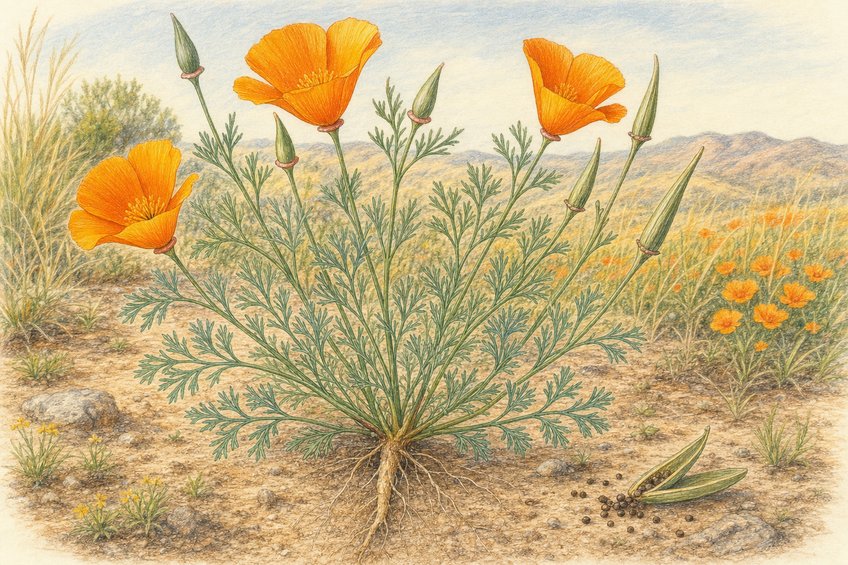
California poppy is a low, airy wildflower with ferny blue-green leaves and silky, cup-shaped blossoms. Its flowers are usually bright orange, though wild populations may also show yellow, cream, rose, or red-orange tones.
Crush a fresh leaf between your fingers and you may notice a green, slightly bitter scent, more meadow than perfume. The foliage feels delicate and finely cut, like lace made from cool sea mist, while the petals have the soft, thin texture of tissue paper warmed by the sun.
This plant has a lively daily rhythm. On cloudy days, in chilly wind, and as evening falls, the petals fold closed, as if the flower is tucking itself in until the light returns.
A Journey Through Time
Long before it became the state flower of California, Eschscholzia californica grew across the homelands of many Native Californian peoples. Ethnobotanical records describe how communities including the Cahuilla, Pomo, and other groups knew the plant as part of the seasonal landscape, and some prepared its young greens or used the colorful blossoms in traditional ways.
The plant entered European botanical literature after the Russian exploring ship Rurik visited the California coast in 1816. Poet and naturalist Adelbert von Chamisso later named the genus Eschscholzia in honor of his friend and fellow expedition naturalist Johann Friedrich von Eschscholtz.
By the pioneer era, California poppy had become a symbol of western abundance. While colonial housewives in New England filled pantry jars with familiar Old World herbs, settlers moving west met a different medicine-chest of plants, and this golden poppy quickly found a place in regional herbals, gardens, and memory.
Where Does It Grow?
California poppy is native to western North America, with a natural range centered in California and extending into Oregon, Washington, Nevada, Arizona, New Mexico, Baja California, and parts of northwestern Mexico. It thrives in open grasslands, coastal bluffs, chaparral edges, roadsides, sandy flats, and disturbed soils where sunlight is generous.
Today it is planted and naturalized in many temperate places around the world. In its best-loved landscapes, picture a spring meadow after winter rain: gray-green leaves close to the ground, thin stems rising lightly, and orange cups scattered across the hills like lanterns.
The Flowering Herb - A Closer Look
The flowering aerial parts include the stems, leaves, buds, and blossoms gathered while the plant is in bloom. The stems are slender and slightly bluish, the leaves are deeply divided, and the buds wear little pointed caps before opening into four broad petals.
After flowering, the plant forms long, narrow seed pods. When ripe, the pods split suddenly and fling tiny dark seeds outward, a botanical trick that helps the next generation travel a little farther from the parent plant.
What's Inside?
California poppy contains several plant alkaloids, including californidine, eschscholtzine, protopine, and allocryptopine. These belong to broader groups of botanical compounds that chemists study to understand the plant's character and relationship to other members of the poppy family.
The orange color comes largely from carotenoid pigments, the same broad pigment family that gives many flowers, fruits, and autumn leaves their warm yellow-to-red shades. The plant also contains flavonoids and other naturally occurring constituents found in many green plants.
From Garden to Harvest
Gardeners usually sow California poppy directly where it will grow, either in fall in mild climates or early spring in colder regions. It prefers full sun, well-drained soil, and modest fertility; too much pampering can make more leaf than flower. Flowering tops are traditionally gathered on dry mornings after dew has lifted, with plenty of blooms left behind for bees, seed, and the simple pleasure of watching the patch renew itself.
Folklore & Fun Facts
- Did You Know? California poppy became the official state flower of California in 1903, and April 6 is observed as California Poppy Day.
- The American saying "April showers bring May flowers" fits this plant beautifully in many western valleys, where winter and spring rains can lead to breathtaking bloom years.
- Gold Rush culture helped shape the flower's image. Names like "copa de oro," meaning cup of gold, echoed the old phrase "as good as gold" in a land where both flowers and dreams glittered.
- Old garden wisdom warns, "One year's seed is seven years' weed." California poppy is not usually a troublesome plant in dry sunny gardens, but it can self-sow cheerfully when it likes the place.
- Farmers' almanac-style gardeners often watch the weather more than the calendar. A cool, wet winter followed by bright spring sun is the kind of pattern that can turn western slopes into orange quilts.
- Unlike the opium poppy, Papaver somniferum, California poppy is a different genus and is not a source of morphine.
References
- Kew Science, Plants of the World Online: Eschscholzia californica.
- USDA Natural Resources Conservation Service, PLANTS Database: Eschscholzia californica.
- Moerman, Daniel E. Native American Ethnobotany. Timber Press, 1998.
- Chamisso, Adelbert von. Botanical accounts from the Rurik expedition collections, early 19th century.
To notice California poppy is to notice a whole season at once: rain stored in the soil, sunlight caught in petals, bees moving from cup to cup, and seeds waiting for another year. Few wildflowers remind us so clearly that a landscape has its own calendar, written in color.
Where to Find California
Explore our California products in the HawaiiPharm store.