Old gardeners like to say, "One year's seed is seven years' weed," and cleavers seems to have taken that advice to heart. Brush past it on a spring walk and the plant answers back, fastening its green, bristly stems to your sleeve as if it has news to share.
Quick Facts About Cleavers
| Botanical name | Galium aparine L. |
|---|---|
| Family | Rubiaceae, the coffee family |
| Genus | Galium |
| Parts used | Fresh or dried aerial parts - stems, leaves, flowers, and young tops |
| Other names | Goosegrass, catchweed, stickywilly, sticky weed, grip grass, bedstraw, clivers |
| Native region | Primarily Europe, North Africa, and temperate Asia; now widespread in North America and many temperate regions |
What Is Cleavers?
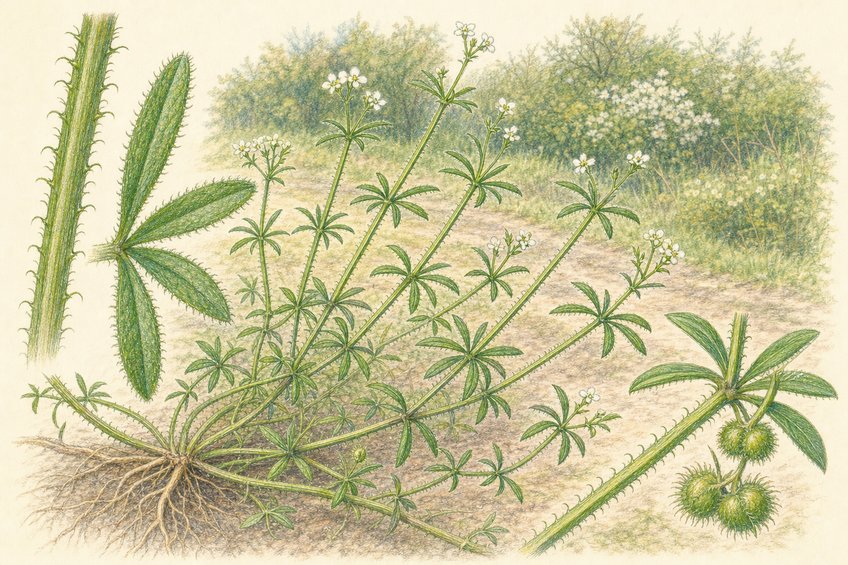
Cleavers is a scrambling annual herb, thin-stemmed and eager, often found leaning through hedges, garden edges, and damp spring corners. Its stems are square, its leaves grow in neat whorls like little green wagon wheels, and its tiny white flowers look like pinpricks of starlight.
The plant does not climb with tendrils. Instead, it clings with hundreds of minute hooked hairs that catch on fabric, fur, feathers, and neighboring plants. Run a stem gently between your fingers and it feels faintly raspy, almost like the soft scratch of a cat's tongue.
Crush a fresh handful and cleavers gives off a mild green scent - grassy, watery, and springlike, with a hint of cucumber peel. It is not a showy plant, but it is wonderfully memorable once it has attached itself to your socks.
A Journey Through Time
In the hedgerows of England and Ireland, country people knew cleavers by touch as much as by sight. Children tossed "sticky willy" at one another's jumpers, while goosekeepers noticed that geese and young poultry nibbled it readily - one reason the old name "goosegrass" stuck.
Early European herbals recorded the plant under names such as clivers, goosegrass, and aparine. John Gerard described it in his 1597 herbal, noting its clinging habit, and Nicholas Culpeper later placed it among the familiar green simples of household practice in 1653. Colonial American households inherited much of this British herbal language, and dried spring greens like cleavers appeared in domestic traditions alongside nettles, chickweed, and other wayside plants.
In Appalachian and Southern folk herbalism, spring plants carried a special meaning after a winter of stored foods. Mountain families often spoke of "spring tonics" - not as fancy remedies, but as seasonal kitchen lore, a way of welcoming fresh green life back to the table and the teapot.
Where Does It Grow?
Cleavers is at home in cool, moist, disturbed places: hedgerows, woodland edges, thickets, old fields, orchards, fence lines, and the shady side of gardens. It favors nitrogen-rich soil and often appears where leaves have gathered, compost has mellowed, or animals have passed through.
Most modern botanical references place its original range in Europe, North Africa, and temperate Asia, though the plant now grows widely across North America, Australia, New Zealand, and other temperate regions. Some floras discuss native or closely related Galium forms in North America, which is a good reminder that plant geography is sometimes a living conversation rather than a closed book.
The Aerial Parts - A Closer Look
The useful portion of cleavers is generally the aboveground plant: the young stems, narrow leaves, tender tops, and small flowers. Each whorl usually carries 6 to 8 lance-shaped leaves, giving the stem a starry, geometric look when viewed from above.
Later in the season, the flowers give way to paired round fruits covered in hooked bristles. These little burrs are expert travelers, hitching rides on deer legs, dog coats, pant cuffs, and wool blankets - a farmer's almanac lesson in seed dispersal written in miniature.
What's Inside?
Phytochemical studies of Galium aparine have identified iridoid glycosides, including asperuloside and related compounds, along with flavonoids, phenolic acids, tannins, small amounts of coumarin-type constituents, and organic acids. The plant also contains minerals such as potassium and silica, which are common in many green spring herbs.
The Rubiaceae family connection is a fun one: cleavers is a distant cousin of coffee. Its seeds do not rival roasted coffee beans in richness, but they share a family resemblance that has inspired rustic experimentation.
From Garden to Harvest
Cleavers usually germinates in fall or early spring, grows quickly in cool weather, and fades when summer heat settles in. Harvesters traditionally gathered the tender aerial parts before the stems became tough and before seed burrs dominated the plant. A basket, a pair of gloves, and a gentle hand are helpful, because cleavers clings to itself as readily as it clings to people; for drying, the stems are spread in a thin, airy layer and turned often.
Folklore & Fun Facts
Did You Know?
- The species name aparine comes from a Greek word linked with seizing or clinging - a perfect name for a plant that grabs your trouser leg.
- British country children have long used stickywilly as a harmless prank plant, tossing it onto coats to see how well it hangs on.
- In old household lore, cleavers was gathered as one of the fresh green signs of spring, much like the saying "as welcome as flowers in May" - humble, ordinary, and deeply seasonal.
- The roasted seeds were sometimes used as a rough coffee substitute in rural traditions, a nod to cleavers' place in the coffee family.
- Another old garden saying, "A weed is only a plant out of place," fits cleavers nicely. In a vegetable bed it may be a nuisance; along a hedge, it becomes part of the living fabric of spring.
References
- Plants of the World Online, Royal Botanic Gardens, Kew: Galium aparine L.
- USDA PLANTS Database: Galium aparine L., stickywilly.
- Culpeper, Nicholas. The English Physician. 1653.
- Grieve, Maud. A Modern Herbal. 1931.
Cleavers reminds us that not every botanical wonder stands tall or blooms brightly. Some plants whisper their lessons from the hem of a coat, asking us to slow down, look closer, and feel the ingenious little hooks by which wild green life keeps moving through the world.
Where to Find Cleavers
Explore our Cleavers products in the HawaiiPharm store.