DULSE (PALMARIA PALMATA): ATLANTIC RED SEAWEED LORE
At the Auld Lammas Fair in Ballycastle, Northern Ireland, the old song asks whether you treated your sweetheart to dulse and yellowman - a salty red seaweed and a golden honeycomb candy. It is a wonderfully unlikely pair: the sea on one side, the sweet shop on the other, both wrapped in a bit of coastal memory.
A quick look at dulse
| Botanical name | Palmaria palmata |
| Family | Palmariaceae |
| Parts used | Whole blade or frond, also called the thallus |
| Other names | Dillisk, dilisk, duileasc, red dulse, sea lettuce dulse, Rhodymenia palmata as an older synonym |
| Native region | Cold northern Atlantic and northern Pacific coasts |
The red hand of the tide line
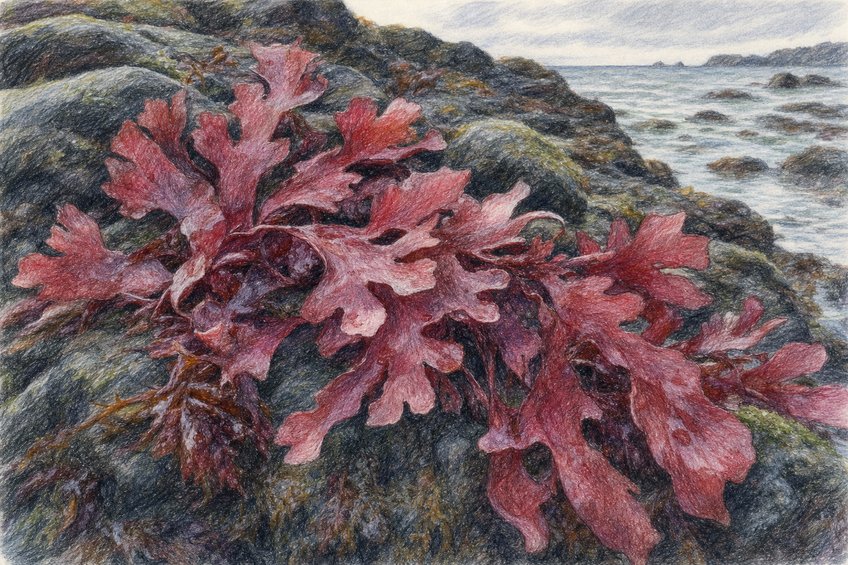
Dulse is a red alga rather than a true leafy plant, so it has no flowers, seeds, or woody stem. Its body is a thallus: a flattened, leathery blade that branches like a little crimson hand waving from the rocks.
Fresh dulse can look deep rose, wine red, or purplish brown depending on light, age, and wetness. When you lift a blade from a tide pool, it feels slick and supple at first, then almost suede-like as it begins to dry in the sea wind.
Crush a damp piece between your fingers and the scent is unmistakable: brine, clean stone, and a faint savory note like a kitchen where broth has just begun to simmer. Dried dulse darkens to burgundy-black and often carries a soft, smoky ocean aroma.
The blades commonly grow from about 4 to 20 inches long, attached by a small disk-shaped holdfast. That holdfast grips rock or sometimes the stipe of larger kelps, but it does not draw food from the host the way a root would draw from soil.
Where cold water writes its name
Palmaria palmata belongs to northern shores. It grows along the Atlantic coasts of Ireland, Scotland, Norway, Iceland, Greenland, eastern Canada, and New England, with related populations across parts of the northern Pacific.
Look for it in the lower intertidal zone, where the rocks spend part of the day under seawater and part of the day shining wet in the air. It also grows just below the low-tide mark, especially in places with steady waves, clear water, and cool temperatures.
The Bay of Fundy, especially Grand Manan Island in New Brunswick, became one of North America's classic dulse gathering places. The tides there rise and fall dramatically, revealing broad rock ledges where experienced harvesters move quickly before the water turns back.
Those shores are part of the wider Wabanaki homeland, including Passamaquoddy and Mi'kmaq coastal territories. In Wabanaki maritime knowledge, the tide, the moon, shellfish beds, edible shore plants, and weather signs were read together rather than treated as separate subjects on a page.
The blade people gather
The used part of dulse is the blade, the soft, red thallus that photosynthesizes in seawater. Harvesters usually cut or pinch the blade above the holdfast, leaving the base attached so the alga can regrow.
That small detail matters. A clean cut above the holdfast can allow several rounds of regrowth in a season, while yanking the whole plant from the rock removes the living anchor.
Fresh dulse is tender enough to eat, though many coastal households dried it for storage. On drying racks or beach stones, the blades shrink, wrinkle, and turn darker, taking on the texture of thin leather.
Irish, Scottish, and North Atlantic table lore
The word dulse is often linked to the Irish and Scottish Gaelic duileasc or duileasg. In Ireland, dillisk appears in old food traditions, and coastal families ate it as a snack, simmered it with potatoes, or tucked dried pieces away for lean weather.
At Ballycastle's Auld Lammas Fair, dulse is still tied to yellowman candy in local memory. The fair's song kept the pairing alive: dulse for salt, yellowman for sweet, and a seaside crowd with wind in its coat sleeves.
In parts of Ireland and Scotland, dried dulse was sometimes nicknamed the poor man's tobacco because people chewed it as they walked or worked. The comparison was about habit and texture, not about the plant being related to tobacco.
Medieval Irish monastic communities lived close to shore resources, and seaweeds appear in early Irish food culture beside fish, shellfish, oats, and dairy. Monks who copied manuscripts also knew the practical rhythm of fasting days, winter stores, and low-tide gathering.
Irish and Scottish immigrants carried a taste for dulse to Atlantic Canada and New England. In fishing villages, it could sit in the pantry the way apples or dried beans did inland: plain, useful, and familiar.
What gives dulse its color and character?
Dulse owes its red tones to pigments common in red algae, especially phycoerythrin, along with chlorophyll and carotenoids. These pigments help the alga use light in the shifting blue-green world beneath the tide.
Its natural chemistry also includes dietary fiber, protein, mineral salts, and carbohydrates such as floridean starch and cell-wall polysaccharides. Like many seaweeds, it contains iodine, though the amount can vary widely with location, season, age of the blade, and drying method.
Dulse also contains small phenolic compounds and mycosporine-like amino acids, part of the chemical kit a marine alga needs to survive bright sun and cold, moving salt water.
Did you know?
Dulse can taste surprisingly rich when toasted in a dry pan. Some cooks compare the aroma to savory smoke or roasted nuts, which explains why modern chefs have become curious about this old shoreline food.
Growing, gathering, and drying by the moon
Dulse is still mostly wild-harvested, though aquaculture trials and rope-culture methods have grown in interest. Cultivation is more complicated than planting lettuce in a garden bed because the alga depends on seawater flow, temperature, light, and a multi-stage life cycle.
Traditional hand harvesting follows the tide table as closely as any farmer follows frost dates. The best low tides often come around the new moon and full moon, when spring tides pull the sea farther back and reveal the lower rocks.
That is old almanac wisdom in a sea-coast coat: watch the moon, watch the wind, and do not argue with the returning water. On the Bay of Fundy, a person who lingers too long can watch a dry route become a channel in minutes.
After harvest, dulse is spread thinly to dry in sun and moving air. Good drying preserves the blade's color and keeps the pieces flexible rather than brittle as ash.
Small facts from a big ocean
- Dulse is not a land plant washed out to sea. It is a true marine red alga with a body plan built for saltwater.
- The older scientific name Rhodymenia palmata appears in many older herbals, cookbooks, and seaweed guides.
- The species name palmata means palm-shaped, a nod to the hand-like branching of the blade.
- Its color can shift after drying, from rosy red to dark purple-brown, but a little water often revives some of the red tone.
A last look at the tide pool
The next time a cold tide draws back from a northern shore, look for those red, fingered blades lying flat against the stone on a rock that was submerged at breakfast and will be again by afternoon, waiting for the water to return.
References
- Guiry, M.D. and Guiry, G.M. AlgaeBase. World-wide electronic publication, National University of Ireland, Galway. Entry for Palmaria palmata.
- Irvine, L.M. and Guiry, M.D. Seaweeds of the British Isles, Volume 1: Rhodophyta. Natural History Museum, London.
- Mouritsen, Ole G. Seaweeds: Edible, Available, and Sustainable. University of Chicago Press, 2013.
- Indergaard, M. and Minsaas, J. Animal and human nutrition. In Seaweed Resources in Europe: Uses and Potential. John Wiley and Sons, 1991.
- Craigie, J.S. Seaweed extract stimuli in plant science and agriculture. Journal of Applied Phycology, 2011.
Explore our Dulse products in the HawaiiPharm store.