GOLDENSEAL PLANT GUIDE - WOODLAND ROOT AND FOLKLORE
Old Appalachian diggers used to say, "Yellow root hides where the leaf mold lies deep." Goldenseal is that kind of plant - quiet, low to the ground, and easy to miss until its raspberry-red berry glows beneath the forest shade.
A quick look at goldenseal
| Botanical name | Hydrastis canadensis |
| Family | Ranunculaceae, the buttercup family |
| Parts used | Rhizome and roots, sometimes leaves |
| Other names | Yellow root, orange root, ground raspberry, Indian dye, eye root |
| Native region | Eastern North America, especially rich deciduous woodlands |
The shy woodland plant with a golden heart
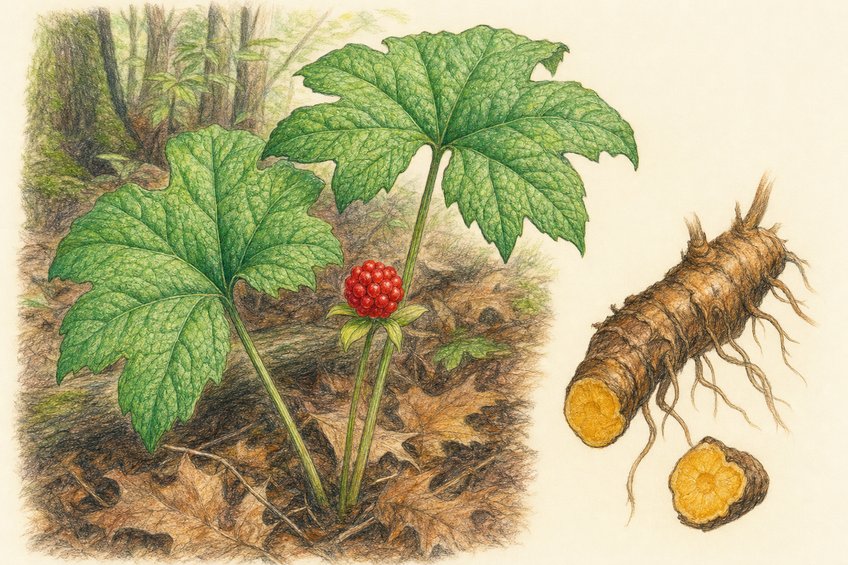
Goldenseal is a small perennial herb, usually standing only 6 to 14 inches tall. It rises in spring from a thick, knobby rhizome that is bright yellow to orange inside, a color so strong it can stain fingers and cloth.
The plant often carries one or two broad leaves, each deeply lobed and wrinkled like a little green umbrella after a rain. Run a finger across the leaf and you feel a soft, uneven surface, almost quilted, with strong veins spreading from the stem.
Its flower is easy to overlook. In early spring, goldenseal sends up a small greenish-white bloom with no showy petals, just a tuft of pale stamens that looks like a tiny forest spark.
By early summer, the flower gives way to a single red berry made of many small drupelets. That berry is the reason one old name for the plant is "ground raspberry," though the fruit is not the sweet bramble berry a hiker might hope for.
Where goldenseal makes its home
Goldenseal belongs to the rich woods of eastern North America. It favors shaded slopes, old hardwood forests, stream terraces, and soil with plenty of leaf litter from maple, tulip poplar, beech, and basswood.
Its native range reaches from southern Ontario and New York west toward the Ozarks, then south into the Appalachian region and parts of the Midwest. The plant has disappeared from many former sites where woods were cleared or roots were heavily dug.
Goldenseal grows slowly. A patch may spread by rhizomes into a loose colony, but it does not race across the forest floor like mint or nettle.
The root that gave goldenseal its name
The part most often gathered is the rhizome, the horizontal underground stem that stores food for the next growing season. Freshly cut, it shows a rich yellow interior with a sharp, bitter smell that seems to rise straight from the damp soil.
The rootlets are wiry and tangled, clinging to crumbs of dark woodland earth. Dried pieces look rough and twisted, but a broken edge still reveals that golden color inside.
Leaves have appeared in some traditional preparations, though the rhizome has been the best-known plant part in American herbal history. Because the rhizome is the plant's growing center, careless digging can remove an entire wild plant from its home.
Native knowledge, frontier cupboards, and old herbals
Goldenseal was known to several Native peoples of eastern North America. Daniel E. Moerman recorded traditional uses among groups including the Cherokee, Iroquois, and Catawba, with preparations connected to yellow dye, wash waters, and bitter plant traditions.
The Cherokee used the yellow root as a dye material, and early European settlers learned to value that bright color. Wool, skin, and household cloth could take on a warm yellow stain from the root.
By the 1800s, goldenseal had become a familiar item in American eclectic and Thomsonian herbal practice. Pioneer families in parts of Appalachia kept dried "yellow root" in cupboards much as they kept boneset, slippery elm, and horehound - plants that traveled in sacks, saddlebags, and memory.
One bit of Southern folk wisdom warned, "Take the root and leave the patch, or next spring you'll find no gold." That saying reflects a practical rule of mountain gathering: leave crowns, seed-bearing plants, and enough of the colony for the woods to renew itself.
What is inside the golden rhizome?
Goldenseal contains several well-known plant alkaloids, especially hydrastine, berberine, and canadine. Alkaloids are naturally occurring compounds that often taste bitter and can be quite active in plants.
Berberine is the compound that gives the rhizome much of its yellow color. It also occurs in other yellow-rooted plants, including barberry and Oregon grape.
The plant also contains resins, fatty acids, and small amounts of essential oil. These constituents vary with plant age, growing conditions, harvest season, and how the root is dried.
Growing goldenseal without emptying the woods
Goldenseal can be cultivated under artificial shade cloth or in woodland gardens that mimic its natural home. It prefers humus-rich soil, steady moisture, good drainage, and dappled light rather than full sun.
Growers often plant rhizome pieces with buds, spacing them in loose beds covered with leaf mulch. Seeds can be used, but they need careful handling and a period of cold before they wake.
Harvest usually takes place in the fall after the tops begin to yellow and die back. At that point, the rhizome has drawn energy down into its underground storage tissue.
Wild goldenseal is a conservation concern. It is listed in Appendix II of CITES, which monitors international trade, and United Plant Savers has long treated it as an at-risk native herb.
Did you know?
- Goldenseal is in the buttercup family, even though its root looks more like a piece of turmeric than a buttercup cousin.
- The red fruit is a cluster of small fleshy segments, giving rise to the old name "ground raspberry." It is more useful for identification than for snacking.
- Many country names for the plant mention color: yellow root, orange root, and Indian dye all point to the rhizome's strong golden pigment.
- Farmers' almanac-style wisdom often places root harvest in autumn, after the plant has sent its strength below ground.
A plant worth kneeling down for
Goldenseal asks for close attention: the puckered leaf under maple shade, the pale spring flower, the small red fruit, and the startling yellow root hidden beneath last year's leaves. In a quiet eastern woodland, a patch no bigger than a doormat can take decades to knit itself through the leaf mold.
References
- Flora of North America Editorial Committee. Flora of North America North of Mexico, Hydrastis canadensis.
- USDA Natural Resources Conservation Service. PLANTS Database: Hydrastis canadensis L.
- Moerman, Daniel E. Native American Ethnobotany. Timber Press, 1998.
- Foster, Steven and James A. Duke. A Field Guide to Medicinal Plants and Herbs of Eastern and Central North America. Houghton Mifflin, 2000.
- United Plant Savers. Species at Risk: Goldenseal, Hydrastis canadensis.
- CITES. Appendices I, II and III: Hydrastis canadensis listing.
Where to Find Goldenseal
Explore our Goldenseal products in the HawaiiPharm store.