GUARANA PLANT GUIDE: AMAZON VINE WITH EYE-LIKE SEEDS
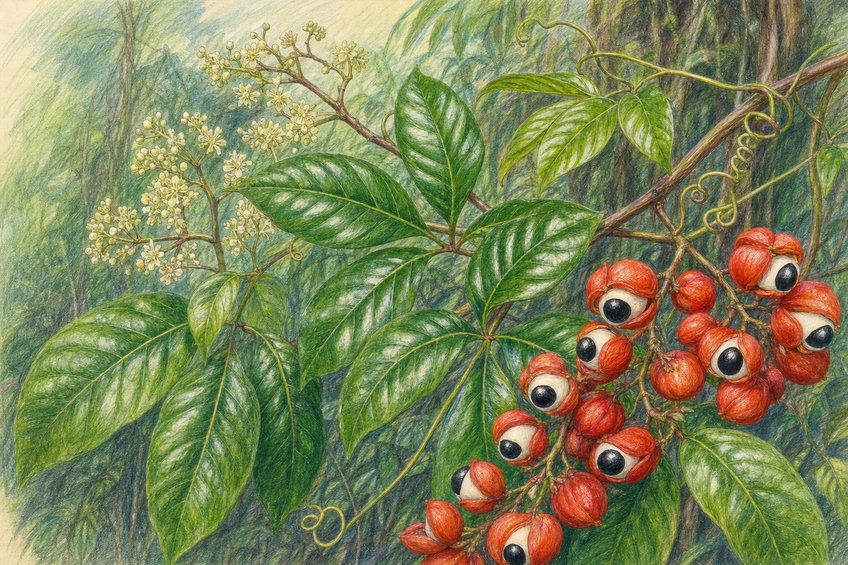
In a Satere-Mawe story from the Brazilian Amazon, guarana began with a pair of buried eyes. When the ripe fruit splits, the black seed peers out from a white aril inside a red capsule, and the old tale suddenly feels less like fancy and more like careful forest observation.
A quick look at guarana
| Botanical name | Paullinia cupana Kunth |
|---|---|
| Family | Sapindaceae, the soapberry family |
| Parts used | Seeds, usually dried, roasted, and ground |
| Other names | warana, Brazilian guarana, uarana |
| Native region | Amazon basin of northern Brazil and nearby parts of Venezuela and Colombia |
The vine with watchful fruit
Guarana is a woody climbing vine, or liana, that scrambles upward through humid forest edges and cultivated groves. Its tendrils help it grip nearby branches, while glossy compound leaves spread in groups of leaflets with toothed edges.
The flowers are small and pale, gathered in loose clusters that do not shout for attention. The fruit does the talking: a red to orange capsule that opens when ripe, revealing a dark, round seed tucked into a white, fleshy aril.
Fresh guarana fruit has a damp, green forest smell, but the prepared seed is another story. Once roasted and ground, it can smell earthy, bitter, faintly smoky, and a little like unsweetened cocoa scraped from the bottom of an old wooden bowl.
What part is gathered?
The seed is the treasured part of guarana. Harvesters remove the fruit pulp and aril, then dry or roast the seeds before grinding them into powder or shaping them into hard sticks.
Among the Satere-Mawe, often associated with the domestication and cultural care of guarana, traditional preparation included grating a dried guarana stick over a rough surface and mixing the powder with water. The drink belonged to travel, work, gatherings, and stories told in the shade.
The seed itself is hard, glossy, and dark brown to black. When broken, it shows pale inner tissue rich in starch, tannins, and methylxanthines, the plant compounds that give guarana its sharp botanical character.
Where the forest keeps it warm
Guarana is native to the Amazon basin, especially in regions of Brazil where heat, rain, and filtered light are part of the yearly rhythm. It favors warm conditions, acidic to neutral soils, and enough support to climb.
Today, guarana is cultivated in Brazil, especially in Amazonas and Bahia. Some plants grow on trellises, while others are trained near living supports, a reminder that this crop still carries the habits of a forest vine.
The old almanac habit of reading the plant before reading the calendar fits guarana well. Growers watch for capsules that redden and split, because a ripe fruit can drop its seed if a basket arrives too late.
Amazon memory and written records
The name guarana is tied to Indigenous languages of Amazonia, and the Satere-Mawe name warana is often translated in connection with beginnings, knowledge, and cultivation. Their origin story tells of a beloved child whose eyes gave rise to the first plant, a myth that matches the fruit's striking appearance.
Jesuit missionary Joao Felipe Bettendorff wrote about guarana in 1669 while working in the Amazon region. European observers were especially struck by the way Indigenous communities roasted, pounded, and shaped the seeds into portable forms.
As the old English saying goes, good things come in small packages. Guarana makes that proverb feel botanical: the showy fruit is small, but the dense seed inside became one of the Amazon's best-known plant foods.
What is inside the seed?
Guarana seeds contain caffeine, a methylxanthine alkaloid also found in coffee, tea, cacao, and yerba mate. Analyses commonly report guarana seed caffeine levels around 2 to 6 percent by dry weight, which is often higher than coffee beans.
The seeds also contain related methylxanthines such as theobromine and theophylline in smaller amounts. These names may sound like chemistry class, but they simply point to a family of bitter plant alkaloids found in several familiar beverages.
Guarana is also rich in tannins, including catechins and procyanidins. Tannins give the seed its puckery, drying taste, much like strong black tea left to steep a little too long.
Starch, proteins, fats, saponins, and trace minerals round out the seed's makeup. The result is a compact seed with a flavor that is bitter first, earthy second, and memorable for a long while after.
Growing, flowering, and harvest
Guarana can be grown from seed, though fresh seed is preferred because viability drops with time. In cultivation, growers also use selected plants and vegetative propagation to keep desirable fruiting traits.
The vine likes moisture but not stagnant water. Young plants appreciate partial shade, and mature vines need room to climb, flower, and hang their red capsules where harvesters can reach them.
Fruits are picked by hand as they open. After cleaning, the seeds may be roasted in clay ovens or metal pans, then ground and worked with water into sticks that dry until hard.
That old method made guarana easy to carry along rivers. A traveler could grate off a little seed when needed, much as a pioneer in North America might have shaved dried ginger or nutmeg from a small store kept safe from damp weather.
Did you know?
- Guarana belongs to the soapberry family, Sapindaceae, the same broad plant family as lychee, longan, and horse chestnut.
- The fruit's eye-like look is caused by a black seed surrounded by a white aril after the red capsule splits open.
- The cultivated form is often connected with Paullinia cupana var. sorbilis, a name used in older botanical and agricultural writing.
- In Brazil, guarana became part of regional food culture as a seed powder, a grated drink, and later as a flavor associated with sparkling beverages.
A forest plant worth pausing for
Guarana asks for a close look: a climbing stem, a small pale flower, a red capsule opening like a tiny lid, and then that dark seed staring back from white flesh.
References
- Kew Science, Plants of the World Online. Paullinia cupana Kunth.
- Schimpl, F. C., da Silva, J. F., Goncalves, J. F. C., and Mazzafera, P. 2013. Guarana: revisiting a highly caffeinated plant from the Amazon. Journal of Ethnopharmacology.
- Henman, A. R. 1982. Guarana, Paullinia cupana var. sorbilis: ecological and social perspectives on an economic plant of the central Amazon basin. Journal of Ethnopharmacology.
- Smith, N., Mori, S. A., Henderson, A., Stevenson, D. W., and Heald, S. V. 2004. Flowering Plants of the Neotropics. Princeton University Press.
- Food and Agriculture Organization of the United Nations. Minor oil crops and stimulant plants: regional crop notes on guarana cultivation in Brazil.
Explore our Guarana products in the HawaiiPharm store.