
WILD LETTUCE PLANT: BOTANY, FOLKLORE, BITTER LATEX
Victorian druggists had a dramatic nickname for wild lettuce: "lettuce opium." The name came from its white sap, which dries into dark, bitter tears, though Lactuca virosa is a daisy-family cousin of garden lettuce and contains no morphine.
Quick facts from the hedgerow
| Botanical name | Lactuca virosa |
| Family | Asteraceae, the daisy family |
| Parts used | Leaves, flowering tops, and dried milky latex known as lactucarium |
| Other names | Wild lettuce, bitter lettuce, great lettuce, opium lettuce |
| Native region | Europe, North Africa, and parts of western Asia |
A tall lettuce with a white secret
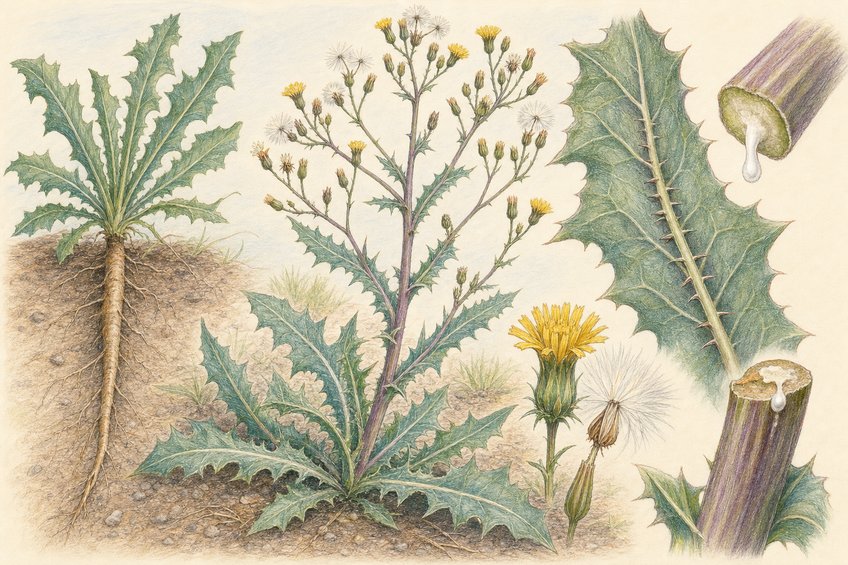
Wild lettuce begins modestly as a ground-hugging rosette, then rises in its second year into a stiff, branching plant that can reach 3 to 7 feet tall. Its stem is pale green to purplish, smooth in places, and often dusted with a bluish bloom.
The leaves are long, toothed, and clasp the stem with little ear-like lobes. Turn a leaf over and you may find a row of prickles along the midrib, a field mark that helps separate it from softer salad greens.
Break a fresh stem and a bead of white latex appears almost at once. It smells green and resinous, like a snapped dandelion stem mixed with raw lettuce, and it quickly turns tan-brown on the skin as the bitter sap meets the air.
In summer, small yellow flower heads open in loose sprays. Each head is made of strap-shaped florets, and by late season they become tiny parachute seeds, ready to ride the next dry breeze along a roadside ditch.
The part people noticed most: the milky latex
The most talked-about part of Lactuca virosa is its latex, the milky fluid found in the stems and leaf ribs. When collected and dried, this material was called lactucarium in old pharmacy books.
Fresh leaves and flowering tops also appeared in herbals, especially when the plant was gathered before the stem grew woody. Mature leaves are tough and sharply bitter, a far cry from the mild crunch of romaine.
That bitterness is a clue. Many relatives in the chicory tribe, including dandelion, endive, and chicory, carry bitter compounds in their milky sap.
Old books, monastery beds, and country sayings
Wild lettuce has a paper trail that winds through European herbals. John Gerard described wild and garden lettuces in his 1597 Herball, using the cool-and-moist language common to the Galenic medicine of his day.
Nicholas Culpeper, writing in 1653, placed lettuce under the Moon, a detail that tells us as much about 17th-century herbal astrology as it does about the plant. In that older worldview, watery, pale-sapped plants often belonged to lunar symbolism.
Monastery gardens kept several lettuces close at hand. Charlemagne's Capitulare de villis, a list of useful plants for imperial estates around 812, named lactuca among the plants to be grown, and monks later copied herbals that preserved such plant lore in careful script.
In British hedgerow language, the plant's names told the story: bitter lettuce for the taste, great lettuce for its height, and opium lettuce for the dark dried latex. Country names can be blunt, but they often point to the feature a walker would notice first.
Appalachian cooks used the old word "sallet" for cooked spring greens, gathered when leaves were young and tender. Wild lettuce relatives sometimes joined those pots, while the bitter, milky stems warned that the green season had moved on.
Farmers' almanac wisdom treated garden lettuce as a cool-weather crop, often sown with the waxing moon. Wild lettuce follows its own calendar: rosette in cool months, yellow flowers in high summer, and windborne seed when the fields are dry.
Where wild lettuce makes itself at home
Lactuca virosa is native across much of Europe and nearby regions of North Africa and western Asia. From there, it traveled with people, seed, hay, ballast soil, and disturbed ground.
Today it appears in parts of North America, especially in sunny, open places. Look for it along roadsides, field edges, old lots, rail corridors, dry banks, and the rough margins where mowers do not quite reach.
It favors well-drained soil and tolerates chalky or gravelly ground. Like many biennials, it uses the first year to build a root and leaf rosette, then spends the second year on height, flowers, and seed.
What gives wild lettuce its bite?
The bitter latex of wild lettuce contains sesquiterpene lactones, a group of plant compounds known for their sharp taste. Lactucin, lactucopicrin, and related compounds are among the best known in this plant.
Lactucarium, the dried latex, also contains resinous material, waxes, gums, and plant pigments. These substances help explain why the sap is sticky when fresh and darkens as it dries.
Wild lettuce also contains common plant constituents such as flavonoids and phenolic acids. These are part of the plant's chemistry, much as aroma compounds belong to mint or sulfur compounds belong to garlic.
Growing, gathering, and the plant's two-year rhythm
Wild lettuce grows readily from seed in open soil with full sun. It does not need rich garden beds; in fact, it often looks happiest in lean, gravelly places where competition stays low.
Seeds are small and light, each attached to a silky pappus. Once a plant ripens, it can self-sow freely, so gardeners who grow it for study often remove seed heads before the wind does the work.
Traditional gatherers cut leaves and flowering tops while the plant was still green and vigorous. The latex beads at cut surfaces, so old apothecary methods involved careful scoring, drying, and repeated collection rather than pulling up the whole plant.
For botanical observation, gloves are useful because the sap is sticky and bitter. A hand lens makes the plant more interesting: the prickles under the leaf midrib look like tiny pale teeth.
Did you know?
- Wild lettuce is in the same genus as cultivated lettuce, Lactuca sativa, though the grocery-store plant was shaped by long selection for tender leaves and mild flavor.
- The nickname "lettuce opium" is historical, not botanical. Wild lettuce belongs to Asteraceae, while the opium poppy belongs to Papaveraceae.
- Those yellow "flowers" are flower heads. Each one is a cluster of small florets, a family trait shared with dandelions, asters, and sunflowers.
A last look at the roadside giant
By late summer, wild lettuce stands like a pale green candelabra above dry grass, its yellow heads opening in the morning and its seed fluff loosening by afternoon. A plant most people pass as a weed can hold a whole shelf of stories: monastery lists, hedgerow names, bitter sap on the fingers, and tiny parachutes lifting into the heat.
References
- Plants of the World Online, Royal Botanic Gardens, Kew: Lactuca virosa L.
- Flora of North America Editorial Committee. Flora of North America North of Mexico: Lactuca virosa.
- Gerard, John. The Herball or Generall Historie of Plantes. 1597.
- Culpeper, Nicholas. The English Physician Enlarged. 1653.
- Grieve, Maud. A Modern Herbal. 1931.
- United States Department of Agriculture, Germplasm Resources Information Network: Lactuca virosa.
Where to Find Wild Lettuce
Explore our Wild Lettuce products in the HawaiiPharm store.
