American mushroom hunters have a blunt little proverb: "When in doubt, throw it out." Lion's Mane is one of the few wild fungi that can make even cautious foragers pause in delight - a snowy, shaggy waterfall of soft spines hanging from old hardwood like a forest creature's mane.
Quick Facts
| Scientific name | Hericium erinaceus |
| Kingdom | Fungi |
| Family | Hericiaceae |
| Genus | Hericium |
| Parts used | Fruiting body; cultured mycelium in modern research and preparations |
| Other names | Bearded tooth fungus, satyr's beard, pom pom mushroom, yamabushitake, hou tou gu |
| Native region | Temperate forests of North America, Europe, and East Asia |
What Is Lion's Mane?
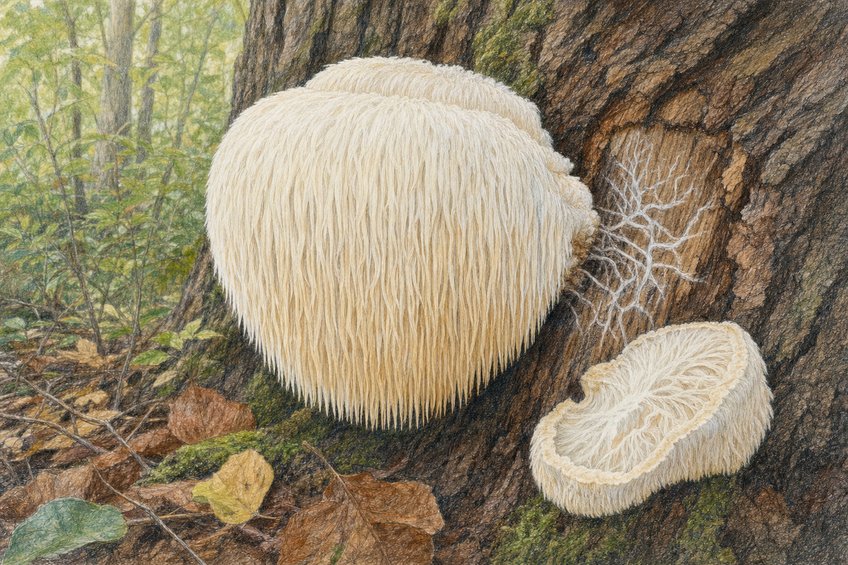
Lion's Mane is not a leafy green plant at all, but a tooth fungus - a mushroom whose fertile surface forms dangling spines instead of the gills you might expect under a grocery-store mushroom cap. Its Latin name, Hericium erinaceus, points to its hedgehog-like appearance; "erinaceus" means hedgehog.
Picture a cool October woods after rain. On the scar of an old beech or oak, a round white mass swells outward, then breaks into hundreds of soft icicle-like teeth. Fresh Lion's Mane can look like whipped cream, coral, or a tiny white waterfall frozen in midair.
Up close, the surface feels tender and slightly springy, with spines that brush the fingertips like damp embroidery thread. Its scent is mild, earthy, and faintly sweet - some cooks compare the aroma to shellfish, while others notice a clean mushroom fragrance like wet leaves and fresh-cut wood.
A Journey Through Time
In China, Lion's Mane was known as hou tou gu, often translated as "monkey head mushroom," a nod to its shaggy, rounded form. Chinese culinary and materia medica traditions valued it as both food and a respected forest ingredient, especially in soups and slow-cooked dishes.
In Japan, it is called yamabushitake, a name linked with the yamabushi, mountain ascetics of the Shugendo tradition. The mushroom's hanging white spines were said to resemble the pom poms on the garments of these wandering practitioners, giving the fungus a name that carries both woodland and spiritual imagery.
European and North American foragers knew tooth fungi as curiosities of old woods, but Lion's Mane was never as common in colonial pantries as dried sage, mint, or boneset. Still, the pioneer rule "waste not, want not" fit mushroom country well: edible fungi were often sliced, dried, or simmered when families had the knowledge to identify them safely.
Where in the World Does It Grow?
Lion's Mane is native across much of the temperate Northern Hemisphere. It appears in eastern North America, parts of the Pacific Northwest, Europe, China, Japan, Korea, and other woodland regions where mature hardwood trees provide the right home.
In the wild, it grows on living or dead hardwoods, especially beech, oak, maple, walnut, and sycamore. Like many wood-decay fungi, it helps break down tough lignin in wood, returning old trees to the forest floor - a quiet reminder of the saying, "Mighty oaks from little acorns grow," and eventually feed the next generation of woodland life.
The Fruiting Body - A Closer Look
The visible "mane" is the fruiting body, the part that releases spores. Instead of a cap and stem, Lion's Mane forms a rounded clump covered with long, downward-pointing teeth, usually white when young and gradually cream to yellowish with age.
The best specimens are firm, pale, and moist, with spines that have lengthened but not browned. Older fruiting bodies can become sour-smelling, tough, or bitter, which is why experienced foragers often repeat the old mushroom hunter's saying: "There are old mushroom hunters, and there are bold mushroom hunters, but there are no old, bold mushroom hunters." Careful identification matters.
What's Inside?
Lion's Mane contains a range of natural compounds that have made it a subject of modern mycological study. Researchers have identified polysaccharides, including beta-glucans, along with proteins, amino acids, minerals, and sterols such as ergosterol, a compound that can convert to vitamin D2 under ultraviolet light.
Two groups of compounds are especially associated with this mushroom in the scientific literature: hericenones, found mainly in the fruiting body, and erinacines, found mainly in the mycelium. These names may sound like tiny forest characters, but they are simply chemical families that help researchers describe what makes Hericium species distinctive.
From Garden to Harvest
Cultivators usually grow Lion's Mane on sterilized hardwood sawdust blocks or inoculated hardwood logs, keeping conditions humid and shaded. On farms, the fruiting bodies are harvested when the spines are well formed and still pale; in the wild, thoughtful foragers cut rather than tear, take only fresh specimens they can identify with confidence, and leave some behind for spores and forest creatures.
Folklore & Fun Facts
- Did You Know? Lion's Mane belongs to the order Russulales, the same broad fungal order that includes many brittle-gilled mushrooms, even though Lion's Mane looks nothing like a typical cap-and-stem mushroom.
- British and Irish country wisdom often treated mushrooms with a healthy dose of caution. The old table rule was simple: know it well, or leave it be - a practical cousin of the American "When in doubt, throw it out."
- In East Asian cooking, Lion's Mane has been treasured for its unusual texture. When sliced and cooked, the tender flesh can pull apart in strands, giving it a hearty, almost seafood-like bite.
- Farmers' almanac style wisdom says mushrooms often follow soaking rains and cool nights. In the woods, Lion's Mane commonly appears in late summer through fall, though timing depends on region, tree species, and weather.
- The genus name Hericium comes from Latin roots connected with hedgehogs, a fitting image for a fungus covered in soft white spines.
References
- Index Fungorum. Hericium erinaceus species record and taxonomic placement.
- MycoBank. Hericium erinaceus nomenclature and classification data.
- Global Biodiversity Information Facility (GBIF). Hericium erinaceus occurrence records and distribution data.
- Flora of China. Hericium erinaceus species treatment and regional notes.
- Arora, David. Mushrooms Demystified. Ten Speed Press, 1986.
- Stamets, Paul. Growing Gourmet and Medicinal Mushrooms. Ten Speed Press, 2000.
- Friedman, Mendel. "Chemistry, Nutrition, and Health-Promoting Properties of Hericium erinaceus (Lion's Mane) Mushroom Fruit Bodies and Mycelia." Journal of Agricultural and Food Chemistry, 2015.
To meet Lion's Mane in the forest is to notice how much life hides in plain sight: old trees feeding fungi, fungi feeding soil, and soil preparing the next green chapter. The next time you pass a weathered hardwood after rain, look closely - the woods may be wearing a white beard.
Where to Find Lion's Mane
Explore our Lion's Mane products in the HawaiiPharm store.