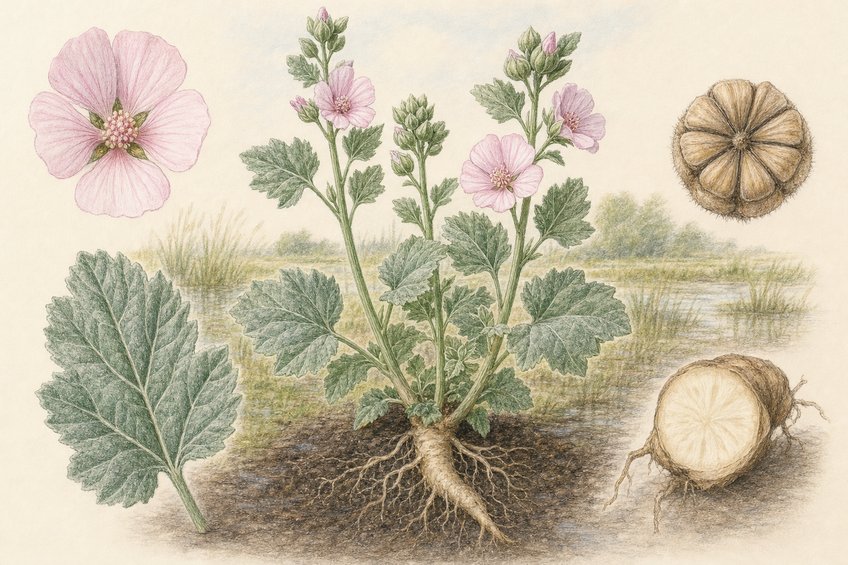
MARSHMALLOW PLANT: ALTHAEA OFFICINALIS LORE & BOTANY
Long before the campfire marshmallow met a chocolate bar, its name belonged to a soft-leaved wetland plant with roots that turn slick as silk in water. Marshmallow, Althaea officinalis, was the plant behind an old confection, a monastery garden staple, and a familiar friend of marshes where the soil stays damp underfoot.
A few quick facts from the marsh edge
| Botanical name | Althaea officinalis |
| Family | Malvaceae, the mallow family |
| Parts used | Root, leaf, and flower |
| Other names | Marsh mallow, althea, white mallow, sweet weed |
| Native region | Europe, western Asia, and northern Africa |
The plant that gave candy its name
Marshmallow is a perennial herb that usually grows 3 to 5 feet tall, with upright stems and soft, gray-green leaves. Touch a leaf and you may understand why old herbals lingered over this plant: the surface feels downy, almost felted, as if dusted with fine wool.
In summer, the plant opens pale blush flowers with five broad petals and a deeper pink wash near the center. They look like a quieter cousin of hollyhock, which makes sense because both belong to the mallow family.
The root is thick, pale cream to white, and faintly sweet in scent when freshly cut, with a starchy, earthy note. When the sliced root meets water, it releases a slippery mucilage that coats the fingers like a thin botanical gel.
Where it keeps its feet wet
Marshmallow is native to damp meadows, riverbanks, coastal marshes, and brackish ditches across much of Europe, western Asia, and northern Africa. It likes moisture, sun, and soil that many garden plants would call too heavy.
The plant traveled with people and has naturalized in parts of eastern North America. In the United States and Canada, it may appear near old homesteads, roadsides, wet fields, and disturbed low ground, especially where the soil stays rich and moist.
Gardeners sometimes say that marshmallow likes "wet feet and a sunny head." It is a plain bit of garden wisdom, but a useful one: the crown wants light, while the roots prefer steady moisture.
Root, leaf, and flower in the herbal basket
The root is the most famous part, especially in the older European herbal tradition. It is usually gathered from mature plants in autumn, when the aboveground growth begins to yellow and the plant has stored energy below the soil.
The leaves are collected before or during flowering, while they are still green and pliable. The flowers are more delicate and are gathered in summer, then dried carefully so their pale pink color does not fade too quickly.
Once dried, marshmallow root becomes firm and light in color. Cut pieces may look plain in a jar, but add water and the old marsh plant reveals its most recognizable trait: that cool, slippery texture from its mucilage.
What is inside that silky root?
Marshmallow root is rich in mucilage, a group of water-loving plant polysaccharides. These natural carbohydrates swell in water and create the smooth, gel-like feel that made the plant so useful in old kitchen and apothecary preparations.
The root also contains starch, pectin, sugars, and small amounts of flavonoids and phenolic acids. The leaves contain mucilage too, along with flavonoid compounds related to quercetin and kaempferol.
These constituents are part of the plant's own structure and survival. In a wetland plant, water-binding compounds help tissues stay flexible through changing seasons of rain, salt, sun, and drying wind.
From Nile sweets to apothecary shelves
The candy story is the one people remember first. Ancient Egyptian confectioners are often credited with mixing marshmallow root preparations with honey for sweets reserved for the well-to-do, though the exact recipes are lost to time.
Later, French confectioners made pate de guimauve, a soft sweet that used marshmallow root before gelatin became the easier choice. Modern marshmallows usually contain no marshmallow plant at all, which is a funny twist for a candy that kept the plant's name.
Did you know?
The species name officinalis is a clue from old European apothecaries. It comes from officina, the storeroom or workshop where monks, physicians, and herbalists kept useful plants and prepared materials.
In medieval monastery gardens, mallows often grew among other household herbs. Benedictine and other monastic gardeners valued plants that could be harvested, dried, and stored, and marshmallow fit neatly into that practical world of roots, leaves, jars, and handwritten herbals.
Colonial cupboards and country sayings
European settlers brought familiar herbs across the Atlantic, and marshmallow came along in that broad movement of seeds, roots, and household knowledge. Colonial American housewives and village herbalists kept dried mallow roots in pantry jars, often beside elderflower, horehound, and other plants known from British and European home traditions.
In the hedgerows of England, country people called related mallows "cheeses" because the round seed discs look like tiny wheels of cheese. Children nibbled them as wayside curiosities, a small green snack picked while walking lanes and field edges.
Old farmers' almanac habits also touched the way people handled root herbs. Many gardeners preferred to dig roots in the fall, after the tops had faded, and some followed the waning moon for underground harvests - more seasonal custom than laboratory rule, but memorable advice for anyone with muddy boots and a basket.
Growing marshmallow in a garden patch
Marshmallow grows best in full sun to partial sun with consistently moist soil. It can tolerate heavier ground than many herbs, and it has a special liking for low spots that dry out slowly after rain.
Seeds benefit from a period of cool, moist conditions before sprouting. Gardeners often start them in late winter or early spring, then set young plants outdoors after hard frost has passed.
Once established, marshmallow forms a sturdy clump and returns from the crown each year. The stems may die back in winter, leaving the roots quiet in the soil until spring warmth sends up new gray-green shoots.
Harvesters who want roots usually wait until the second year, when the plant has built a stronger underground store. Leaves and flowers are dried in a shaded, airy place, while roots are washed, sliced, and dried until the pieces snap rather than bend.
How to recognize it without a field guide in hand
Look for a tall, softly hairy plant in damp ground, with lobed leaves that feel velvety on both sides. The stems are upright and pale green, sometimes with a gray cast from the fine hairs.
The flowers are gentle rather than showy: five petals, pale pink to nearly white, with a central column typical of the mallow family. After flowering, the plant forms flattened, circular seed clusters that split into small wedge-shaped segments.
In late summer, a marshmallow stand can look silvery from a distance. Up close, bees work the flowers while the lower leaves begin to roughen and yellow at the edges.
Little facts tucked among the leaves
- The genus name Althaea is linked to the Greek word altho, meaning "to heal," a reminder of how Greek writers placed the plant in their materia medica.
- Marshmallow belongs to the same family as okra, hibiscus, cotton, cacao, and hollyhock.
- The plant's mucilage is most noticeable in cool water, where the root releases its slippery texture without the need for boiling.
- Its preferred habitat explains the common name: this is a mallow of marshes, wet meadows, and watery margins.
A final look at the marsh mallow
Marshmallow is easy to overlook beside brighter garden flowers, but a closer look rewards the patient observer: gray velvet leaves, pale summer blossoms, and roots that remember the damp ground they came from. In a wet meadow, the plant stands quietly among reeds and grasses, carrying the unlikely history of candy, monastery shelves, and muddy autumn harvests in one woolly stem.
References
- Plants of the World Online, Royal Botanic Gardens, Kew. Althaea officinalis L.
- USDA Natural Resources Conservation Service. PLANTS Database: Althaea officinalis L., marshmallow.
- Missouri Botanical Garden Plant Finder. Althaea officinalis.
- Grieve, Maud. A Modern Herbal. 1931. Entry: Marsh Mallow.
- Gerard, John. The Herball or Generall Historie of Plantes. 1597.
- European Medicines Agency. Assessment report on Althaeae radix. Committee on Herbal Medicinal Products.
Where to Find Marshmallow
Explore our Marshmallow products in the HawaiiPharm store.