MILK THISTLE: MARBLED LEAVES AND OLD HERBAL GARDEN LORE
Never grab a thistle in haste, country gardeners like to warn, and milk thistle proves the point with style. Its leaves look as if someone brushed them with spilled cream, yet every glossy edge is armed with sharp yellow spines - a plant that seems to say, admire me first, handle me later.
A thistle with a milky signature
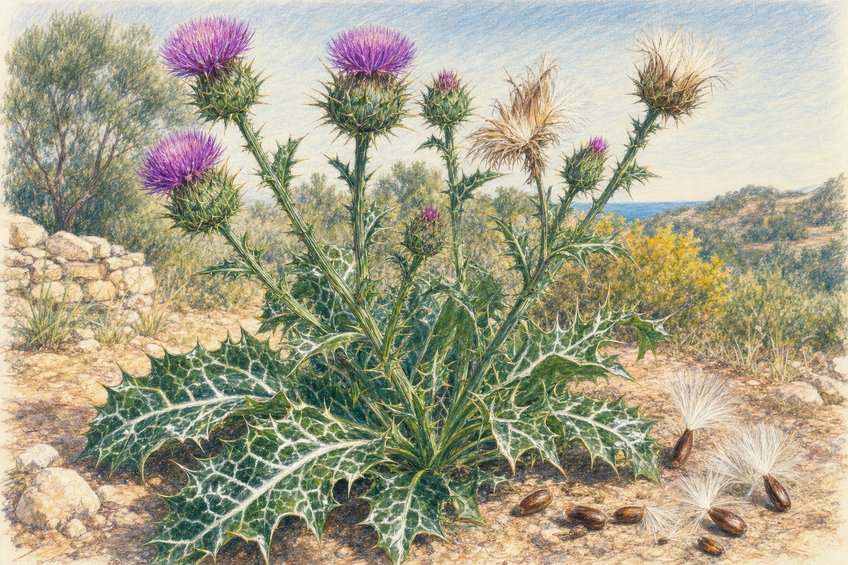
Milk thistle is one of the easiest thistles to recognize once you know its secret mark: bold white marbling across deep green leaves. In a sunny patch, the plant can rise shoulder-high, crowned with purple flower heads that resemble small shaving brushes tucked inside prickly cups.
Crush a young leaf and you may notice a green, slightly bitter, artichoke-like scent. The surface feels smooth and waxy between the veins, but the margins are stiff and unforgiving, a reminder that this plant belongs to the thistle tribe.
The flower heads mature into tight clusters of brown, glossy fruits often called seeds. Each fruit wears a silky tuft, or pappus, built for travel on wind, much like its dandelion cousins.
Quick facts from the herb garden
| Botanical name | Silybum marianum |
|---|---|
| Family | Asteraceae, the daisy and sunflower family |
| Parts used | Ripe fruits, commonly called seeds; young leaves and flower buds were also gathered as seasonal foods in some traditions |
| Other names | Marian thistle, St. Mary's thistle, holy thistle, lady's thistle, variegated thistle |
| Native region | Mediterranean basin, southwestern Europe, North Africa, and western Asia |
What makes milk thistle stand out?
Botanically, milk thistle is usually an annual or biennial. In its first season it often forms a broad rosette of spiny, white-veined leaves close to the ground; in the next stage it sends up a ribbed, branching stem.
The flower heads are purple to rose-violet and surrounded by fierce bracts tipped with spines. Bees and other pollinators visit the flowers, while birds may investigate the mature fruits after the heads dry.
Look closely at the leaves and you can see why the plant gathered so many devotional names in Europe. The pale streaks are not random speckles, but bold marbled bands, as if milk had run through the leaf veins and settled there.
Mary's thistle and the old herbals
One of milk thistle's best-known folk stories comes from Christian Europe. According to legend, the white markings appeared when drops of the Virgin Mary's milk fell upon the plant, giving rise to names such as Marian thistle, lady's thistle, and St. Mary's thistle.
Monastery gardens helped preserve knowledge of many Mediterranean plants, and milk thistle found a place among those practical, symbolic herbs. Monks and country herbalists valued it for household use and for the meanings people read into its shapes, colors, and seasons.
In England, John Gerard described milk thistle in his 1597 Herball, noting its striking leaves and garden presence. Nicholas Culpeper later included it in his 1653 herbal, placing it within the body-system language and astrological ideas common to his time rather than the language of modern science.
Colonial American settlers brought European herb lore across the Atlantic in books, seeds, and memory. While milk thistle was not a Native North American plant, it gradually appeared around farms, roadsides, and waste places where Old World plants often followed human travel.
Where in the world does it grow?
Milk thistle began its story around the Mediterranean, where hot summers, open ground, and disturbed soils suited it well. Today it grows far beyond that home range, naturalized in parts of Europe, North America, South America, Australia, and other temperate regions.
It favors full sun, well-drained soil, field edges, roadsides, vacant lots, and pastures. Like many thistles, it is quick to claim bare ground, especially where soil has been turned or grazed.
In some regions, milk thistle is considered weedy or invasive because it spreads readily and competes with pasture plants. Gardeners who wish to grow it typically check local guidance first and remove flower heads before seeds scatter if self-sowing is a concern.
The part most often gathered: the fruit called a seed
The part most often discussed in modern herbal writing is the ripe fruit, although it is commonly called a seed. Botanists call it an achene, a small dry fruit with a single seed inside.
When the purple flowers fade, the heads dry and the papery tufts begin to loosen. Traditional collectors watched for this moment carefully, because a windy afternoon could send the harvest floating away.
The fruits are small, smooth, and brown to gray-brown, sometimes with faint striping. They have little aroma until crushed, when they reveal a mild, oily, nutty character beneath their firm coat.
Inside the glossy little fruits
Milk thistle fruits contain silymarin, a cluster of related plant compounds that includes flavonolignans such as silybin (also called silibinin), isosilybin, silychristin, and silydianin.
The fruits also contain flavonoids such as taxifolin, plus fatty acids, plant sterols, and proteins. The chemistry of silymarin has been studied in laboratory settings since the 1960s, and researchers continue to examine how its individual components interact with one another.
For a plant better known for its spines and flowers, the fruit is where most of the interesting chemistry sits.
Growing, gathering, and minding the spines
Milk thistle grows best in open sun and soil that drains well. It tolerates lean ground, which is one reason it has traveled so successfully beyond its native range.
Seeds are usually sown directly where the plant is meant to grow, because the young taproot does not appreciate too much disturbance. In mild climates, plants may overwinter as rosettes before sending up tall flowering stems.
Harvesting requires gloves, long sleeves, and patience. The old gardener's rule applies here: take the thistle on your terms, not on its terms.
For the fruit harvest, heads are collected as they turn dry and the pappus begins to loosen. They are then dried further, threshed, and cleaned to separate the fruits from chaff and fluff.
Folklore, sayings, and small surprises
In British and Irish countryside lore, thistles often carried a double meaning: troublesome in the field, yet strong, protective, and hard to ignore. There is a thistle cousin to the old saying about silk purses and sow's ears - you cannot handle a thorny plant as if it were lettuce.
Scottish tradition famously honors the thistle as a symbol of watchfulness and defense. Milk thistle is not the only thistle in that story, but it shares the same architecture: a soft flower guarded by an army of spines.
Farmers' almanac-style wisdom often advised cutting thistles before they set seed, and anyone who has watched milk thistle fluff lift into the breeze understands why. One missed week can turn a single plant into a small colony.
Did you know?
Milk thistle belongs to the same large plant family as daisies, sunflowers, lettuce, dandelions, and artichokes. Once you notice the family resemblance in the flower head, the connection suddenly makes sense.
The white leaf markings are so distinctive that milk thistle can often be identified before it flowers. A young rosette on bare soil looks like a green star painted with streaks of milk.
A final look at a prickly neighbor
Thorny, bold, and occasionally invasive - milk thistle is not a plant that asks for your approval. But its marbled leaves, purple crowns, and odd journey from Mediterranean roadsides to the pages of Tudor herbals make it hard to walk past without stopping.
References:
- Kew Science, Plants of the World Online. Silybum marianum.
- USDA NRCS PLANTS Database. Silybum marianum, blessed milkthistle.
- European Medicines Agency. Assessment report on Silybi mariani fructus.
- Grieve, Maud. A Modern Herbal. 1931.
- Wichtl, Max. Herbal Drugs and Phytopharmaceuticals: A Handbook for Practice on a Scientific Basis.
Where to Find Milk Thistle
Explore our Milk Thistle products in the Milk Thistle store.
MILK THISTLE
Milk Thistle has been used for many years as an herbal remedy for a variety of ailments, particularly liver, kidney and gall bladder problems. Milk Thistle is an herbaceous annual or biennial plant th..