OREGANO (ORIGANUM VULGARE): MOUNTAIN HERB LORE
In the hills of Greece, oregano earned a name that sounds like a blessing: "joy of the mountain." Crush a small leaf between your fingers and the reason rises at once - warm, peppery, green, and sun-baked, like a stone path after noon.
A quick look at oregano
| Botanical name | Origanum vulgare |
| Family | Lamiaceae, the mint family |
| Parts used | Leaves and flowering tops |
| Other names | Wild marjoram, common oregano, European oregano, mountain mint |
| Native region | Europe, the Mediterranean region, and parts of western and central Asia |
The mountain mint you can smell before you see
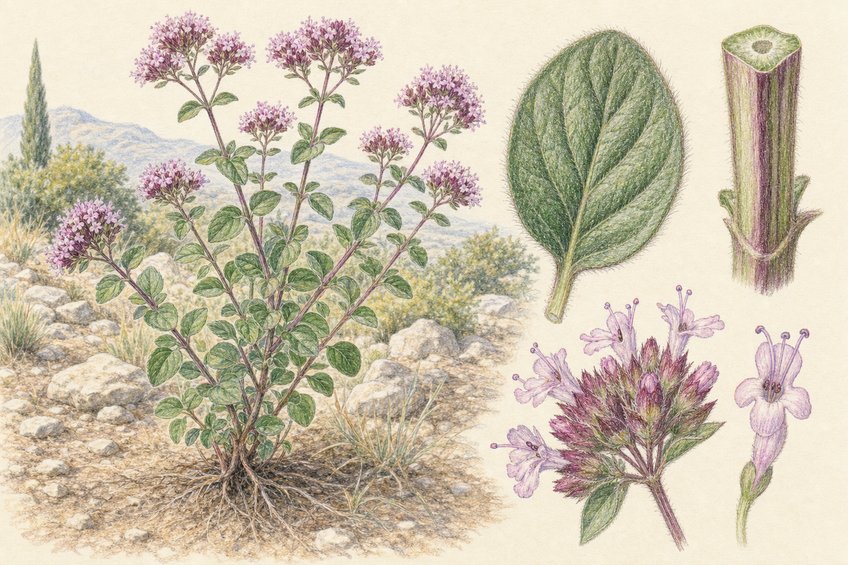
Oregano is a perennial herb with wiry, branching stems that often reach 1 to 2 feet tall. Like many members of the mint family, its stems are square, and its leaves grow in opposite pairs along the stem.
The leaves are small, oval, softly hairy, and deep green to gray-green depending on sun and soil. In dry weather they can feel slightly leathery, a clever way for the plant to hold onto moisture on rocky slopes.
In summer, oregano lifts loose clusters of tiny flowers above the foliage. The blossoms may be pale pink, lavender, or purplish, gathered among papery bracts that make the whole flowering tip look delicate and a little wild.
Bees find it quickly. Picture a July hillside with thin soil, pale stones, and oregano blooming in low drifts while honeybees nose through the flower heads one by one.
Leaves, flowering tops, and the good timing of harvest
The leaf is the part most familiar in the kitchen, but herbal collectors often value the flowering tops too. Just before and during early bloom, the plant is especially aromatic, and the upper stems carry both leaf and flower in a useful little bundle.
Old farmers' almanac advice for leafy herbs still fits oregano well: cut on a dry morning after the dew has lifted, before the day grows hot. The fragrance is strongest when the leaves are dry, the sun is climbing, and the plant has not yet wilted in afternoon heat.
Fresh oregano smells greener and sharper than dried oregano. Drying rounds the aroma, bringing forward the familiar warm, resinous note that many North Americans first met on pizza.
Where oregano makes itself at home
Origanum vulgare is native across a broad stretch of Europe and into western and central Asia, with close relatives and regional forms scattered around the Mediterranean. It favors open places, sunny banks, scrubby hillsides, field edges, and thin soils that drain fast.
Today, oregano grows far beyond its native range. Gardeners cultivate it across North America, and in some mild regions it escapes into roadsides, pastures, and old garden edges.
The plant prefers full sun and lean, well-drained soil. Rich soil and too much water can make it lush, but the scent often turns softer; a bit of hardship gives oregano its stronger character.
From Greek hillsides to American pizza ovens
The word Origanum is usually traced to Greek roots: oros, meaning mountain, and ganos, meaning joy, brightness, or delight. Ancient Greek and Roman writers knew oregano as a fragrant plant of hillsides, gardens, and household use.
Dioscorides, the Greek physician and author of De Materia Medica in the first century, described several oregano-like plants. His work traveled through Byzantine, Arabic, and European manuscript traditions, so oregano's reputation moved from warm hillsides into monastery libraries and garden beds.
In medieval Europe, monks grew many aromatic herbs near kitchens and infirmaries, including marjoram and oregano relatives. These gardens were practical places: a few steps from the cloister walk, a cook or herbal keeper could gather a handful of leaves before the evening pot was set on the fire.
Colonial American gardens more often listed sweet marjoram than strong oregano, especially in English-influenced household plots. Oregano became widely familiar in the United States after World War II, when returning soldiers helped popularize Italian dishes seasoned with this bold, resinous herb.
Folklore tucked into the flower heads
Greek folklore associated oregano with gladness. Brides and grooms were sometimes crowned with oregano or marjoram-like herbs, a fragrant wish for a peaceful household.
Another old Mediterranean custom placed oregano near graves, where it was read as a sign of rest and quiet. That may sound somber, but in the old language of plants, scent often carried memory better than stone.
In the hedgerows of Britain, wild marjoram - the common English name for Origanum vulgare - was known as a plant of warm banks and bee country. Country gardeners watched it for pollinators much as they watched clover fields, because a patch in bloom could hum in the heat.
Did you know? Oregano is a member of the mint family, but it does not run across the garden like spearmint. It forms clumps instead, with woody bases that can become pleasantly gnarled after a few seasons.
What gives oregano its bold aroma?
Oregano's scent comes from essential oil stored in tiny glandular structures on the leaves and flowering tops. The exact aroma changes with climate, subspecies, harvest time, and drying conditions.
Two well-known aromatic compounds in oregano are carvacrol and thymol. These phenolic compounds are also found in other mint-family herbs, especially thyme, which explains why some oregano has a thyme-like edge.
Oregano also contains rosmarinic acid, a plant polyphenol named after rosemary, along with flavonoids and other terpenes such as p-cymene and gamma-terpinene. These names sound like a chemistry shelf, but on the plant they translate into scent: sharp at first, then warm, woody, and a little bitter.
Growing oregano without spoiling its spirit
Oregano is easy to grow if it has sunlight, drainage, and room for air to move through the stems. It dislikes wet feet, especially in winter, when soggy soil can damage the crown.
Gardeners often start it from seed, cuttings, or division. Seed-grown plants vary in flavor, which can be part of the fun; one may taste mild and grassy, while another has a hot, peppery bite.
To harvest, snip the upper stems before the flowers are fully open, then dry them in small bunches away from direct sun. Once crisp, the leaves can be rubbed from the stems, releasing that familiar fragrance in a soft green cloud.
A small herb with a wide trail
Oregano is humble at a glance - small leaves, modest flowers, no grand display. Yet it carries mountain weather in its scent, honeybee traffic in its blossoms, and a long human trail from Greek hillsides to monastery plots to backyard herb beds.
The next time oregano blooms, look closely at the tiny flowers before thinking of the spice jar. A whole summer hillside can be hidden in one gray-green stem.
References
- Royal Botanic Gardens, Kew. Plants of the World Online: Origanum vulgare.
- Flora of North America Editorial Committee. Flora of North America: Origanum vulgare.
- United States Department of Agriculture, Natural Resources Conservation Service. PLANTS Database: Origanum vulgare L.
- Dioscorides. De Materia Medica, first century CE, later translated and transmitted through European herbal traditions.
- Grieve, Maud. A Modern Herbal. 1931. Entries on marjoram and related Origanum species.
- Peter, K. V., editor. Handbook of Herbs and Spices. Woodhead Publishing, 2012. Sections on oregano chemistry and cultivation.
Where to Find Oregano
Explore our Oregano products in the HawaiiPharm store.