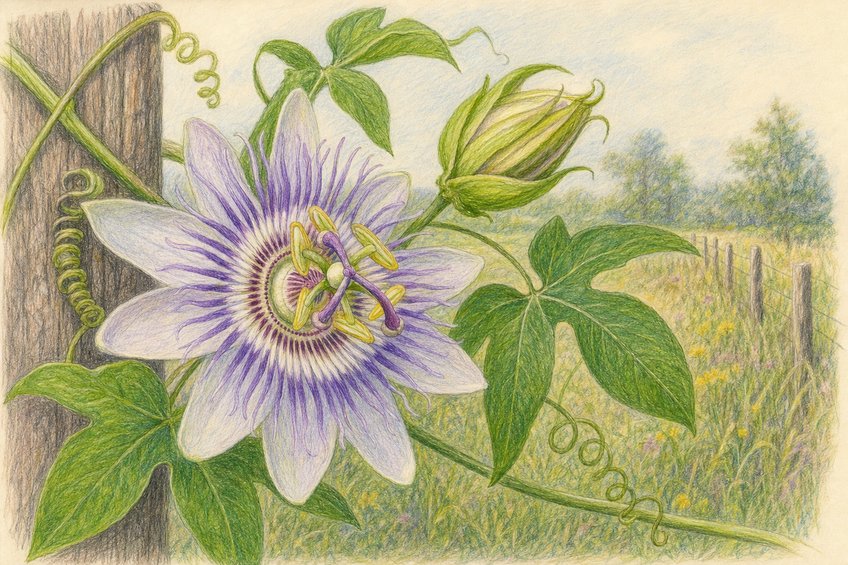
PASSION FLOWER: MAYPOP VINE OF SOUTHERN SUMMER FIELDS
In the South, children once knew a green fruit that would burst with a soft pop under a bare foot - the maypop. That playful name belongs to Passiflora incarnata, a native vine whose flowers look almost too elaborate for a fence row: pale petals, purple filaments, and curling tendrils reaching like little hands.
A quick look at passion flower
| Botanical name | Passiflora incarnata L. |
| Family | Passifloraceae |
| Parts used | Aerial parts in flower, especially leaves, stems, and flowers; ripe fruit as food |
| Other names | Maypop, purple passion flower, true passion flower, wild passion vine, apricot vine |
| Native region | Southeastern and south-central United States |
The flower that looks hand-built
Passion flower is a climbing perennial vine that dies back in cold weather and returns from underground runners when warm days settle in. Its leaves are usually three-lobed, smooth to the touch, and a fresh green that stands out against dry pasture grass and roadside wire.
The flower is the unforgettable part. Picture a summer bloom about the width of a teacup saucer, with pale lavender to white petals beneath a ring of wavy purple-and-white filaments. Up close, the center rises like a tiny clock tower, carrying five stamens and three rounded stigmas.
Crush a leaf between your fingers and the scent is green, mild, and faintly grassy. The ripe fruit has a soft skin that wrinkles as it matures, and inside it holds golden pulp around dark seeds, with a tropical fragrance that can surprise anyone who first meets the plant in a Georgia ditch or an Oklahoma fence line.
Where the maypop makes its home
Passiflora incarnata is native to the southeastern United States, with a natural range reaching from Florida and Texas northward into places such as Missouri, Illinois, Indiana, Ohio, and Pennsylvania. It favors sunny edges: open woods, thickets, fields, disturbed ground, roadsides, and old garden fences.
The plant climbs by tendrils, wrapping around grasses, shrubs, and wire rather than making woody trunks of its own. In mild regions it can wander freely by underground suckers, popping up a few feet from the parent vine like a botanical practical joke.
Today passion flower is also cultivated in herb gardens and pollinator plantings. It draws bees to its ornate flowers and serves as a host plant for Gulf fritillary and zebra longwing butterflies, whose caterpillars feed on passion flower leaves.
A vine with a sacred name and a country nickname
The name "passion flower" does not refer to romance. Spanish missionaries in the Americas read Christian symbolism into the bloom and associated its parts with the Passion of Christ: the corona as a crown, the five stamens as wounds, and the three stigmas as nails.
Italian scholar Giacomo Bosio published one of the early European discussions of the flower in 1610, based on reports and drawings that had traveled from the Americas. By the 1600s and 1700s, passion flowers were curiosities in European gardens, admired as living religious emblems as much as plants.
On this side of the Atlantic, the vine kept its earthier name: maypop. The word is often linked to the fruit's habit of popping under pressure, though in many places the fruits ripen later than May. Southern folk names rarely worry over calendar accuracy when a good sound is available.
Native knowledge, settlers' gardens, and Southern memory
Native American communities knew the plant long before European botanists named it. Ethnobotanist Daniel Moerman recorded uses of Passiflora incarnata among several Southeastern peoples, including the Cherokee, who ate the fruit and prepared parts of the plant in traditional household practice.
The Cherokee name "ocoee" has been associated with the maypop, and the Ocoee River in Tennessee is commonly linked to that plant name.
Colonial and pioneer families in the South treated maypop as both a wild food and a familiar garden vine. Ripe fruits were eaten fresh or made into simple preserves, while the leafy flowering tops appeared in home herbal preparations, especially in evening routines.
Old Southern garden wisdom says a vine that comes back after the plow has a stubborn root. Passion flower proves the point: its underground runners can rest quietly, then send up new shoots when sunlight reaches the soil.
The part used: leafy tops and summer flowers
In herbal traditions, the aerial parts are the main focus. That means the aboveground vine, especially leaves, young stems, tendrils, buds, and open flowers collected while the plant is in bloom.
Harvesters usually choose clean, healthy growth from plants that are actively flowering. The cut vines dry into a light, leafy material with bits of tendril and the occasional faded purple flower, keeping a gentle haylike aroma.
The fruit belongs to a different kind of use. Ripe maypops are food: soft, fragrant, seedy, and best when the green skin begins to yellow and wrinkle, just before it drops or disappears into the hands of birds and curious children.
What is inside the vine?
Passion flower contains several groups of natural plant compounds. Among the best known are flavonoids, including C-glycosyl flavones such as vitexin, isovitexin, orientin, and isoorientin.
A 2004 review by Dhawan, Dhawan, and Sharma in the Journal of Ethnopharmacology also documented small amounts of indole alkaloids in the harman group, along with phenolic acids, sugars, and other common plant constituents. The exact profile can vary with growing conditions, harvest time, plant part, and drying method.
These compounds help botanists and herbal researchers identify and compare plant material. They also remind us that a vine on a fence is chemically busy long before anyone gathers it.
Growing passion flower without pampering it
Passiflora incarnata likes full sun, warm weather, and soil that drains well. It tolerates poorer ground better than many ornamentals, though it grows more lushly where the soil holds some moisture.
Gardeners often start it from seed, root cuttings, or young divisions. Seeds can be slow and uneven to sprout, and many growers use cold stratification or gentle scarification to wake them up.
Give the vine a trellis, fence, or open shrub to climb. Without support, it will sprawl through nearby plants and stitch them together with tendrils.
For dried aerial parts, harvest is typically done when flowers are open and the vine is full of leaf. For fruit, patience matters: a maypop picked too early can be bland, while a ripe one feels slightly soft and smells sweet when opened.
Did you know?
- Passion flower is Tennessee's official state wildflower, chosen in 1919 after schoolchildren helped bring attention to the native maypop.
- The Gulf fritillary butterfly relies on passion flower vines as a larval food plant. Its orange adults often hover near the same patches where the caterpillars feed.
- European monastery and mission gardens prized passion flowers for religious symbolism. The flower's unusual structure made it easy for preachers and gardeners to turn botany into a teaching image.
- In Southern farm country, maypops were a children's seasonal snack. The fruit's pop underfoot made the plant memorable even to people who never learned its Latin name.
A last look at the fence row
Passion flower is easy to miss until it blooms, then suddenly the whole vine seems to be holding tiny purple wheels to the sun. The next time a tendril curls around a wire fence or a green maypop hides in the grass, there is a whole story there - butterflies, Cherokee place names, missionary symbolism, and a fruit that still knows how to surprise a bare foot.
References
- USDA Natural Resources Conservation Service. PLANTS Database: Passiflora incarnata L.
- Flora of North America Editorial Committee. Flora of North America North of Mexico: Passiflora incarnata.
- Moerman, Daniel E. Native American Ethnobotany. Timber Press, 1998.
- Dhawan, K., Dhawan, S., and Sharma, A. Passiflora: a review update. Journal of Ethnopharmacology, 2004.
- Grieve, Maud. A Modern Herbal. Jonathan Cape, 1931.
- Tennessee Blue Book. State symbols and Tennessee state wildflower history.
Where to Find Passion Flower
Explore our Passion Flower products in the HawaiiPharm store.