PEPPERMINT: BOTANY, FOLKLORE, AND COOL GREEN LEAVES
"A sprig of mint makes a meal remember the garden," an old kitchen saying might have gone, and peppermint earns the thought the moment you bruise a leaf. Crush one between your fingers and the scent rises sharp, green, and cold, as if a shaded stream had somehow learned to grow leaves.
A quick look at peppermint
| Botanical name | Mentha x piperita |
| Family | Lamiaceae, the mint family |
| Parts used | Leaves and flowering tops |
| Other names | Brandy mint, balm mint, English peppermint, Mitcham mint |
| Native region | Believed to have arisen in Europe, likely from a natural cross between water mint and spearmint |
The accidental child of two mints
Peppermint is a botanical hybrid, written with an "x" in its Latin name because it comes from two parent species: water mint, Mentha aquatica, and spearmint, Mentha spicata. This meeting likely happened in damp European ground where the two grew close enough for bees to do their quiet work.
English botanist John Ray described peppermint in 1696 after it was noticed in England, and by the 1700s it had become closely tied to the famous mint fields around Mitcham, Surrey. "Mitcham mint" became a name growers spoke with pride, especially when the leaves were distilled for their strong, clean oil.
Did you know? Peppermint often sets little viable seed because of its hybrid nature. Gardeners usually spread it by cuttings, root divisions, and runners - which is why one polite little plant can become a green-footed wanderer by midsummer.
How to recognize it in the garden
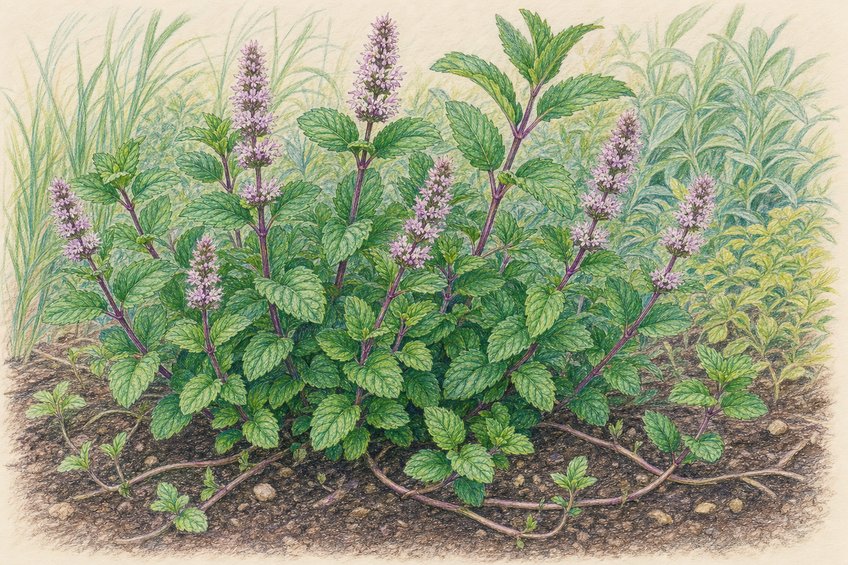
Peppermint stands on square stems, a family trait shared by many mints. The stems are often flushed purple, especially in sun, and they feel faintly ridged under the fingertips rather than smooth and round.
The leaves are deep green, pointed, and toothed along the edges, with fine veins that give them a lightly quilted look. Run a thumb across the surface and it feels pebbled and thin, then suddenly aromatic when the oil glands break.
In summer, peppermint sends up slender spikes of tiny pinkish-lilac flowers. They are modest flowers, more like a soft haze than a showy bloom, but bees and small pollinators visit them steadily on warm afternoons.
The leaves and flowering tops people gather
The most valued parts are the leaves and the tender flowering tops. These hold the aromatic oil that gives peppermint its brisk scent, cool taste, and familiar breath of menthol.
Harvesters often cut peppermint just before or as flowering begins, when the leaf is full and fragrant. A fresh bundle has a surprising weight for such a leafy herb, cool and slightly damp in the hand, with square stems that snap cleanly and release that unmistakable candy-cane scent long before they reach the drying rack.
For drying, the plant is usually spread in a shaded, airy place. Properly dried peppermint leaves turn brittle and papery, curling at the edges and crumbling with a dry rasp between the fingers; too much heat can flatten the aroma, leaving hay where there should be green sparkle.
Where peppermint likes to put down roots
Peppermint favors moisture, good soil, and partial to full sun. It will tolerate a garden bed, a streamside edge, or a large pot, but it dislikes being baked dry for long stretches.
Today peppermint grows across Europe, North America, and many temperate parts of the world. In the United States, commercial peppermint fields became especially important in New York in the early 1800s, then moved westward to Michigan, Indiana, Oregon, Washington, and Idaho.
Its roots travel by rhizomes, those underground stems that creep beyond the original clump. Farmers' almanac-style garden wisdom often says, "Plant mint where you can keep an eye on it," and many modern gardeners translate that into one word: pot.
From monastery beds to pioneer pantries
Medieval European monastery gardens grew many kinds of mint, though the records often used broad names rather than separating peppermint as we do today. Charlemagne's Capitulare de villis, issued around 812, listed menta among the plants wanted on imperial estates, a reminder that mints had a place in ordered herb beds as well as in wild ditches.
In England, country people tucked mints near doorways, dairies, and kitchen paths where the leaves could be snipped quickly. A bit of old garden advice says, "Mint runs faster than gossip," which any gardener who has lifted a mat of roots will understand.
Colonial American households kept dried mint among their household simples, the practical herbs stored in jars, bags, and pantry corners. Peppermint tea appeared after heavy meals, while fresh leaves scented sauces, vinegars, and cool drinks.
Appalachian and Southern home gardens often gave mint a place near the springhouse or porch, where damp soil and foot traffic kept it within reach. A plain mountain-garden warning still fits the plant: "Give mint a handspan and it'll ask for a yard." It was the kind of herb best planted where a family could snip it often and rein it in with a boot heel.
Indigenous peoples in North America knew native mints long before European peppermint arrived, including species such as Mentha canadensis. After settlement, introduced peppermint joined many mixed gardens, but it is best understood as a newcomer rather than a plant native to those traditions.
What gives peppermint its cool character?
Peppermint's aroma comes from tiny oil glands on the leaves and flowering tops. The essential oil is rich in menthol and menthone, with smaller amounts of menthyl acetate, 1,8-cineole, limonene, and other fragrant terpenes.
Menthol is the compound behind peppermint's cooling sensation. It interacts with cold-sensing receptors in the mouth and on the skin, which is why peppermint can feel chilly even at room temperature.
The leaf also contains rosmarinic acid, flavonoids such as eriocitrin and luteolin derivatives, and tannins. These compounds help explain the plant's flavor, color changes during drying, and its long-standing place in aromatic household preparations.
Growing peppermint without surrendering the whole bed
Peppermint grows best from divisions or cuttings, since seed is unreliable and may not come true to type. A stem cutting placed in water often pushes out pale roots within days, a small kitchen-window lesson in mint's appetite for life.
Give it rich soil, regular moisture, and room to spread. If grown in open ground, a buried barrier can help, but rhizomes are clever; a large container is usually the tidier choice.
Cutting the stems encourages bushy regrowth. Many gardeners harvest in the morning after the dew has dried, when the leaves are perky and the scent rises at the lightest touch.
Folklore and small surprises
- In British garden lore, mint near the back door meant hospitality was close at hand: a leaf for sauce, tea, or a cooling summer drink.
- An English kitchen-garden saying puts mint's usefulness simply: "Where mint grows, the cook is never at a loss." The plant earned that reputation beside lamb, peas, potatoes, vinegar, and summer pitchers.
- Old almanac-minded gardeners often favored harvesting leafy herbs before full bloom, when the plant's strength was thought to be "in the leaf." Peppermint fits that custom well.
- Modern gardeners have turned peppermint's wandering habit into a proverb of their own: "Plant mint once, pull mint forever." Its underground runners make the joke easy to prove.
- The word Mentha reaches back to Greek stories of Minthe, a nymph associated with fragrant mint. The tale varies by source, but the plant's sharp perfume kept the name alive.
- Peppermint is a member of Lamiaceae, a family with square stems and aromatic leaves that also includes basil, thyme, sage, and rosemary.
A closing note from the mint patch
Peppermint is easy to overlook because it is so familiar, yet one crushed leaf holds a whole story: damp European banks, English distillers, colonial pantries, purple stems, bee-sized flowers, and a cooling scent that rises before the plant is even seen. Next time a mint leaf brushes your hand along a garden path, pause long enough to notice the cold green fragrance on your fingertips.
References
- Royal Botanic Gardens, Kew. Plants of the World Online: Mentha x piperita.
- Flora of North America Editorial Committee. Flora of North America, Vol. 17: Mentha.
- Grieve, M. A Modern Herbal. 1931. Entry on Peppermint.
- Lawrence, B. M. Mint: The Genus Mentha. CRC Press, 2006.
- PubChem, National Library of Medicine. Menthol and menthone compound summaries.
Peppermint products in the HawaiiPharm store.