SMALL FLOWER WILLOWHERB: PLANT PROFILE AND LORE GUIDE
Old ditch-walkers in Britain had a practical saying: "Willowherb in the drain, water in the ground." Small Flower Willowherb proves the point beautifully, lifting its soft pink blossoms from wet meadow edges, stream banks, and forgotten corners where soil stays cool underfoot.
A small plant with a long name
| Botanical name | Epilobium parviflorum |
|---|---|
| Family | Onagraceae, the evening primrose family |
| Parts used | Flowering aerial parts, especially leaves, stems, and flowers |
| Other names | Small-flowered willowherb, small flower willow herb, hoary willowherb, small-flowered hairy willowherb |
| Native region | Europe, western Asia, and North Africa |
How to recognize it by the water
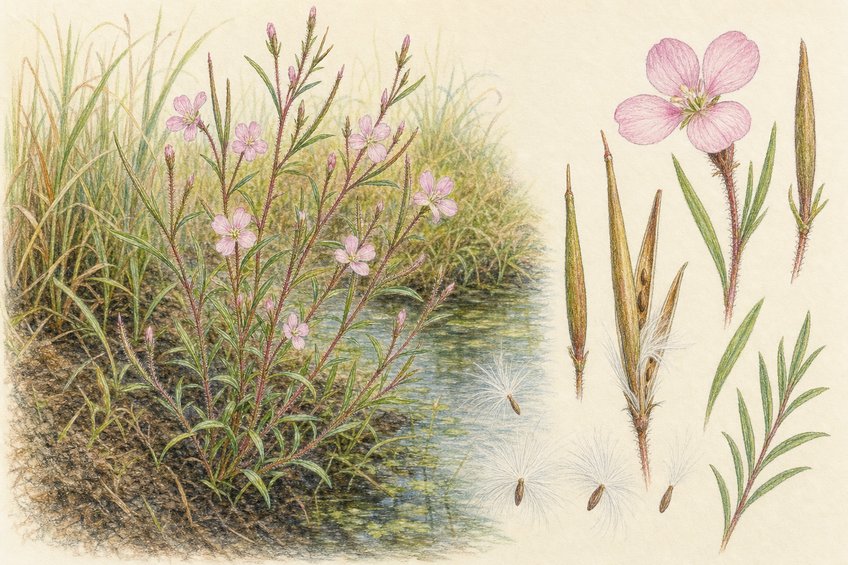
Small Flower Willowherb is a soft, upright perennial that often reaches 12 to 32 inches tall. Its stems are slender, green to reddish, and lightly clothed in fine hairs that catch the morning light like dust on velvet.
The leaves are narrow and willow-like, which explains the common name. They sit opposite each other on the lower stem, then shift to a more alternate pattern higher up, with shallow teeth along the edges and a slightly downy feel when rubbed between finger and thumb.
The flowers are modest but lovely. Each one has four pale pink to rosy petals, faintly notched at the tips, held above long green ovaries that later become thin capsules.
When those capsules ripen, they split lengthwise and release tiny seeds tipped with white silk. On a dry late-summer afternoon, a patch of willowherb can look as if someone brushed it with milkweed fluff.
The small flowers that gave it a name
The species name parviflorum means "small-flowered," from Latin words for small and flower. It is a helpful clue, because this plant shares wet ground with several larger, showier relatives.
Its flowers are usually only a fraction of an inch across, softer and quieter than the bold blooms of great willowherb. Look closely and the plant rewards patience: pink petals, a cross-shaped arrangement, a four-lobed stigma, and long seed pods lined up like green needles.
Where in the world does it grow?
Epilobium parviflorum is native across much of Europe, western Asia, and North Africa. Today it has also naturalized in parts of North America and other temperate regions, usually following the damp soils it prefers.
It favors stream margins, wet meadows, marsh edges, ditches, pond banks, seepage areas, and disturbed ground that holds moisture. In farm-country language, it is a "wet-footed" plant, the kind that tells you a low spot does not dry quickly after rain.
Despite its fondness for water, it is not an aquatic plant. It likes light, air, and mud at the root, often growing with rushes, sedges, mint, meadowsweet, and other plants of damp edges.
European household lore and careful distinctions
Small Flower Willowherb belongs to a group of plants that older European herbals often treated together under the broad name "willowherb." That can make old records tricky, because writers did not always separate Epilobium parviflorum from its cousins.
In European home herbal practice, the flowering tops were dried for household teas connected with the "waterworks," a quaint British term for the body's water passages. Those uses belong to folk tradition and should be read as history, not as a modern medical claim.
Austrian herbal writer Maria Treben brought renewed attention to small-flowered willowherbs in the late 20th century through her book Health Through God's Pharmacy. Her writing helped make Epilobium species familiar to many home herbalists in German-speaking countries.
English country people also had a habit of reading plants as weather and soil signs. A ditch thick with willowherb told the same story as rushes in a pasture: the ground held water, even if the surface looked dry in July.
What part do herbalists gather?
The traditional gathered part is the flowering aerial portion: leaves, tender upper stems, buds, flowers, and sometimes young seed capsules. The plant is usually collected as flowering begins, before the stems become too tough and before the silky seeds start drifting.
Freshly cut Small Flower Willowherb has a green, meadowy scent, mild rather than sharp. When dried carefully in a thin layer, the leaves turn a soft olive color and the small pink flowers fade to muted rose or beige.
Roots are not the usual focus in the European herb trade. The above-ground portions carry the identity of the plant best: hairy stems, narrow leaves, small pink flowers, and those long slender capsules.
What is inside the leaves and flowers?
Small Flower Willowherb contains several groups of plant compounds that chemists can identify in the aerial parts. The best-known include ellagitannins, especially oenothein B, along with flavonoids such as quercetin, kaempferol, and myricetin derivatives.
It also contains phenolic acids, including gallic and ellagic acid, plus small amounts of sterols and other common plant constituents. These compounds help researchers distinguish Epilobium species in laboratory analysis.
Tannins are partly responsible for the plant's gently astringent character. If you taste an unsweetened infusion in a traditional context, that dry, puckering edge on the tongue is the tannins making themselves known.
Did you know?
- The seeds travel on silky hairs, much like tiny parachutes, which helps the plant colonize damp disturbed soil after floods or ditch clearing.
- Small Flower Willowherb is in the evening primrose family, the same family as fireweed and evening primrose, even though its flowers are much smaller.
- Many North Americans know the showy fireweed, Chamerion angustifolium, from northern Indigenous food and craft traditions. Small Flower Willowherb is a different Old World species, so those traditions should not be casually transferred from one plant to the other.
Growing it without turning the garden into a marsh
Gardeners who grow Small Flower Willowherb usually give it moist soil, sun to part shade, and a place where self-sown seedlings will not be a nuisance. It does best in a rain garden edge, wildlife corner, or damp border rather than a dry herb bed.
The seeds are tiny and need light, so they are usually surface-sown and pressed gently into moist soil. Once established, the plant can spread by seed readily, especially where bare wet soil appears after weeding or flooding.
Harvesters cut the upper flowering stems on a dry morning after dew has lifted. A clean cut above the lower leaves lets the plant keep growing, while leaving plenty of flowering stems for seed, insects, and the small wildlife of the ditch bank.
Folklore in the hedgerow
In the hedgerows of England and Ireland, plants with willow-shaped leaves often gathered practical names before botanists sorted them into Latin. "Willowherb" simply means an herb with willow-like leaves, even though it is not a true willow at all.
European monastery gardens often placed moisture-loving plants near drains, ponds, and fish pools rather than in the dry square beds shown in old drawings. A plant like Small Flower Willowherb would have been most at home at those working wet edges, where gardeners carried buckets and rinsed tools.
Farmers' almanac wisdom has long treated wild plants as field notes. Rushes warned of wet pasture, elder marked old settlement ground, and willowherb in a ditch pointed to soil that stayed damp below the boot heel.
A last look at the pink flowers
Small Flower Willowherb is easy to pass by because it does not shout for attention. Stop beside a wet ditch in late summer, though, and its small pink stars, downy stems, and drifting white seed silk reveal a plant ready to seed the next strip of bare, wet mud after a ditch is cleared.
References
- Plants of the World Online, Royal Botanic Gardens, Kew: Epilobium parviflorum Schreb.
- Flora of North America Editorial Committee. Flora of North America North of Mexico: Epilobium and related taxa.
- European Medicines Agency. Assessment report on Epilobii herba, Committee on Herbal Medicinal Products.
- Wichtl, M. Herbal Drugs and Phytopharmaceuticals: A Handbook for Practice on a Scientific Basis.
- Treben, M. Health Through God's Pharmacy, English editions based on the original German work.
- USDA NRCS PLANTS Database: Epilobium parviflorum distribution records.
Explore our Small Flower Willow products in the HawaiiPharm store.