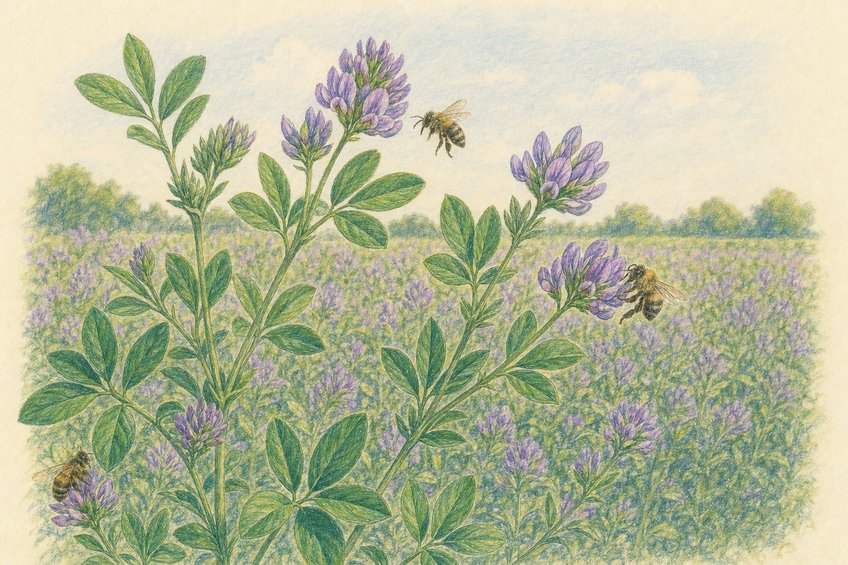
"Make hay while the sun shines" could have been written for alfalfa. On a warm June morning, a cut field smells green, sweet, and faintly nutty, while bees nose into small violet blossoms and the leaves dry into the soft, leafy hay that has fed horses, cattle, and curious herb gatherers across half the world.
Quick facts from the hayfield
| Botanical name | Medicago sativa |
| Family | Fabaceae, the pea family |
| Parts used | Dried aerial parts - leaf, tender stem, and flower tops; seeds are also grown for sprouts as food |
| Other names | Lucerne, purple medick, Chilean clover, buffalo herb |
| Native region | Western and central Asia, with early cultivation around Iran, the Caucasus, and the eastern Mediterranean |
A little pea relative dressed for the pasture
Alfalfa is a perennial legume, usually growing 1 to 3 feet tall, with upright stems that branch into airy green sprays. Each leaf is divided into three oval leaflets, lightly toothed at the tips, like a tiny clover with a sharper tailor.
In bloom, the plant carries loose clusters of pea-shaped flowers in purple, lavender, or bluish tones. After pollination, it forms small spiral pods, curled like miniature watch springs, each holding kidney-shaped seeds.
Crush a fresh leaflet between your fingers and the scent is grassy and mineral-green, closer to fresh hay than to garden herbs. The dried leaf keeps a soft green color when cured well, though too much sun turns it pale and stemmy.
The part people gather
The leafy upper growth is the part most often dried for herbal use. Growers usually cut alfalfa at early bloom, when the plant has made plenty of leaves but has not yet poured all its energy into seed.
That timing matters in the field. Old farm calendars often advised haymakers to wait until the dew lifted, then cut during a run of clear weather, because damp alfalfa can lose its color and fragrance before it reaches the barn.
The root is famous too, though it is not the usual harvested herb. Mature alfalfa sends down a strong taproot that can reach many feet into the soil, helping the plant find moisture long after shallow-rooted pasture plants have gone quiet.
From Persian horses to American barns
Alfalfa has traveled with animals, armies, and farmers. Greek and Roman writers knew a forage from Media, an ancient region of northwestern Iran, which is one reason the genus is named Medicago.
Persian horse keepers valued the crop, and later Arabic-speaking farmers carried it westward. The English word "alfalfa" came through Spanish from Arabic; garden books sometimes repeat the nickname 'father of all foods,' though many etymologists connect the word more closely with Arabic terms for fresh fodder.
In Britain and parts of Canada, people often call the same plant "lucerne," a name common in old agricultural manuals. Early American farmers tried it in the eastern colonies, but alfalfa truly found its stride in the irrigated valleys and dry uplands of the West, where its deep roots made sense.
Pioneer farm lore treated a good alfalfa stand almost like money in the ground. A clean field could feed teams, dairy cows, and sheep through lean months, which explains why rural people gave haymaking its own weather wisdom, moon notes, and breakfast-table arguments.
Where lucerne makes itself at home
Wild relatives and early forms of alfalfa belong to the broad belt from western Asia into the Mediterranean region. Today, Medicago sativa grows in temperate farming regions across North America, Europe, Australia, South America, and parts of Asia.
It likes full sun, well-drained soil, and a near-neutral to slightly alkaline pH. Heavy wet soil can trouble it, while deep loams and dry summer air often bring out its best field character.
Alfalfa is also a soil partner. Like other legumes, it forms nodules on its roots with nitrogen-fixing bacteria, especially Sinorhizobium meliloti, which change atmospheric nitrogen into forms the plant can use.
What is tucked inside the leaf?
Alfalfa leaf contains plant proteins, fiber, chlorophyll, carotenoids, and minerals drawn from the soil. It is also known for vitamin K, a fat-soluble vitamin naturally present in many leafy green plants.
Its phytochemical profile includes saponins, flavonoids such as apigenin and luteolin derivatives, and coumestans, including coumestrol. These names sound like laboratory glassware, but they are simply part of the plant's own chemistry - the compounds it makes while growing, flowering, and meeting the stresses of sun, insects, and weather.
Because alfalfa is a forage crop as well as an herb, plant breeders and agronomists have studied its chemistry closely. Leafiness, stem texture, bloom stage, soil minerals, and drying method all change the final character of the harvested plant.
Growing notes from the field edge
Alfalfa is usually seeded in spring or late summer into a firm, weed-free bed. Farmers often inoculate seed with the right root-nodule bacteria, especially in ground where alfalfa has not grown before.
Once established, a stand may be cut several times in a season, depending on climate and rainfall. The best-looking dried herb comes from leafy tops handled gently, dried quickly, and kept away from harsh light.
Its flowers have a clever little mechanism called "tripping." When a bee presses into the blossom, the flower's reproductive parts spring upward, dusting the visitor with pollen; leafcutter bees are especially useful in alfalfa seed fields.
Did you know?
- Alfalfa leaflets can fold and shift with light, a daily movement that makes the plant look slightly different at dawn than it does at noon.
- The curled seed pods are a helpful clue for identification, especially when the purple flowers have faded.
- A healthy alfalfa stand can fix about 200 to 300 pounds of atmospheric nitrogen per acre in a year under good growing conditions, thanks to bacteria living in its root nodules.
- In many Western farming communities, the smell of fresh-cut alfalfa is as tied to summer as dust on boots and irrigation water in ditches.
A field plant worth a closer look
Alfalfa can look ordinary from a car window - just another green field beyond the fence. Step closer and it becomes a small world of three-part leaves, coiled pods, purple pea flowers, bees at work, and roots reaching down where the soil stays cool.
References
- USDA Natural Resources Conservation Service. PLANTS Database: Medicago sativa L.
- Kew Science. Plants of the World Online: Medicago sativa L.
- UC Agriculture and Natural Resources. Alfalfa production and management resources.
- Small, E. Alfalfa and Relatives: Evolution and Classification of Medicago. NRC Research Press, 2011.
- Duke, James A. Handbook of Legumes of World Economic Importance. Plenum Press, 1981.
Explore our Alfalfa products in the HawaiiPharm store.