ALOE FEROX: CAPE ALOE PLANT HISTORY AND FOLK USES
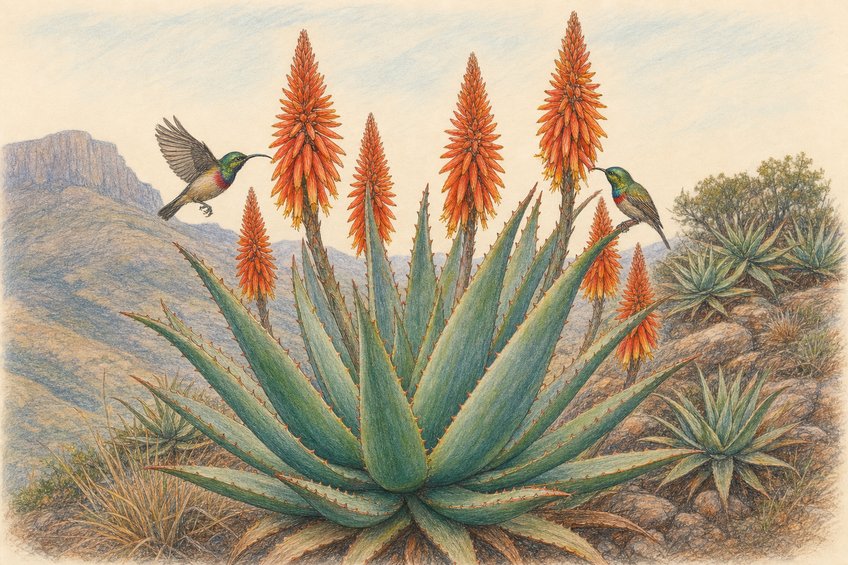
Bitter as aloes was once an English way to describe anything painfully sharp on the tongue. With Aloe ferox, the phrase makes perfect sense: nick one of its thick blue-green leaves and a yellow sap beads up with a fierce, resinous bitterness, while tall orange-red flower candles rise above the thorny rosette like winter torches on a South African hillside.
A quick look at Cape aloe
| Botanical name | Aloe ferox Mill. |
|---|---|
| Family | Asphodelaceae |
| Parts used | Leaf exudate, dried latex resin, inner leaf gel |
| Other names | Cape aloe, bitter aloe, red aloe, tap aloe |
| Native region | South Africa and Lesotho, especially the Cape regions and nearby dry highlands |
The fierce beauty of the leaf rosette
Aloe ferox earns its species name honestly. Ferox means fierce, and the plant wears a ring of reddish-brown teeth along the edges of its long, fleshy leaves.
A mature plant forms a single upright trunk topped by a heavy rosette. The leaves can look dusty blue, gray-green, or olive, often with a waxy bloom that softens the glare of dry country sun.
In winter, branched flower stalks rise well above the leaves. Each stalk carries dense, upright clusters of tubular flowers, most often glowing orange to scarlet, though yellow forms appear in some populations.
Stand near a flowering plant on a cool morning and the scene feels busy. Sunbirds, weavers, bees, and other nectar seekers move among the flower spikes, while the leaves below remain still, armored, and heavy with stored moisture.
The leaf, split in two
The Aloe ferox leaf holds two very different materials. Just under the outer green skin runs a bitter yellow exudate, the sap that dries into the dark, glossy substance historically called Cape aloes.
Inside the leaf is a clear, slippery gel. It has a cool, watery feel between the fingers and only a faint green scent when freshly cut.
Traditional harvesters treated these two leaf materials separately. The yellow exudate was drained from cut leaves, while the inner gel was handled as a fresh plant material with a much milder character.
Where the Cape aloe keeps its footing
Aloe ferox is native to South Africa and Lesotho, with strong populations across the Western Cape, Eastern Cape, KwaZulu-Natal, Free State, and parts of the interior. It favors open, sunny places where the soil drains quickly.
You may see it on rocky slopes, dry grassland, scrubby hills, and exposed ridges. It often grows where summer heat is strong and rain may be seasonal or uncertain.
The plant has also been cultivated in warm, dry regions beyond its homeland, especially in botanical collections and aloe farms. Like many aloes, it dislikes wet feet more than it dislikes drought.
Hands, heat, and harvest
Traditional Aloe ferox harvesting in South Africa is still often done by hand. Mature lower leaves are cut from living plants and stacked around a shallow hollow or container so the yellow exudate can drain out.
That liquid is then concentrated by heat until it becomes a dark, bitter resin. Old accounts describe it cooling into hard, glassy lumps that could be packed for trade.
Careful harvest matters because the plant grows slowly. Harvesters generally leave the central crown intact, allowing the aloe to keep making leaves and flower again in another season.
Gardeners who grow Aloe ferox usually give it full sun, mineral-rich soil, and a light hand with water. In cold climates it is often kept in a pot and moved under cover before frost can bite the fleshy leaves.
From Cape trade to country cupboards
European traders at the Cape of Good Hope shipped dried aloe resin under the name Cape aloes by the 1700s. Apothecaries in Britain and North America knew the material as one of the intensely bitter botanicals of the old drug trade.
Colonial American households often kept a small store of imported bitters in medicine chests and pantry cupboards. Aloe resin appeared in apothecary manuals alongside rhubarb root, senna, and gentian, all handled with the caution given to strong-tasting plant materials.
In European monastery gardens, aloes were usually grown in pots rather than open beds, because most could not tolerate northern winters. Monks and later physic-garden keepers valued them as curiosities from warmer lands, plants that looked more like carved green stone than soft kitchen herbs.
Among Xhosa- and Zulu-speaking communities in southern Africa, aloes broadly have been known by names often rendered as inhlaba. Local knowledge distinguished between species, places of growth, and the proper way to cut leaves without destroying the plant.
What is tucked inside the bitter leaf?
The yellow exudate of Aloe ferox contains anthraquinone glycosides, including aloin A and aloin B. These compounds help explain the famous bitterness of Cape aloes.
The leaf exudate also contains aloe-emodin, related phenolic compounds, chromones, and aloeresins. The exact profile can vary with plant age, growing region, harvest season, and processing method.
The inner gel is chemically different from the yellow latex. It contains water-rich polysaccharides, including acemannan-type materials, along with small amounts of minerals, amino acids, and organic acids.
That split personality is one reason old herbals spoke carefully about aloes. The outer leaf exudate and the inner gel were never quite the same thing in the hands of experienced plant workers.
Folklore, sayings, and small surprises
Did you know?
Aloe ferox often flowers in the cooler months, bringing strong color to dry country when many other plants are quiet. A mature plant can stand taller than a person when its trunk and flower stalks are counted together.
- English speakers once used the comparison bitter as aloes for a harsh taste, a sharp experience, or a stern lesson. The saying traveled well because anyone who tasted aloe latex understood it at once.
- Old British and Irish household lore grouped aloes with the great bitters, the plants people respected more than they enjoyed. A tiny taste was enough to make the point.
- Colonial apothecaries in ports such as Boston, Philadelphia, and Charleston stocked imported Cape aloes because ships moving around the Cape helped bring southern African botanicals into Atlantic trade.
- Farmers' almanac wisdom often advised cutting sappy plants in dry weather, when stored moisture was less likely to spoil in the shed. Aloe harvesters in the Cape likewise favored clear, dry conditions for draining and concentrating the exudate.
A plant shaped by sun and stone
Aloe ferox is easy to admire from a distance, but it rewards a slower look. Its teeth, waxy leaves, winter flowers, and bitter sap all speak of a plant built for bright slopes, lean soil, browsing animals, and long dry spells.
The next time an aloe blooms in a garden or conservatory, notice who visits the flowers and how the leaves hold their water. In that quiet architecture, Cape aloe carries the weather of its homeland.
References
South African National Biodiversity Institute, PlantZAfrica: Aloe ferox species profile.
Royal Botanic Gardens, Kew, Plants of the World Online: Aloe ferox Mill.
Grace, O. M., Simmonds, M. S. J., Smith, G. F., and van Wyk, A. E. 2009. Documented utility and biocultural value of Aloe L. in southern Africa. Economic Botany.
Reynolds, G. W. 1950. The Aloes of South Africa. The Aloes Book Fund, Johannesburg.
British Pharmacopoeia historical monographs and materia medica records for Cape aloes.
Where to Find Aloe
Explore our Aloe products in the HawaiiPharm store.