BLACK COHOSH: WOODLAND ROOT, FOLKLORE, AND BOTANY
"The woods keep their own clock," an old country saying goes, and black cohosh proves it in midsummer. Long after spring ephemerals have vanished, tall white wands rise from the shaded forest floor like candles set among maple roots, sweet to some noses and musky to others, buzzing with tiny beetles and flies.
A quick look at black cohosh
| Botanical name | Cimicifuga racemosa, widely treated today as Actaea racemosa |
|---|---|
| Family | Ranunculaceae, the buttercup family |
| Parts used | Rhizome and roots |
| Other names | Black snakeroot, bugbane, fairy candles, rattleroot, macrotys |
| Native region | Eastern North America, especially rich deciduous woodlands |
The woodland candles
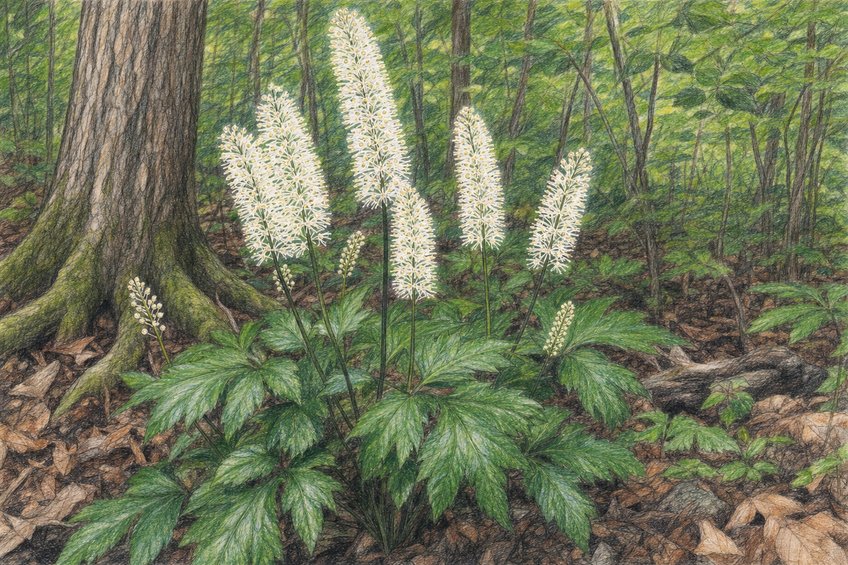
Black cohosh is a tall perennial of deep woods and shaded slopes. In good soil it can stand 4 to 8 feet high, with large, divided leaves that give the plant a ferny, almost shrub-like presence before the flowers appear.
The leaves are dark green and sharply toothed, arranged in branching sets of three leaflets. Run a finger along the edge and you feel a clean, saw-like bite, a useful field clue when the plant is not in bloom.
Then come the flower stalks. The blossoms grow in long racemes, narrow spires packed with small white flowers that seem fuzzy from a distance.
Did you know? The snowy look does not come from petals. Black cohosh flowers have tiny sepals that fall away early, while the pale stamens do most of the visual work, giving each flower spike its bottlebrush shape.
The scent is part honey, part damp cellar, part old woodland leaf mold. Crush a bit of the root and the smell turns stronger - earthy, bitter, and dark, a hint of why old herbals treated the root with respect.
A black root with many names
The part traditionally gathered is the rhizome with its attached roots. A rhizome is a thick underground stem, and in black cohosh it is knotty, dark brown to nearly black, with fine wiry rootlets spreading from it like a little forest of threads.
The name cohosh likely comes from an Algonquian word used for rough or knobby roots, a good description when the plant is lifted from the soil. The older botanical name Cimicifuga comes from Latin words meaning bug and drive away, which explains the folk name bugbane.
Rattleroot is another old name, often linked to the dry seed pods that can make a faint rattling sound when the stalk is shaken in late summer. Black snakeroot tied the plant to frontier naming habits, when settlers often named woodland roots by shape, color, animal association, or a story passed from one cabin to the next.
Where the plant feels at home
Black cohosh is native to eastern North America, from parts of southern Ontario and the northeastern United States south through the Appalachian region and west toward Missouri, Arkansas, and neighboring areas. It favors rich, moist, well-drained woods rather than open fields.
Look for it in cove forests, north-facing slopes, streamside woods, and limestone-influenced soils where fallen leaves build a deep humus layer. Tulip poplar, sugar maple, beech, oak, and hickory often share the neighborhood.
In July, a patch of black cohosh can make a dim woodland look lit from within. The tall white spires catch stray shafts of light while the broad leaves stay cool and shadowed below.
Native knowledge and early American herbals
Ethnobotanical records gathered by Daniel E. Moerman and other scholars note that several Native American communities knew black cohosh and related woodland roots. Cherokee and Haudenosaunee herbal traditions included preparations of the root, especially in carefully taught household and women's traditions.
Those records deserve a respectful reading. They reflect living cultures and specialized knowledge, not a grab bag of old recipes. Preparation, timing, and context mattered, and many details belonged to trained practitioners within their own communities.
By the 1800s, black cohosh had entered colonial and early American materia medica. Eclectic physicians - a 19th-century American school of botanical practitioners - wrote about the root under names such as macrotys and Cimicifuga.
John King described it in his 1854 work connected with Eclectic practice, and black cohosh appeared in American dispensatories during the 19th and early 20th centuries. Pioneer families in the eastern mountains often kept bundles of dried roots in attic rafters or pantry corners, where the bitter smell kept company with boneset, blue cohosh, and dried mint.
Appalachian plant lore gave black cohosh a seasonal role as well. When its white candles opened high in the shade, summer had settled into the coves and blackberry picking was near.
Folklore in the name bugbane
Country names carry old observations. Bane in plant names often meant something that drove away or was unfriendly to a creature - fleabane, henbane, wolfbane, bugbane.
British gardeners later grew related Cimicifuga plants and used the name bugbane because the scent of some species was believed to discourage troublesome household insects. Whether or not a bunch above a bedstead did much work, the name stuck firmly enough to follow black cohosh through garden catalogs.
Another bit of garden wisdom says woodland seed should be sown when the plant offers it, not when the calendar is convenient. Black cohosh seed often needs a warm spell followed by cold before it sprouts, so old-fashioned growers let outdoor seasons handle the work.
What is inside the rhizome?
Black cohosh rhizome contains several groups of plant compounds. The best-known are triterpene glycosides, including actein, 27-deoxyactein, and related cimicifugosides.
It also contains phenolic acids such as caffeic, ferulic, isoferulic, and fukinolic acids, along with tannins, resins, and small amounts of volatile constituents. These names may sound like a chemistry cabinet, but they are simply part of the plant's natural fingerprint.
Black cohosh is not a legume and does not contain soy-like isoflavones as a main feature. The American Herbal Pharmacopoeia's 2002 black cohosh monograph describes identity standards, marker compounds, and physical traits used to help distinguish Actaea racemosa rhizome from other roots in commerce.
Growing slowly in good shade
Black cohosh can be cultivated in a woodland garden if given patience. It likes partial to full shade, deep leaf mold, steady moisture, and soil that drains without drying into dust.
Seeds are slow. Fresh seed may need a warm period, then winter cold, and seedlings can take two or more years to become sturdy little plants.
Gardeners often propagate black cohosh by dividing mature rhizomes in early spring or fall. Each division needs a healthy bud and enough root to settle back into the soil.
Harvest, where legally and ethically done, usually happens in autumn after the seeds mature and the plant has sent energy back underground. The rhizome is cleaned, cut, and dried with good airflow until the pieces are hard and dark.
Wild populations need care. United Plant Savers lists black cohosh among at-risk North American medicinal plants because slow growth and root harvest make wild stands vulnerable when gathering is heavy.
How to recognize it without rushing
- Look for tall, white, wand-like flower clusters in shaded woods from early to midsummer.
- Notice the large compound leaves with toothed leaflets and a dark green sheen.
- Check the habitat: rich eastern hardwood forest is more likely than dry open ground.
- Remember the root is dark, knotty, and aromatic, but digging wild plants can damage a colony.
Several woodland plants share divided leaves or white flower clusters, so field identification should rest on the whole plant, its season, and its setting. A mature black cohosh in bloom is hard to forget once its white flower wands have risen above the ferns.
A closing walk in the shade
Black cohosh asks for the kind of attention that shaded woods reward: a slower step, a glance upward along a flower spike, a moment spent noticing beetles moving through pale stamens. By August, those pale brushes have browned into dry seed capsules that can whisper and rattle when the stalk moves in a late-summer breeze.
References
- Flora of North America Editorial Committee. "Actaea racemosa." Flora of North America North of Mexico.
- USDA Natural Resources Conservation Service. PLANTS Database: Actaea racemosa L.
- Moerman, Daniel E. Native American Ethnobotany. Timber Press, 1998.
- Upton, Roy, editor. Black Cohosh Rhizome: Actaea racemosa L. syn. Cimicifuga racemosa. American Herbal Pharmacopoeia, 2002.
- Foster, Steven, and James A. Duke. A Field Guide to Medicinal Plants and Herbs of Eastern and Central North America. Houghton Mifflin, 2000.
- United Plant Savers. Species at-risk list and conservation resources for black cohosh.
Where to Find Black Cohosh
Explore our Black Cohosh products in the HawaiiPharm store.