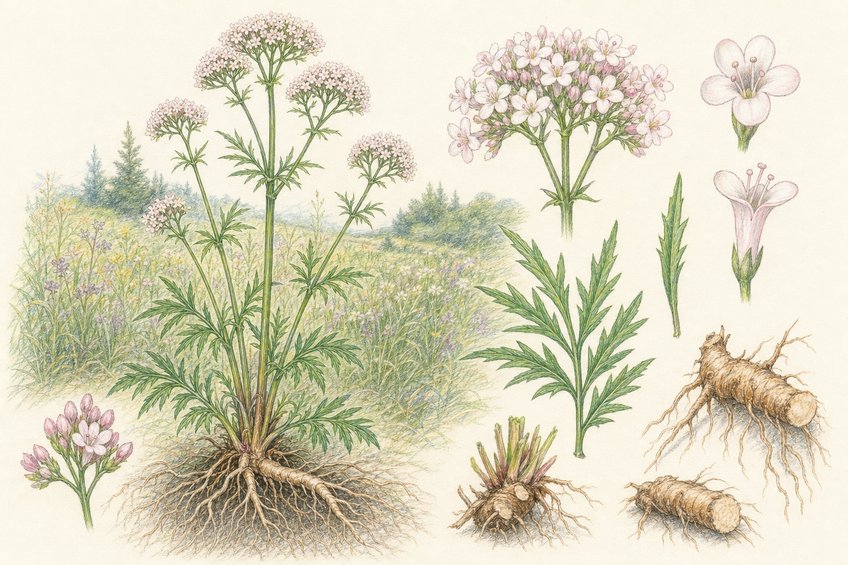
Valerian - The Musky Root of Old Herb Gardens
"Early to bed and early to rise," Benjamin Franklin famously wrote, and long before electric lamps stretched our evenings, valerian had already earned a place near the bedside in European cottages and monastery gardens. Its flowers look airy and sweet, but its root tells a different story - earthy, sharp, and so musky that cats may roll on it as if they have discovered a secret treasure.
Quick Facts
| Botanical name | Valeriana officinalis L. |
|---|---|
| Family | Caprifoliaceae, honeysuckle family; formerly placed in Valerianaceae |
| Genus | Valeriana |
| Parts used | Root and rhizome, usually dried |
| Other names | Garden valerian, common valerian, all-heal, setwall, phu |
| Native region | Europe and temperate western Asia; naturalized in parts of North America and other temperate regions |
What Is Valerian?
Valerian is a tall, upright perennial herb that can rise 3 to 5 feet in favorable ground. In early to midsummer, it lifts branching stems topped with rounded clusters of tiny white to pale pink flowers, each bloom delicate enough to look like lace from a distance.
The leaves are opposite and divided into narrow leaflets, giving the plant a feathery, slightly fernlike look. Run your fingers along the foliage and you may notice a soft, green scent, but the root is the famous part - dense, tangled, tan-brown, and unmistakably aromatic.
Fresh valerian root smells strong and damp, like a mix of wet earth, old hay, and a barn loft after rain. Some people find it comforting; others wrinkle their nose at once. As old English country gardeners might say, "There is no accounting for taste," and valerian proves the point beautifully.
A Journey Through Time
The name Valeriana is often linked to the Latin word valere, meaning "to be strong" or "to be well." In the first century, Dioscorides described plants believed to be valerian relatives in De Materia Medica, and later European herbals carried the plant into household tradition.
In European monastery gardens, monks grew valerian among other useful herbs, carefully drying the roots for the apothecary shelf. John Gerard included valerian in his 1597 Herball, and Nicholas Culpeper discussed it in his 1653 herbal, both helping preserve its reputation in English-speaking herbal lore.
Colonial American households brought many European herb habits across the Atlantic, and valerian appeared in some early garden and household records as a familiar root from the old country. Appalachian and Southern folk herbalists later knew it as a strong-smelling root associated with quiet evening rituals, though local traditions varied from family to family.
Where Does It Grow?
Valerian is native to much of Europe and temperate western Asia, where it favors moist meadows, stream banks, woodland edges, and ditches with rich soil. Picture a summer meadow in July: tall grasses leaning in the breeze, bees moving through pale flower heads, and valerian stems standing like soft white lanterns above the green.
Today, Valeriana officinalis grows widely in temperate gardens and has naturalized in parts of North America, especially in cool, moist regions. It prefers full sun to partial shade, steady moisture, and soil that drains but does not dry out completely.
The Root - A Closer Look
The part most associated with valerian is the underground portion: a short rhizome surrounded by many slender roots. When freshly dug, the roots are pale to tan and pliable, but as they dry, they darken and their aroma becomes deeper and more penetrating.
That scent comes from volatile constituents that develop and change after harvest. It is the reason valerian has been called both beloved and beastly in herb rooms - a plant that invites curiosity before it invites agreement.
What's Inside?
Valerian root contains a complex mix of naturally occurring plant compounds. Among the best known are valerenic acid and related sesquiterpenes, which are often used as chemical markers for quality in botanical research.
The root also contains volatile oils, iridoids known as valepotriates, lignans, flavonoids, and small amounts of other aromatic compounds. Like many herbs, valerian is not defined by one ingredient alone; its character comes from a whole botanical orchestra playing together.
From Garden to Harvest
Valerian can be grown from seed, though the seed is best sown fresh because it loses vigor quickly. Gardeners usually harvest the roots in autumn of the second year, after the plant has stored energy underground; the roots are lifted, washed gently, sliced or loosened, and dried in a well-ventilated place away from harsh direct heat.
Folklore & Fun Facts
Cats Know the Root
Valerian can attract cats much like catnip does, and old European household lore noticed this long ago. A country saying in parts of Britain held that if you planted valerian, "the cats will find it before the neighbors do." Folklore even linked valerian to the Pied Piper legends of Germany, where strong-smelling roots were sometimes said to draw small animals.
A Bedtime Plant With a Proverbial Shadow
English-speaking families have long passed around sayings such as "A good laugh and a long sleep are the best cures in the doctor's book." Valerian often stood near that same cultural doorway - not as a miracle, but as one of the old roots people associated with the hush of evening.
Did You Know?
Valerian flowers are sweetly scented to many noses, while the dried root can smell like damp socks, cheese rind, or an old stable. This split personality is one reason the plant is so memorable: above ground it looks like a cottage-garden cloud, below ground it smells like folklore with muddy boots.
Another old garden belief advised harvesting roots when the plant's energy had "gone downward" in autumn. Farmers' almanac-style wisdom often tied root digging to the waning moon, reflecting the broader rural idea that underground crops were best gathered when growth was retreating below the soil.
References
- Plants of the World Online, Royal Botanic Gardens, Kew: Valeriana officinalis L.
- USDA Natural Resources Conservation Service PLANTS Database: Valeriana officinalis.
- Missouri Botanical Garden Plant Finder: Valeriana officinalis.
- European Medicines Agency, Committee on Herbal Medicinal Products: assessment materials on Valeriana officinalis root.
- Gerard, John. The Herball or Generall Historie of Plantes, 1597.
- Culpeper, Nicholas. The English Physician, 1653.
Valerian reminds us that plants do not have to be tidy to be wonderful. Some charm us with fragrance, some with beauty, and some - like this musky-rooted meadow dweller - invite us to lean closer, ask better questions, and notice the lively stories hidden under the soil.
Where to Find Valerian
Explore our Valerian products in the HawaiiPharm store.