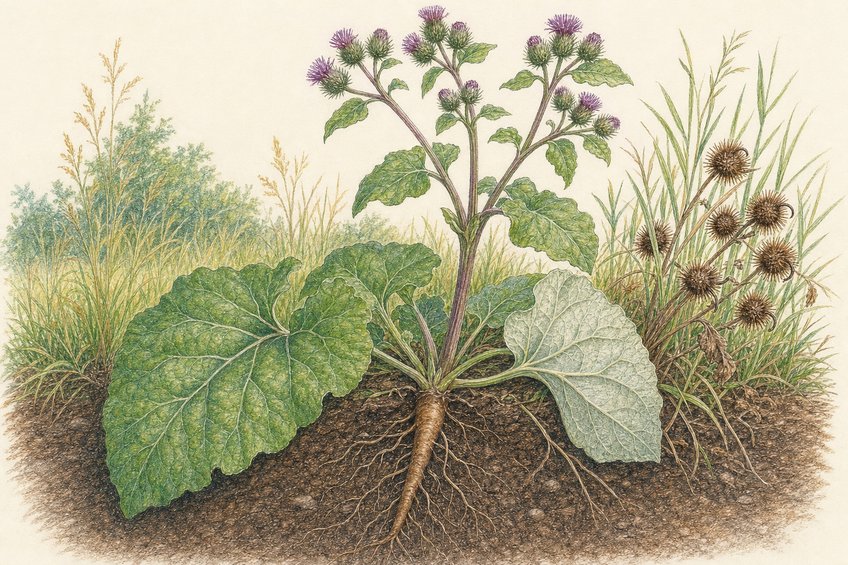
BURDOCK (ARCTIUM LAPPA): ROOTS, BURRS, AND LORE
Before Velcro fastened shoes, jackets, and space gear, it began with a walk through weedy ground: Swiss engineer George de Mestral noticed burdock burrs clinging to his dog in 1941 and looked closer under a microscope. Those tiny hooks, so annoying on wool socks, became one of the best-known inventions borrowed from a plant.
A quick look at burdock
| Botanical name | Arctium lappa |
| Family | Asteraceae, the daisy family |
| Parts used | Root, leaf, seed-like fruits |
| Other names | Greater burdock, gobo, beggar's buttons, clotbur, lappa |
| Native region | Europe and northern Asia |
The plant that wears hooks
Burdock is a biennial, which means it spends its first year building a deep taproot and a broad rosette of leaves close to the ground. In its second year, it sends up a stout, branching stalk that may stand 3 to 6 feet tall.
The leaves are large, wavy, and heart-shaped, green above and pale grayish beneath. Run a finger across the underside and it feels softly felted, as if dusted with fine wool.
By midsummer, burdock carries round flower heads with purple thistle-like florets peeking from a cage of hooked bracts. When the heads dry, they become burrs that grab fur, denim, and shoelaces with stubborn little claws.
Crush a fresh leaf and the scent is green, earthy, and faintly bitter. Dig the root in cool weather and it smells like damp soil, carrot skin, and a cellar where vegetables are stored for winter.
Root, leaf, and burr
The root is the best-known part of burdock in cooking and herbal traditions. It is long, narrow, brown-skinned, and crisp when fresh, often reaching a foot or more into loose soil.
In Japan, the root is called gobo and is sliced into soups, stir-fries, and a seasoned dish called kinpira gobo. Its flavor is earthy and mildly sweet, with a texture that stays pleasantly firm after cooking.
The leaves have been gathered young in some folk traditions, though mature leaves grow coarse and bitter. The seed-like fruits, called achenes in botany, are known in traditional Chinese herbal literature as niu bang zi.
From Eurasian roadsides to North American fence lines
Arctium lappa is native across much of Europe and northern Asia, where it favors disturbed ground, hedgerows, field margins, riverbanks, and the edges of paths. It likes rich soil and enough moisture to feed that long taproot.
European settlers carried many familiar plants across the Atlantic, some on purpose and some tucked into hay, wool, and soil. Burdock found a welcome home in North America, especially around barns, old gardens, pastures, and rail lines.
Today, greater burdock grows in many parts of the United States and Canada. In some regions it behaves like a stubborn weed, especially where the burrs hitch rides on livestock, pets, and pant legs.
Old herbals, pantry roots, and country names
John Gerard described burdock in his 1597 English herbal under the name "Clot-bur," a name that fits the way the burrs clot and cling in wool. Nicholas Culpeper, writing in 1653, placed burdock among familiar household herbs in the language of astrology and garden medicine used in his day.
In European monastery gardens, large-leaved plants such as burdock often grew near other useful roots and kitchen herbs. Hildegard of Bingen wrote about a plant called "cletta" in the 12th century, which many historians connect with burdock or a close relative.
Colonial and pioneer households knew burdock as a spring root and a rough-and-ready pantry herb. Appalachian mountain herbalists later spoke of digging roots after the first frost, when old-timers said the plant had "sent its strength underground."
After burdock spread in North America, some Native communities incorporated the newcomer into local plant knowledge. Ethnobotanical records compiled by Daniel E. Moerman note Iroquois uses of burdock preparations, a reminder that plant traditions often changed as new species appeared along trade routes and settlement edges.
What is inside the root?
Burdock root contains inulin, a soluble plant fiber also found in chicory, dandelion root, and Jerusalem artichoke. In cool-season roots, inulin is one way the plant stores energy for the tall flowering stalk it will make the next year.
The plant also contains mucilage, tannins, polyphenols such as chlorogenic acid and caffeoylquinic acids, and lignans including arctiin and arctigenin. The burrs and leaves contain bitter compounds and small amounts of sesquiterpene lactones, the kind of chemistry often found in members of the daisy family.
These constituents help explain burdock's earthy taste, slightly slippery cooked texture, and old reputation as a serious root rather than a delicate salad green. Chemistry gives the plant its character before anyone gives it a story.
Growing a giant from a seed
Burdock grows readily from seed in deep, loose soil. Gardeners who want straight roots often sow it where the plant will stay, because the taproot dislikes being moved.
The first-year root is usually harvested in autumn or very early spring, before the flowering stalk rises. Once the second-year stem appears, the root becomes woody as stored energy moves upward.
Farmers' almanac-style wisdom often favored root digging during the dark of the moon, when underground crops were thought to be at their best. Whether or not one follows moon signs, cool soil does make the root crisper and easier to handle.
The burrs need no help traveling. A single plant can make many hooked heads, and each one is built like a tiny hitchhiker.
Did you know?
- The genus name Arctium comes from the Greek word arktos, meaning bear, likely referring to the rough, bristly flower heads.
- The species name lappa is linked to old words for seizing or taking hold, a perfect fit for a burr that grabs passing animals.
- The old saying "sticks like a burr" comes from plants like burdock, whose hooks cling long after a walk through tall weeds.
- Children in parts of Britain and rural North America once used burdock burrs as natural building toys, pressing them together into little baskets, crowns, and prankish decorations.
A closer look beside the path
Burdock is easy to dismiss until its burrs tug at a sleeve or its broad leaves shade the ground like green umbrellas. Look again in late summer and there is clever engineering in every hook, a pantry root underfoot, and a purple thistle-flower visited by bees at the rough edge of a field.
References
- Royal Botanic Gardens, Kew. Plants of the World Online: Arctium lappa L.
- U.S. Department of Agriculture, Natural Resources Conservation Service. PLANTS Database: Arctium lappa L.
- Gerard, John. The Herball or Generall Historie of Plantes. London, 1597.
- Culpeper, Nicholas. The English Physician. London, 1653.
- Moerman, Daniel E. Native American Ethnobotany. Timber Press, 1998.
- de Mestral, George. U.S. Patent 2,717,437, Velvet Type Fabric and Method of Producing Same, 1955.
- Lim, T. K. Edible Medicinal and Non-Medicinal Plants, Volume 7: Flowers. Springer, 2014.
Explore our Burdock products in the HawaiiPharm store.