CAT'S CLAW PLANT: AMAZON VINE WITH HOOKED THORNS
"A cat may look at a king," says the old English proverb, but in the Amazon forest, cat's claw does something bolder - it climbs toward the canopy with curved hooks that catch like tiny paws. Run a finger along a young stem and you can feel why Spanish-speaking herbalists called it "una de gato," the claw of the cat.
A vine with a feline grip
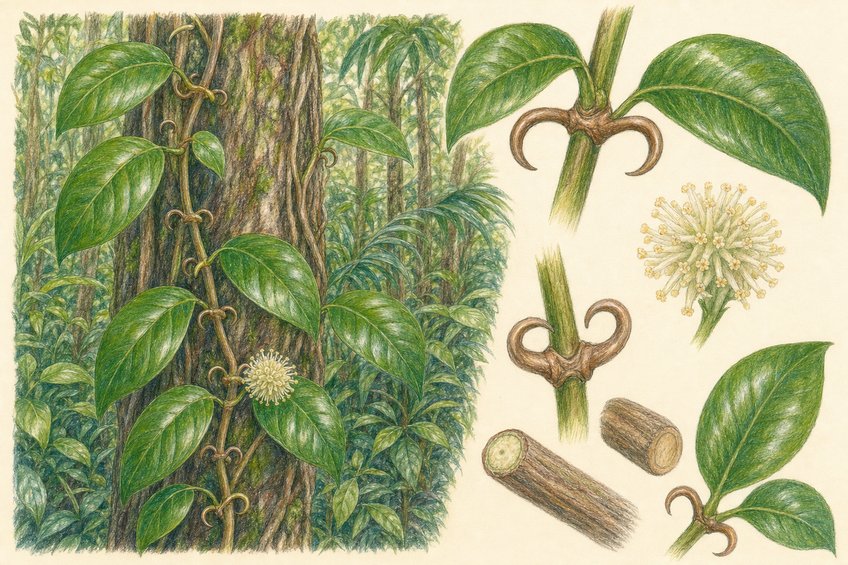
Cat's Claw, or Uncaria tomentosa, is a woody tropical vine from the coffee family. In its home forest, it scrambles up trees rather than standing alone, using pairs of curved thorns to hold fast as it reaches for filtered light.
The leaves grow opposite each other along the stem, smooth-edged and oval, with a glossy green surface and a paler underside. New growth may feel softly hairy, which helps explain the species name tomentosa, meaning woolly or covered with fine hairs.
Its flowers are small, pale yellow to cream, and gathered into round, button-like heads. They are easy to miss in the green shade, but the hooked thorns are unmistakable - the plant's signature written in wood.
Quick facts from the forest edge
| Botanical name | Uncaria tomentosa |
| Family | Rubiaceae, the coffee family |
| Parts used | Stem bark and inner bark; root bark was also known in traditional practice |
| Other names | Una de gato, vilcacora, life-giving vine, saventaro |
| Native region | Amazon basin and tropical regions of Central and South America |
Where the vine makes its home
Uncaria tomentosa grows in humid lowland rainforest, forest margins, and disturbed clearings where a vine can find both support and light. It is especially associated with Peru, but its range extends through parts of Colombia, Ecuador, Bolivia, Brazil, Venezuela, and neighboring tropical regions.
Cat's claw favors warmth, steady moisture, and living architecture - trunks, branches, and shrubs that give it something to climb. Old gardeners have a saying for climbing plants: "First they sleep, then they creep, then they leap." In the rainforest, cat's claw seems to know the last part well.
It often shares its habitat with palms, orchids, bromeliads, and other lianas. In a damp forest after rain, the bark gives off a mild woody scent, while the cut inner bark smells earthy and tannic, a little like fresh twigs and black tea.
The bark beneath the hooks
The best-known plant material is the bark, especially the inner bark from mature stems. When stripped carefully, it shows a warm tan to reddish-brown color and a fibrous texture that can peel in narrow ribbons.
The taste is astringent because the bark contains tannins. That mouth-puckering quality is familiar in many bark plants, from oak to witch hazel, and it is one reason bark has held a steady place in traditional plant work around the world.
Root bark was historically gathered in some settings, but cutting roots can kill the vine. Stem bark harvest from mature plants, when done with restraint, leaves more of the plant alive to regrow.
Names, forest knowledge, and a late arrival in written herbals
The Spanish name "una de gato" simply means "cat's claw," a practical field name for a plant that grabs. The Latin genus Uncaria comes from uncus, a hook, so both common and scientific names point to the same sharp little feature.
Indigenous peoples of the Amazon knew the vine long before it appeared in European-language herbals. Among Ashaninka communities of Peru, the plant was known as "vilcacora" or by related local names, and bark preparations were part of traditional forest practice under the guidance of knowledgeable healers.
Shipibo-Conibo and other Amazonian communities also knew plants called cat's claw within their own plant traditions. As with many rainforest species, knowledge was local, place-based, and tied to careful recognition of the correct vine.
European monastery gardens were full of sage, rue, angelica, and rosemary, yet cat's claw was absent from those cloister beds. This was not a plant of abbey walls or colonial American pantries; while settlers in North America kept yarrow, peppermint, and boneset in household chests, cat's claw remained rooted in tropical forests far to the south.
What plant chemists find inside
Cat's claw bark contains several groups of naturally occurring compounds. The most discussed are oxindole alkaloids, including pteropodine, isopteropodine, mitraphylline, isomitraphylline, speciophylline, and uncarine F.
Some plants contain more pentacyclic oxindole alkaloids, while others contain more tetracyclic oxindole alkaloids such as rhynchophylline and isorhynchophylline. These natural chemotypes are one reason botanists and quality researchers pay close attention to correct identification.
The bark also contains quinovic acid glycosides, procyanidins, catechins, plant sterols, triterpenes, and tannins. Those names may sound like a chemist's cabinet, but they are simply different families of plant molecules, each with its own structure, taste, and behavior in laboratory analysis.
Did you know?
Cat's claw belongs to the same plant family as coffee. The two plants look very different at first glance, but the Rubiaceae family is enormous, with shrubs, trees, herbs, and vines spread across the tropics.
Another surprise: "cat's claw" is not one single plant name around the world. Uncaria tomentosa is often confused with Uncaria guianensis, another hooked Amazonian vine, and with unrelated ornamentals that also bear claw-like thorns.
Old country people in Britain sometimes said, "A cat in gloves catches no mice." Cat's claw seems to have taken the opposite lesson - its bare hooks are exactly what let it climb.
Growing, climbing, and careful harvest
Cat's claw is a tropical plant and does not tolerate cold winters. Where it is cultivated, growers provide heat, high humidity, rich soil, and strong support, much like the tree trunks and forest edges it uses in the wild.
Propagation can be done from seed or cuttings, though seeds are small and require suitable moisture and warmth. Young vines need patience before they begin to climb with confidence.
Responsible harvest focuses on mature stems rather than roots. Harvesters may remove bark in sections and leave enough living tissue for the vine to continue growing, a practical approach in forests where a single careless cut can end a plant that took years to reach the canopy.
How to recognize true cat's claw
Look for a woody liana with opposite leaves and paired, curved hooks at the nodes. The hooks often look like a cat's claws caught mid-scratch, emerging where leaves meet the stem.
The leaf shape is usually elliptic, with a clear central vein and a smooth margin. Flower heads, when present, are round and pale, made of many tiny tubular flowers packed together.
Correct identification matters because common names travel faster than botany. A plant called cat's claw in a desert garden, roadside thicket, or houseplant collection may have no close relationship to Uncaria tomentosa.
A closing look under the canopy
In the Amazon understory, its curved thorns catch a branch, the stem tightens its grip, and the vine rises a few inches closer to the light.
References
- Ridsdale, C. E. "A revision of Mitragyna and Uncaria." Blumea, 1978.
- Heitzman, M. E., Neto, C. C., Winiarz, E., Vaisberg, A. J., and Hammond, G. B. "Ethnobotany, phytochemistry and pharmacology of Uncaria tomentosa." Phytochemistry, 2005.
- Keplinger, K., Laus, G., Wurm, M., Dierich, M. P., and Teppner, H. "Uncaria tomentosa: ethnomedicinal use and new pharmacological, toxicological and botanical results." Journal of Ethnopharmacology, 1999.
- Duke, J. A. Handbook of Medicinal Herbs, 2nd edition. CRC Press, 2002.
- Missouri Botanical Garden, Tropicos database. Uncaria tomentosa botanical record.
Cat's Claw products in the HawaiiPharm.com store