CHAGA MUSHROOM GUIDE: BIRCH'S BLACK FOREST CONK LORE
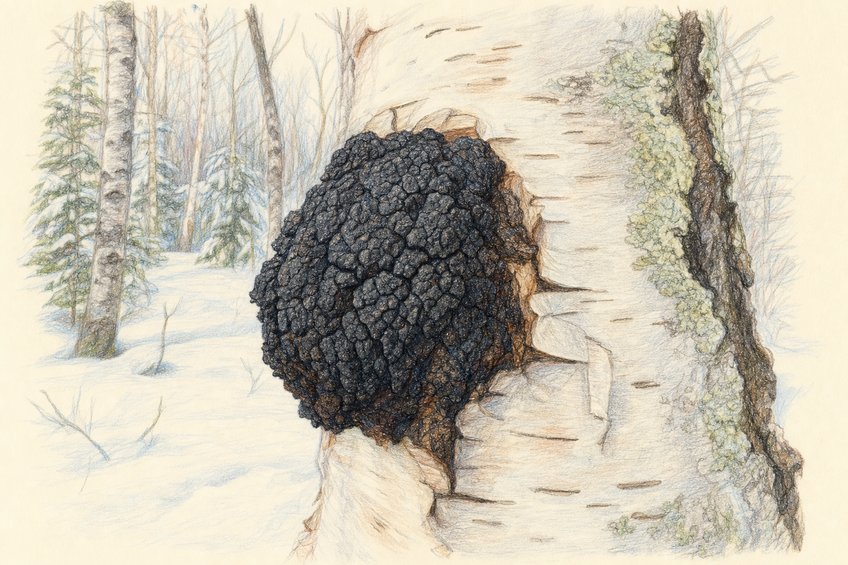
Old woodsmen had a plain rule: if your hands are cold, look to the birch. On a pale trunk in a snowy forest, chaga looks like a chunk of burnt bread pressed into the bark - black, cracked, and rough outside, with a warm cinnamon-brown interior that smells faintly earthy when freshly cut.
A quick look at chaga
| Botanical name | Inonotus obliquus |
|---|---|
| Family | Hymenochaetaceae |
| Parts used | Sterile conk, often called the sclerotial mass |
| Other names | Chaga, clinker polypore, cinder conk, birch mushroom, pakuri |
| Native region | Cool northern forests of North America, Europe, and Asia, especially where birch trees grow |
The black conk on the white birch
Chaga is a fungus, though the part people notice does not look like the umbrella-shaped mushrooms found after rain. It forms a hard, irregular mass on living birch trees, often bulging from a wound in the trunk like cooled lava.
The outside is coal-black because it contains dark melanin-like pigments. Break it open and the inside shifts to rusty orange, ocher, and brown, with a dense corky texture that can blunt a knife if the conk is old and dry.
Mycologists call the visible lump a sterile conk. The true spore-bearing surface usually appears later, hidden under bark as a thin brown pore layer after the tree has died or declined.
Did you know?
The chaga sold in chunks or ground pieces is usually not the fungus's reproductive cap. It is more like a long-lived storage and growth mass, built slowly as the fungus lives within the birch wood.
Where the birches lead, chaga may follow
Chaga belongs to the cold country. It appears in boreal and cool temperate forests across Canada, Alaska, the northern United States, Scandinavia, the Baltic region, Russia, Korea, and northern Japan.
Birch is its favorite host, especially white birch, yellow birch, and paper birch in North America. It can occur on other hardwoods, but traditional chaga gathering has long centered on birch because the best-known conks form there.
In winter, chaga is easier to spot. Picture a stand of paper birch after a snowfall: white trunks, black branch scars, and here and there a dark knob jutting from the bark at shoulder height or higher.
A slow life inside the tree
Chaga enters birch through damaged bark, broken limbs, or other openings. Once established, it grows within the wood and may take many years to form a visible conk.
The fungus and tree share a long, uneasy association. The conk can continue enlarging season by season, while the birch still leafs out in spring and sheds golden leaves in fall.
This slow pace matters for gatherers. A large conk may represent years of growth, so old-timers in northern woods often took only what they needed and left smaller pieces to continue on the tree.
The part people collect
The part used is the hard outer conk, usually cut from the trunk with a hatchet, saw, or sturdy knife. Fresh chaga feels woody and damp inside; dried chaga becomes lighter, tougher, and easier to store in chunks.
Gatherers traditionally cleaned away loose bark and debris, then broke the inner brown material into small pieces for drying. When simmered in water, it gives a dark brown drink with a mild, woody taste and a scent that some people compare to wet forest floor and toasted bark.
Responsible harvesting avoids young conks, dead trees with crumbly material, and heavy cutting into the birch itself. In many northern communities, good chaga spots were remembered like fishing holes and berry patches.
What is inside chaga?
Chaga contains a mix of fungal and birch-derived compounds. Its dark crust is rich in melanin-like pigments, the same broad class of pigments that gives color to many living tissues in nature.
The inner portion contains polysaccharides, including beta-glucans, which are structural carbohydrates found in many fungi. A 2021 review in the Journal of Ethnopharmacology also documented triterpenes including betulin and betulinic acid, compounds shared with birch bark chemistry.
Other constituents reported in chaga include sterols, phenolic compounds, organic acids, and minerals. Like many wild fungi, chaga can also contain notable levels of oxalates, which is one reason careful identification and source knowledge matter.
Forest lore, fire kits, and northern tea
In Russian and Siberian households, chaga was commonly simmered into a dark, plain drink, especially in forest regions where birch was abundant. The Russian word "chaga" is often traced through regional languages of the Ural and Siberian north.
In Finland, the fungus is known as "pakuri." During times when imported tea or coffee was scarce, pieces of birch conk were roasted or brewed as a local forest beverage.
Ethnographic accounts from the northern woodlands of North America describe Cree and Anishinaabe people using chaga-like sterile conks as punky tinder for carrying fire. A glowing coal could be tucked into the porous material and kept alive during travel, a quiet spark saved for the next camp.
Colonial and pioneer households valued dependable tinder in the same practical spirit. New England woodsmen used the word "touchwood" for fungi that caught a spark, and a dry piece in the kit could mean a faster fire on a wet morning.
Birch itself carries a thick trail of British, Irish, and Scottish folk meaning. In Scottish and Irish tree lore, birch was associated with beginnings, and birch twigs were tied into besoms for seasonal sweeping - a household image that fits a tree whose pale bark shines first in the dim woods.
Growing and gathering in cold country
Chaga is not grown like garden herbs. Commercial cultivation is difficult because the fungus develops through a long relationship with living trees, cool weather, wounds in bark, and time.
Most chaga on the market has been wild collected or produced through controlled fungal culture methods that do not create the same birch-grown conk. Wild collection is heaviest in northern forest regions where birch stands are common.
Farmers' almanac-style wisdom favors winter gathering, when leaves are down, ticks are quiet, and the black conks stand out against snow and pale bark. Dry weather helps, too, because wet chunks can mold if they are packed away before proper drying.
A careful harvester cuts the protruding mass without girdling the tree, leaves part of the conk when possible, and skips protected areas. The best field lesson is simple: if the forest looks poorer after you leave, you took too much.
A few curious facts from the birch woods
- Chaga can resemble burnt charcoal so closely that first-time hikers often mistake it for an old fire scar.
- The orange-brown interior has been used as a natural dye material in some craft traditions, giving warm earthy tones.
- The fungus grows slowly enough that a fist-sized conk may have taken years to form.
- Chaga's visible conk is usually found on living trees, while the spore-producing stage is often hidden and short-lived.
A final look at the black ember
Chaga asks for a slower kind of attention: the eye that notices one black knot among a hundred white birch trunks, the hand that feels the corky crackle of its crust, the nose that catches that faint woody scent from a fresh cut. Next time a birch grove gleams beside a cold trail, look carefully at the bark - the forest may be holding a dark ember in plain sight.
References
- Ryvarden, L. and Melo, I. 2017. Poroid Fungi of Europe. Synopsis Fungorum 37. Fungiflora.
- Phillips, R. 2010. Mushrooms and Other Fungi of North America. Firefly Books.
- He, Y., Zhang, Y., and colleagues. 2021. Inonotus obliquus: a review of traditional uses, chemical constituents, and biological research. Journal of Ethnopharmacology.
- MycoBank. Inonotus obliquus species record. International Mycological Association database.
- Stamets, P. 2005. Mycelium Running: How Mushrooms Can Help Save the World. Ten Speed Press.
Where to Find Chaga
Explore our Chaga products in the HawaiiPharm store.