LOMATIUM DISSECTUM: FERNLEAF BISCUITROOT OF THE WEST
In the sagebrush country of the inland West, spring can look spare until Lomatium dissectum lifts its yellow umbels above the gravel. Crush a bit of leaf between your fingers and the scent rises sharp and resinous - part parsley, part pine pitch, part sun-warmed desert soil.
A quick look at Lomatium
| Botanical name | Lomatium dissectum |
| Family | Apiaceae, the carrot family |
| Parts used | Root, and in some traditions seeds or young shoots |
| Other names | Fernleaf biscuitroot, desert parsley, Indian parsley, Toza root |
| Native region | Western North America, especially the Great Basin, Columbia Plateau, Rocky Mountain foothills, and Pacific Northwest interior |
How to recognize this desert parsley
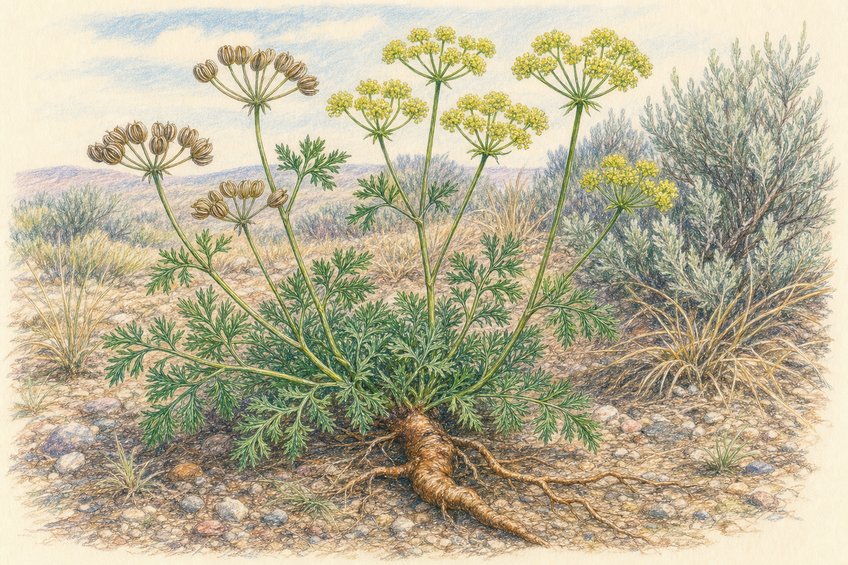
Lomatium dissectum looks airy above ground and stubborn below it. The leaves are divided again and again into narrow, fernlike segments, giving the plant a soft, lacy outline against rocks and bunchgrass.
In spring, rounded clusters of small yellow to greenish-yellow flowers rise on firm stalks. Like other members of the carrot family, the flowers are arranged in umbels, little umbrella-like sprays that catch light before many shrubs have fully leafed out.
The root is the heavy anchor of the plant. It is thick, brown, often branching, and rich with a strong aromatic resin that can cling to a knife, a hand, or a gathering basket.
Where it finds a foothold
Lomatium dissectum belongs to open Western places: sagebrush flats, dry slopes, rocky benches, ponderosa pine edges, and high-desert grasslands. It tolerates lean soils, bright sun, winter cold, and the dry pause that settles in after spring moisture disappears.
Its range stretches across much of the inland Pacific Northwest and Great Basin, with populations reported from states such as Oregon, Washington, Idaho, Montana, Nevada, Utah, Wyoming, California, and Colorado. In Canada, related Lomatium species are part of the dry interior flora of British Columbia.
Look for it early. By the time midsummer heat has baked the hills pale gold, the above-ground growth may be fading while the root waits underground for another year.
The root that carries the story
The root is the part most closely associated with Lomatium dissectum. It stores the plant's energy through snow, drought, grazing, and fire-scarred seasons.
Fresh root has a commanding scent. Some people notice celery and parsley first, while others pick up a bitter, balsamic resin like pitch on a warm pine trunk.
Because this is a perennial with a deep taproot, harvest has always required patience and care. Old gathering wisdom across many root traditions says to dig after the top growth has finished its work, when the plant has sent strength back below the soil.
Great Basin knowledge and Western household lore
Many Native peoples of the inland West knew Lomatium and its relatives well. Ethnobotanical records describe use among Northern Paiute, Washoe, Shoshone, Nez Perce, and other communities, with roots, seeds, or greens prepared in different ways depending on the species, season, and local custom.
Some Lomatium roots were roasted, dried, pounded, or stored as trail food, which helps explain the name biscuitroot. Lomatium dissectum itself is often stronger and more resinous than the milder food species, so traditional knowledge carefully distinguished one kind from another.
Western settlers learned many plant names from Native neighbors and from the plants themselves. Names like desert parsley and Indian parsley show how newcomers tried to place this unfamiliar root into a familiar kitchen map, beside carrot, parsley, celery, and parsnip.
There is an old British saying that parsley seed "goes nine times to the devil before it sprouts," a nod to the slow and fussy germination of parsley. Lomatium, a parsley-family cousin, can be just as patient; its seeds often need winter chill before they wake.
Did you know?
The word Lomatium comes from the Greek loma, meaning a border or fringe, referring to the winged edges on the fruits of many species in the genus. Dissectum points to the finely cut leaves, which look as if a careful hand divided them into green lace.
Another surprise sits in the plant's family tree. Lomatium shares Apiaceae with carrots, dill, fennel, parsley, and celery, yet the family also includes plants that require expert identification. Umbel-shaped flowers are beautiful, but they are never enough for safe field identification.
What gives Lomatium its scent?
Lomatium dissectum root contains aromatic resins and volatile oils, the substances responsible for much of its persistent fragrance. These resinous compounds help give the root its sticky, balsamic character.
The plant also contains coumarin-related compounds, furanocoumarins, flavonoids, and other phenolic constituents. In plain terms, these are plant-made molecules that contribute to color, scent, bitterness, and the way the plant interacts with sunlight, insects, and soil life.
Furanocoumarins are common in several members of the carrot family, including some citrus relatives outside Apiaceae. They are one reason botanists handle plant chemistry with care, especially in species that grow under intense Western sun.
Growing, seed patience, and careful harvest
Lomatium is not a quick garden annual. It prefers well-drained mineral soil, full sun, and a rhythm that includes cold winter weather followed by spring moisture.
Seeds are usually sown fresh or exposed to a cold, moist period before germination. This fits the farmer's almanac style of thinking: some seeds want a winter's sleep before they will trust the spring.
Young plants put serious effort into their roots before making a show above ground. In cultivation or restoration work, that slow beginning matters because a sturdy taproot helps the plant handle dry summers.
Wild harvesters who know the country often leave many mature plants standing and avoid small or isolated populations. A single plant may represent years of underground growth, hidden beneath one brief crown of yellow flowers.
A few more field notes and folk threads
- In parts of the West, biscuitroot species were among the early spring plants watched closely by Indigenous gatherers because timing changed the flavor and usefulness of roots and greens.
- The name Toza root has been used in the herb trade for Lomatium dissectum, though common names can shift from region to region.
- Like many carrot-family plants, Lomatium makes paired dry fruits called schizocarps, which split into two seedlike halves when mature.
- Its flowers can attract small native pollinators during a season when the high desert still holds cool mornings and hard shadows.
The plant in its own country
Picture a basalt slope in April: gray-green sage, bunchgrass just beginning to stir, and Lomatium standing low but bright with yellow umbels above finely cut leaves. The plant does not ask for rich soil or shade, only the old Western bargain of winter moisture, open sky, and room for a deep root to travel.
References
- USDA Natural Resources Conservation Service. PLANTS Database: Lomatium dissectum.
- Hitchcock, C. Leo, and Arthur Cronquist. Flora of the Pacific Northwest. University of Washington Press, 1973.
- Moerman, Daniel E. Native American Ethnobotany. Timber Press, 1998.
- Turner, Nancy J. Food Plants of Interior First Peoples. UBC Press, 1997.
- Burke Museum Herbarium, University of Washington. Lomatium dissectum species account and regional specimen records.
Where to Find Lomatium
Explore our Lomatium products in the HawaiiPharm store.