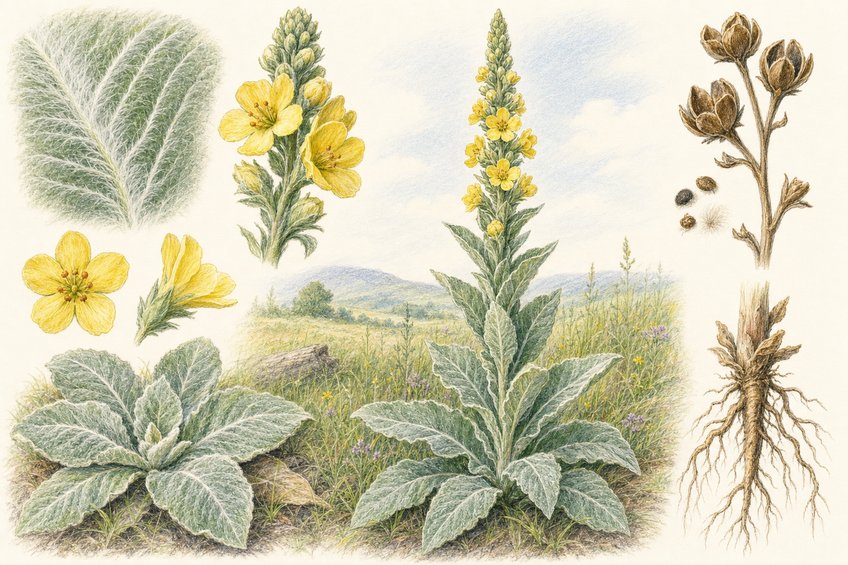
MULLEIN PLANT PROFILE: VELVET LEAVES AND GOLDEN SPIRES
Old country people called mullein a plant that carries its own candle. Stand beside a second-year Verbascum thapsus in midsummer, and the name makes sense: a tall, golden spire rises from a rosette of soft gray-green leaves, as if someone planted a torch in the meadow.
Quick Facts
| Botanical name | Verbascum thapsus L. |
|---|---|
| Family | Scrophulariaceae, the figwort family |
| Genus | Verbascum |
| Parts used | Leaves, flowers, flowering tops, and occasionally roots |
| Other names | Great mullein, common mullein, velvet plant, flannel leaf, candlewick plant, Aaron's rod, shepherd's club, hag's taper |
| Native region | Europe, North Africa, and temperate parts of western and central Asia |
What Is Mullein?
Mullein is a biennial wildflower, meaning it usually takes two growing seasons to finish its life story. In the first year, it forms a low rosette of broad, woolly leaves; in the second year, it sends up a flowering stalk that may reach 2 to 8 feet tall.
The leaves are the part most people remember. Touch one and it feels like old flannel or a lamb's ear - thick, soft, and downy, with tiny hairs that give the plant its silvery cast. Crush a fresh leaf and the scent is mild and green, more field than perfume.
In summer, small five-petaled yellow blossoms open along the spike, one section at a time. On a still morning, the flowers can carry a faint honeyed smell, especially when bees are busy among them.
A Journey Through Time
The Greek physician Dioscorides described mullein in De Materia Medica in the first century CE, and Roman writers noted its usefulness as a practical wayside plant. Long dried stalks were sometimes dipped in fat or wax and burned as torches, which helped give rise to names like candlewick plant and hag's taper.
In European monastery gardens, mullein belonged among the tall, useful herbs tended by monks who copied herbals and observed plants season by season. John Gerard included mullein in his 1597 Herball, a book that helped shape English garden and household plant knowledge.
After mullein arrived in North America with European settlers, it quickly found room along roads, fence lines, and homestead edges. Colonial housewives and pioneer families dried the leaves and flowers for household preparations, while ethnobotanical records describe some Native American communities, including Cherokee and Navajo traditions, adopting the introduced plant into tea or smoke preparations connected with breathing and chest comfort.
Where Does It Grow?
Mullein is native to much of Europe, North Africa, and temperate Asia, but today it is widely naturalized across North America, Australia, New Zealand, and other temperate regions. In the United States and Canada, it is common from roadsides and old fields to dry pastures, railroad edges, sandy banks, and sunny disturbed ground.
This is not a plant that asks for rich pampering. It prefers full sun, open soil, and good drainage, and it often appears where the earth has been scraped, burned, grazed, or otherwise disturbed. In some western regions, land managers monitor it as a weedy or invasive species because one sturdy plant can make a great many seeds.
The Leaves and Flowers - A Closer Look
Mullein leaves grow largest at the base, sometimes reaching more than a foot long, with a tapering shape that guides rainwater down toward the root. Their woolly surface helps reflect sunlight and conserve moisture, a clever design for dry, exposed places.
The flowers are small but plentiful, bright yellow with a warm golden center. Herbal traditions often separated leaf and flower harvests: leaves were gathered before or during early flowering, while blossoms were picked fresh as they opened, since each bloom lasts only a short time.
What's Inside?
Mullein contains a gentle mix of plant compounds that help explain why it attracted so much household attention. The leaves are known for mucilage, a slippery group of polysaccharides, along with saponins, tannins, and flavonoids such as luteolin, apigenin, quercetin, and rutin.
Researchers have also identified iridoid glycosides, including aucubin and catalpol, as well as phenylethanoid glycosides such as verbascoside, also called acteoside. The yellow flowers contribute carotenoid pigments and small amounts of aromatic compounds, which help give them their sunny color and faint sweet scent.
From Garden to Harvest
Gardeners usually start mullein from seed, pressing the tiny seeds onto the soil surface because light helps them germinate. The first-year rosette is left to gather strength, then leaves are harvested sparingly from healthy plants and dried in a warm, airy place; flowers are best collected on dry mornings after dew has lifted, when their color is fresh and bright.
Folklore and Fun Facts
Did You Know?
- Farmers' almanac-style weather lore claimed that the height and thickness of a mullein flower stalk could predict the coming winter. A tall, heavy spike was said to mean deep snow, though botanists would point to growing conditions rather than prophecy.
- An old field saying, often applied to generous seeders like mullein, goes: One year's seed, seven years weed. Mullein lives up to the warning, as a single plant can produce tens of thousands of tiny seeds that may wait in the soil for years.
- British and Irish country names such as hag's taper and Aaron's rod linked mullein with both cottage magic and biblical imagery. Folklore held that the torch-like stalk could keep troublesome spirits at bay.
- In Appalachian and Southern folk tradition, the leaves were sometimes called flannel leaf, a plainspoken name that fits the touch perfectly. Another American nickname, cowboy toilet paper, speaks to frontier humor more than botanical elegance.
- The yellow flowers were once nicknamed Quaker rouge because, according to old cosmetic lore, they were rubbed on the cheeks for a bit of color.
References
- Plants of the World Online, Royal Botanic Gardens, Kew: Verbascum thapsus L.
- USDA NRCS PLANTS Database: Verbascum thapsus, common mullein.
- Flora of North America: Verbascum thapsus species account.
- Gerard, John. The Herball or Generall Historie of Plantes, 1597.
- Grieve, Maud. A Modern Herbal, 1931.
- Dioscorides. De Materia Medica, first century CE, historical botanical source.
- Moerman, Daniel E. Native American Ethnobotany, Timber Press, 1998.
Mullein reminds us that the overlooked edges of the world - roadsides, vacant lots, gravel banks, and old pastures - can hold plants with remarkable stories. The next time a gray rosette catches the light like velvet, pause for a moment; a golden tower may be waiting in its future.
Where to Find Mullein
Explore our Mullein products in the HawaiiPharm store.