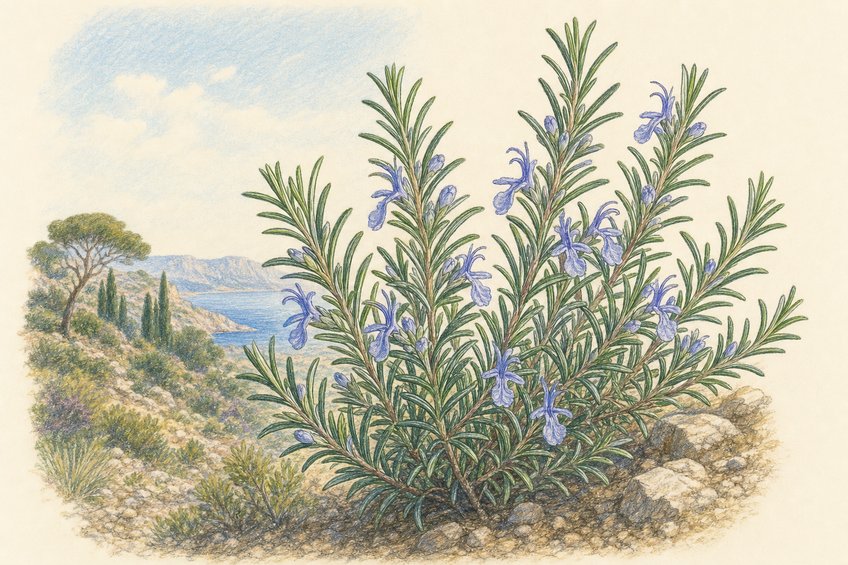
ROSEMARY - MEDITERRANEAN HERB OF MEMORY AND PINE SCENT
"There's rosemary, that's for remembrance," says Ophelia in Shakespeare's Hamlet, handing a sprig heavy with meaning. Crush one needle-like leaf between your fingers and the reason seems plain: the scent rises sharp and resinous, like pine woods warmed by sea air and a kitchen hearth all at once.
A seaside shrub with a scholar's name
Rosemary has long carried the botanical name Rosmarinus officinalis, often translated as "dew of the sea." Modern botanists now place it in the sage genus as Salvia rosmarinus, but the older name still appears in gardens, herbals, and kitchen cupboards across North America.
Its story begins around the Mediterranean basin, where limestone hills, salty breezes, and dry summers shape plants into fragrant survivors. Rosemary grows like a small evergreen shrub, holding its scent through heat, wind, and lean soil.
| Botanical name | Salvia rosmarinus, synonym Rosmarinus officinalis |
| Family | Lamiaceae, the mint family |
| Parts used | Leaves and flowering tops |
| Other names | Rosemary, garden rosemary, sea dew |
| Native region | Mediterranean region of southern Europe, North Africa, and western Asia |
How to recognize rosemary by sight and scent
Rosemary is woody at the base, with upright or trailing stems depending on the variety. Its leaves are narrow, leathery, and evergreen, dark green above and pale beneath, with edges rolled under like tiny scrolls.
Run a hand along the stem and the leaves feel firm, almost waxed. In bloom, rosemary carries small two-lipped flowers in shades of blue, lavender, pale violet, or white, often appearing when many garden plants are still waking up.
The scent is the giveaway. A fresh sprig smells resinous, camphor-like, and slightly peppery, with a clean evergreen bite that lingers on the fingertips.
The leaves and flowering tops people gather
The leaf is rosemary's chief treasure. Its surface is built to hold moisture, while tiny oil glands store the fragrant essential oils that make the plant so recognizable.
Herbalists and cooks often gather the tender tips just before or during flowering, when the aroma is full and the stems have not become too woody. Flowering tops bring a softer scent, with the blossoms adding a faint sweetness to the sharper leaf.
Where rosemary feels at home
Wild rosemary favors sunny slopes, rocky ground, scrubland, coastal cliffs, and open woodland edges around the Mediterranean. It asks for drainage more than richness, and too much winter wet can trouble its roots.
Today it grows in gardens from California to the Carolinas, in pots on Canadian patios, and as clipped hedges in warm regions. In colder areas, gardeners often keep it in a container and bring it indoors before hard freezes.
In its native climate, picture a dry hillside in late winter: gray-green shrubs, pale stones, bees visiting blue flowers, and the smell of resin lifting when the sun warms the leaves.
From monastery beds to colonial pantries
European monastery gardens helped keep rosemary in written herbal tradition. Medieval monks planted aromatic herbs such as rosemary, sage, rue, and hyssop in ordered beds, using them in kitchens, stillrooms, and household preparations.
John Gerard described rosemary in his 1597 Herball, noting its place in English gardens and customs. By the time English colonists crossed the Atlantic, rosemary was familiar enough to travel in seeds, slips, and memory.
Colonial American housewives dried rosemary with other kitchen herbs for winter cooking and household scent. A sprig tucked among linens brought a clean, resinous smell to chests and cupboards, especially when soap, smoke, and wool filled daily life.
Old sayings, wedding sprigs, and graveyard green
In England, rosemary carried a double meaning: remembrance for the dead and fidelity for the living. Sprigs appeared at weddings and funerals, a custom that may seem strange until you remember that an evergreen plant keeps its color when many others fade.
An old English saying claimed, "Where rosemary flourishes, the woman rules." Garden folklore turned the shrub into a household weather vane of sorts, reading domestic strength in a plant that liked sun, drainage, and steady care.
Farmers' almanac-style wisdom often advised taking rosemary cuttings in warm weather after new growth had firmed up. Gardeners still follow a similar rhythm, snipping semi-ripe stems in summer and rooting them before cold weather arrives.
Did you know? Rosemary flowers are shaped for bees. The lower lip of the bloom works like a landing place, and a busy plant can hum softly on a mild day when honeybees and native bees are working the blossoms.
What gives rosemary its aroma
Rosemary belongs to the mint family, a family famous for aromatic leaves. Its essential oil commonly contains 1,8-cineole, camphor, alpha-pinene, borneol, and related terpenes, which give the plant its sharp, forest-like scent.
The leaves also contain rosmarinic acid, a polyphenol found in several mint-family herbs, along with carnosic acid and carnosol. These compounds help explain rosemary's bitter edge, resinous character, and long-standing use as a fragrant culinary herb.
Different growing regions and varieties can produce different scent profiles. Some rosemary leans piney, some more camphor-like, and some softer and almost floral when young tips are gathered.
Growing rosemary without overkindness
Rosemary likes full sun, moving air, and soil that drains quickly. Gardeners who lose rosemary often lose it through wet feet rather than neglect.
In the ground, it can become a sturdy shrub if winters are mild. In a pot, it needs a container with drainage holes and a gritty mix that dries between waterings.
Harvest is simple: snip sprigs with clean shears, taking small amounts from several stems rather than cutting into old bare wood. Bundles dry best in a warm, shaded place where air can move around the leaves.
A few more rosemary curiosities
- Young rosemary stems often show the square shape common in the mint family. Roll a tender stem between your fingers and you may feel its four-sided form beneath the leaves.
- The plant's older genus name, Rosmarinus, comes from Latin roots often read as "dew of the sea," a fitting image for a shrub that thrives near Mediterranean coasts.
- Rosemary is closely related to sage, basil, mint, oregano, thyme, and lavender, all members of the Lamiaceae family.
- Trailing rosemary varieties can spill over stone walls, while upright forms can be clipped into low hedges in mild climates.
One sprig on a windowsill
Rosemary rewards close attention: the pale underside of a leaf, the blue flower shaped for a bee's landing, the old woody stem that smells of sun when cut. A single sprig on a windowsill can carry the feel of a dry Mediterranean hillside into a winter kitchen.
References
- Plants of the World Online, Royal Botanic Gardens, Kew. Salvia rosmarinus Spenn.
- United States Department of Agriculture, Natural Resources Conservation Service. PLANTS Database entries for rosemary and related Lamiaceae taxa.
- Gerard, John. The Herball or Generall Historie of Plantes. London, 1597.
- Grieve, Maud. A Modern Herbal. London: Jonathan Cape, 1931.
- Shakespeare, William. Hamlet, Act 4, Scene 5.
- European Medicines Agency. Assessment report on Rosmarinus officinalis L., folium, 2010.
Where to Find Rosemary
Explore our Rosemary products in the HawaiiPharm store.