SOLOMON'S SEAL (POLYGONATUM ODORATUM) PLANT GUIDE AND LORE
Lift a Solomon's Seal rhizome from the leaf mold and you may find round scars pressed into the rootstock like wax seals on a letter. Those marks, left by old stems, gave this quiet woodland plant its royal name and turned an underground storage organ into a little piece of plant folklore.
A quick look at Solomon's Seal
| Botanical name | Polygonatum odoratum |
| Family | Asparagaceae |
| Parts used | Rhizome, young shoots in some food traditions |
| Other names | Angular Solomon's seal, scented Solomon's seal, fragrant Solomon's seal |
| Native region | Europe and temperate Asia, from western Europe into the Caucasus and parts of Siberia |
The woodland arch and the hanging bells
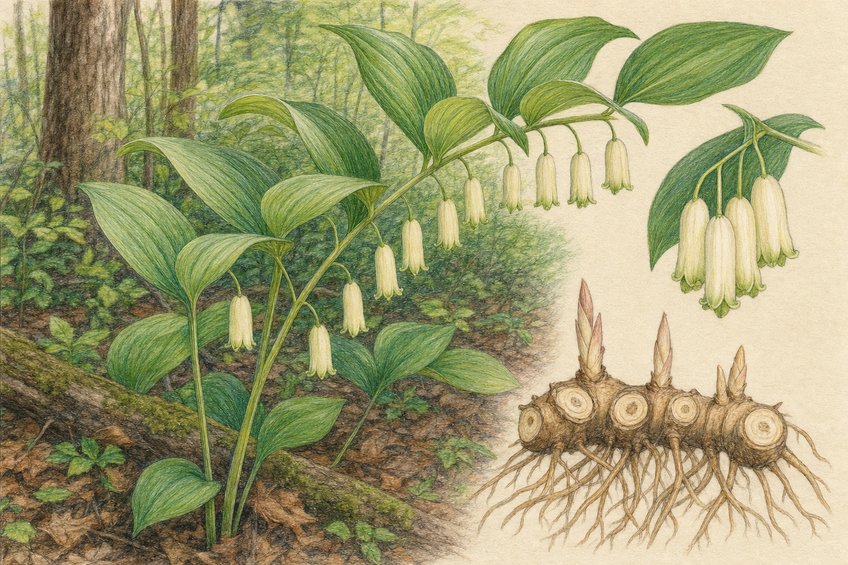
Solomon's Seal is a perennial of soft shade, built with the poise of a fishing rod. Its stems rise and bend in a clean arc, carrying alternate oval leaves that seem to face one direction, each leaf smooth, cool, and faintly waxy to the touch.
In late spring, small tubular flowers dangle beneath the stem in pairs or short clusters. They are creamy white with green-tipped mouths, and if you lean close on a mild morning, the scent can be sweet and shy, more like fresh honey water than perfume.
By late summer the flowers give way to round blue-black berries. The plant then begins to fade into yellow, and the underground rhizome stores the year's growth in a chain of swollen segments.
Why the root looks sealed
The most recognizable part of Solomon's Seal hides below the soil. Its rhizome grows horizontally, adding a new section each season while the old flowering stem leaves behind a circular scar.
Those scars reminded early herbal writers of the seal of King Solomon, the wise ruler of biblical tradition. John Gerard described the plant in his 1597 Herball, paying close attention to its hanging flowers and knotted rootstock, while Nicholas Culpeper included Solomon's Seal in his 1653 herbal under the plant theory of his time.
In cottage-garden speech, a plant like this almost teaches its own memory rhyme: "count the seals, count the seasons." That is gardener's shorthand rather than a formal old proverb, but it captures the practical way people learned plants by touch, shape, and repetition.
The genus name Polygonatum comes from Greek roots often interpreted as "many knees" or "many joints," a nod to the angled, segmented rhizome. The species name odoratum means "fragrant," a fair description when the flowers are fresh.
Where in the world does it grow?
Polygonatum odoratum belongs to woodlands, hedgerows, rocky slopes, and shaded limestone places across much of Europe and temperate Asia. It favors humus-rich soil, dappled light, and the kind of cool spring moisture found under deciduous trees before the canopy fully closes.
Gardeners in North America often know it as an old-fashioned shade perennial, especially the variegated form with pale-edged leaves. It is related to North American Solomon's seals, including Polygonatum biflorum, but Polygonatum odoratum is a Eurasian species with its own range and history.
In a mature shade garden, a clump can look like a row of small green fountains, each stem leaning in the same direction as if it heard music coming from the path.
From monastery beds to cottage borders
European monastery gardens gathered many useful woodland plants close to the cloister, where monks copied herbals and tended orderly beds of roots, leaves, and flowers. Solomon's Seal belonged to that old herbal world as a plant worth knowing by sight, especially because the rhizome was so easy to recognize.
In the hedgerows of England, country folk often named plants by the marks the hand and eye could remember. With Solomon's Seal, the old-style lesson was plain: "the name is in the root," because the scarred rhizome explained the plant better than any label tied to a stem.
Colonial settlers in eastern North America met native relatives of Solomon's Seal in the woods and often used familiar European names for them. Pioneer households dried many roots for household use, guided by the plain pantry wisdom of the day: learn the season, learn the soil, and never trust a root you cannot name.
Close relatives in North American woodlands
Indigenous peoples of North America knew native Polygonatum species rather than the Eurasian Polygonatum odoratum. Ethnobotanical records note that Cherokee plant knowledge included related Solomon's seals, with preparations made from the roots in traditional household practice.
Those records should be read with care. Plant names in older books were often translated loosely, and a European species in a modern garden is not the same as a native plant gathered within a living tribal tradition.
The part used: a slow-growing rhizome
The rhizome is the classic part associated with Solomon's Seal. It is pale tan to cream inside, firm when fresh, and jointed like a string of uneven beads.
Each annual stem leaves a seal-like mark, so an older rhizome can be read almost like a calendar. Gardeners who divide the plant in fall often see several years of growth laid out in one hand.
In parts of Asia, young shoots of some Polygonatum species have been cooked as seasonal greens. The berries of Solomon's Seal are ornamental rather than a table fruit, glossy enough to tempt the eye but best left for the woodland edge.
What is inside the plant?
Polygonatum odoratum contains steroidal saponins, flavonoids, homoisoflavanones, polysaccharides, and small amounts of other plant compounds. These names may sound like chemistry from a laboratory shelf, but they are ordinary parts of how a plant stores energy, responds to its surroundings, and maintains its tissues.
Saponins are soap-like molecules that can foam in water. Polysaccharides are larger carbohydrate molecules, while flavonoids often contribute to the chemistry of leaves and flowers.
The rhizome is especially rich in stored carbohydrates because it must carry the plant through winter and feed the new shoots in spring. That underground reserve is why a stem can rise quickly once the soil warms.
Growing it the patient way
Solomon's Seal grows best in partial to full shade, with loose woodland soil and steady moisture during spring. It dislikes hot, dry exposure, though established clumps can tolerate more dryness than their delicate flowers suggest.
Gardeners usually propagate it by division of the rhizome in fall or very early spring. A small division may take a few seasons to form a handsome patch, which is why old cottage clumps feel so satisfying when they finally arch together.
Almanac-style garden advice gives the timing in a homely phrase: "divide when the tops go yellow and the plant has gone to sleep." By then, the rhizome has stored the season's food, and the gardener can see where the year's stems once stood.
Harvesting the rhizome, where legally and ethically permitted, has traditionally been done after the leaves yellow in autumn. In wild places, taking too much of a slow rhizome can erase a colony that took years to form.
Did you know?
- The flowers hang under the stem rather than above it, so bees and other visitors must search beneath the leaves to find them.
- The "seal" marks on the rhizome are old stem scars, one of the easiest clues for identifying the plant below ground.
- In farmers' almanac style garden lore, shade perennials like Solomon's Seal were often divided as the plant "went to sleep" in fall, after the tops had yellowed and the root had stored its season's food.
- Appalachian herb workers used the name Solomon's Seal for native relatives in the eastern woods, a reminder of a mountain herbalist's caution: common names travel farther than botanical names.
A last look under the leaves
Solomon's Seal rewards a slow glance: the green-tipped bells under the leaves, the blue-black beads of late summer, the hidden rhizome stamped with its yearly marks. Next time a shady path bends under maples or beech trees, look for those quiet arches and imagine the underground chain adding another scar beneath the soil.
References
- Plants of the World Online. Royal Botanic Gardens, Kew. Polygonatum odoratum (Mill.) Druce.
- Flora of China Editorial Committee. Flora of China, Volume 24: Polygonatum.
- Gerard, John. The Herball or Generall Historie of Plantes. 1597.
- Culpeper, Nicholas. The English Physitian, commonly known as Culpeper's Complete Herbal. 1653.
- Grieve, Maud. A Modern Herbal. 1931.
- Moerman, Daniel E. Native American Ethnobotany. Timber Press, 1998.
Explore our Solomon's Seal products in the HawaiiPharm store.