SPILANTHES (ACMELLA OLERACEA): BUZZING JAMBU HERB
A single spilanthes flower bud can make the tongue feel like it touched a tiny 9-volt battery. That odd, fizzy sensation explains why gardeners call it buzz buttons, electric daisy, and toothache plant - names that sound more like carnival signs than botany.
A quick introduction to the buzzing button
| Botanical name | Acmella oleracea (L.) R.K.Jansen |
| Family | Asteraceae, the daisy family |
| Parts used | Fresh or dried flower heads, leaves, and aboveground herb |
| Other names | Spilanthes, jambu, paracress, buzz buttons, electric daisy, toothache plant (a folk name for the tingling sensation it produces) |
| Native region | Likely tropical South America; exact wild origin is debated because it has long been cultivated |
Buttons, bull's-eyes, and a botanical surprise
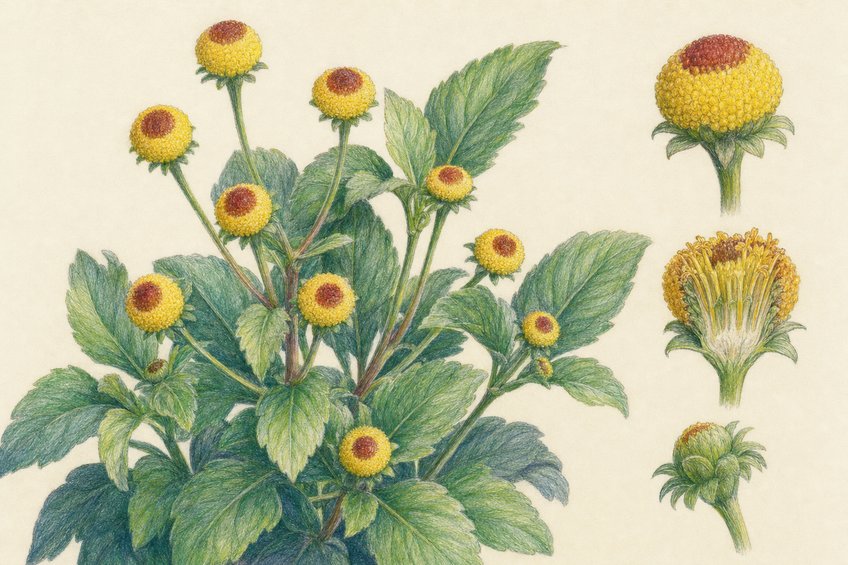
Spilanthes is a low, branching herb that usually grows 8 to 20 inches tall, with soft green stems and opposite leaves. The leaves are oval to triangular, gently toothed along the edge, and tender enough to look at home beside basil or cilantro.
The flower heads steal the show. They rise on slim stalks like tiny golden buttons, often with a reddish-brown center that gives each bloom the look of a painted bull's-eye.
Crush a leaf between your fingers and the scent is green, peppery, and faintly citrus-like. Touch a fresh flower head to the tongue and the flavor moves from grassy and sharp to buzzing, mouth-watering, and almost sparkling.
Did you know? What looks like one spiky flower is really a packed head of many tiny florets. In true daisy-family fashion, spilanthes hides a crowd inside a button.
Jambu, paracress, and a place at the table
In northern Brazil, especially in Para, spilanthes is better known as jambu. Its leaves and flower buds appear in dishes such as tacaca, a warm cassava-based broth served with tucupi, shrimp, and the unmistakable tingle of jambu.
Amazonian foodways shaped the plant's cultural life long before it became a novelty in North American herb gardens. Indigenous knowledge, Afro-Brazilian cooking, and regional market traditions all helped keep jambu rooted in daily meals rather than tucked away as a rare curiosity.
The name paracress points to its peppery bite, though it is not a true cress. In the kitchen, young leaves have been used like a sharp salad green, while the flower heads are usually handled with more respect - a little button can make a whole mouth hum.
Why the old name still follows it
Many herb growers still call the plant Spilanthes, although botanists now place this familiar garden herb in the genus Acmella. The accepted name, Acmella oleracea, was clarified in modern plant taxonomy after close study of the group.
Plant names often carry history in their pockets. Spilanthes lingers on seed packets, herb shelves, and in gardener conversations, while Acmella tells the more current botanical story.
Flower head first: the bud that hums
The flower heads are the most famous part because they contain the strongest buzz. Fresh buds are especially lively, with a tingling effect that comes on quickly and fades after a few minutes.
The leaves are milder, greener, and easier to use as a food herb. They still carry the plant's signature sharpness, especially when harvested before the plant becomes tough in hot weather.
Dried aerial parts keep some of the characteristic flavor, though the fresh plant has the brighter personality. Like many tender herbs, spilanthes speaks most clearly when it has just been cut.
What gives spilanthes its spark?
The best-known constituent in spilanthes is spilanthol, an alkamide found especially in the flower heads. Alkamides are fat-soluble plant compounds, and spilanthol is responsible for much of the plant's prickly, tingling mouthfeel.
Acmella oleracea also contains related alkamides, phenolic compounds, flavonoids, and small amounts of aromatic constituents. These are chemistry details rather than promises; they help explain the plant's flavor, scent, and sensory personality.
A 2013 review by Prachayasittikul et al. in EXCLI Journal examined how spilanthol interacts with sensory receptors that detect warmth and sharpness. Gardeners discovered the sensation the old-fashioned way: by chewing one brave little flower bud.
Where it grows and how it travels
Spilanthes favors heat, moisture, and rich soil. It behaves like a tender annual in most of the United States and Canada, though in frost-free tropical regions it can grow longer and spread more freely.
Its native range is difficult to pin down because people carried and cultivated it widely. Most botanical sources point toward tropical South America, with Brazil often central to the story, and the plant now appears in gardens and markets across warm parts of the world.
In North America, it is most often grown from seed in summer herb gardens. Give it sun, steady water, and warm nights, and it will usually answer with dozens of golden buttons by midseason.
Growing notes from the warm side of the year
Old British garden wisdom says, "Ne'er cast a clout till May be out," meaning do not rush tender plants outdoors before the season has truly warmed. Spilanthes agrees with that advice; cold soil slows it down, and frost can finish it overnight.
Farmers' almanac-style growers often sow tender annuals as the moon waxes, saving root crops for a waning moon. Whether one follows the moon or the thermometer, spilanthes wants warmth above all.
Seeds are small and appreciate light, so they are usually pressed onto the surface or barely covered. Once the plants are sturdy, gardeners pinch the growing tips to encourage branching and harvest flower heads as they open.
In hot, dry weather, the leaves may look tired by afternoon. A deep drink and a little afternoon shade can bring the plant back to its soft, leafy self.
Folklore, parlor tricks, and garden gossip
European monastery gardens were famous for sage, rue, fennel, and other herbs that monks copied into herbals and tended behind stone walls. Spilanthes was not one of those medieval European staples; it entered European and North American curiosity gardens later, after Atlantic trade brought many tropical plants into wider circulation.
That late arrival may be why it still feels like a discovery to many gardeners. A person can walk past the plant without a second glance, then taste one flower and remember it for years.
In Southern herb gardens, a friendly warning often comes with the harvest basket: "Try just one bud first." It is less a formal proverb than practical porch wisdom, offered by someone who has watched a neighbor's eyes widen after biting into a full flower head.
The plant's round yellow heads also invite playful names. Buzz buttons sounds modern, electric daisy sounds like a fairground act, and jambu carries the sound of its Brazilian table tradition.
A closing look at the little electric daisy
Spilanthes is small enough to tuck into a pot, yet it can turn a summer afternoon into a botany lesson with one golden button. Watch the bees work the flower heads, rub a leaf for its peppery scent, and notice how much surprise can fit inside a plant no taller than a kitchen stool.
References
- Royal Botanic Gardens, Kew. Plants of the World Online. "Acmella oleracea (L.) R.K.Jansen." Accessed 2026.
- Jansen, R.K. 1985. "The systematics of Acmella (Asteraceae-Heliantheae)." Systematic Botany Monographs.
- Hind, N. and Biggs, N. 2003. "Acmella oleracea." Curtis's Botanical Magazine.
- Lim, T.K. 2014. Edible Medicinal and Non-Medicinal Plants, Volume 7: Flowers. Springer.
- Prachayasittikul, S., et al. 2013. "Acmella oleracea: a review of its chemistry and biology." EXCLI Journal.
Where to Find Spilanthes
Explore our Spilanthes products in the HawaiiPharm store.