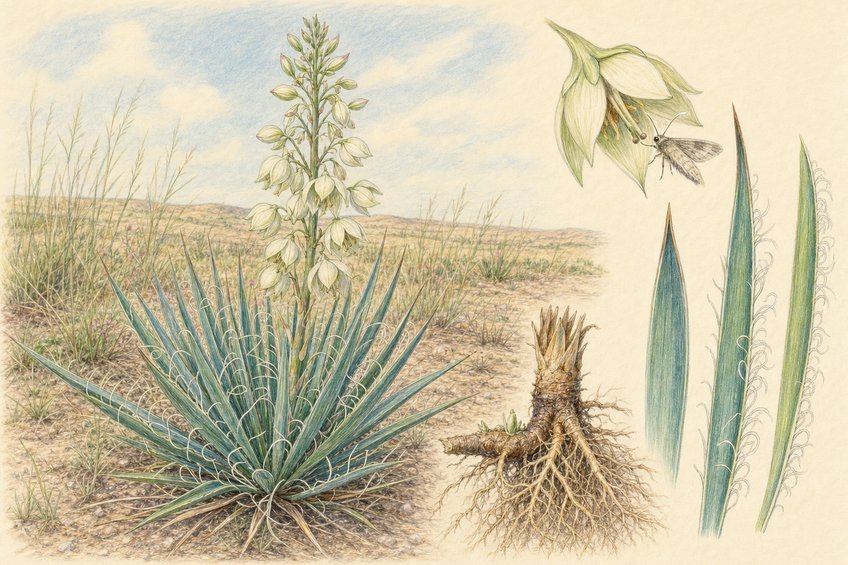
YUCCA GLAUCA: SOAPWEED YUCCA OF THE GREAT PLAINS
On the dry Great Plains, where a washbasin of water might be precious and store-bought soap scarce, people learned to look for a spiky plant with pale bells and a hidden foaming root. Yucca glauca earned its old frontier name, soapweed, because a bruised root stirred in water makes suds you can see with your own eyes.
Quick facts from the prairie
| Botanical name | Yucca glauca Nutt. |
|---|---|
| Family | Asparagaceae, formerly often placed in Agavaceae |
| Parts used | Root or rhizome, leaves, flowers, young flower stalks, and seeds in traditional contexts |
| Other names | Soapweed yucca, plains yucca, narrowleaf yucca, small soapweed, beargrass |
| Native region | Central and western North America, especially the Great Plains and Rocky Mountain foothills |
A plant of spears, curls, and creamy bells
Yucca glauca grows as a low rosette of stiff, narrow leaves that rise from a woody crown like a green-gray fountain frozen in motion. The leaves often carry fine white threads along their edges, little curling fibers that catch the sun and make the plant look as if it has been stitched by hand.
Run a careful finger along an older leaf and you meet a tough, dry surface, with a sharp point at the tip that explains why livestock and barefoot children learned to give it space. In early summer, a flower stalk lifts above the leaf rosette, carrying nodding, bell-shaped blossoms in shades of cream, greenish white, and sometimes faint purple.
At dusk the flowers can seem almost luminous against prairie grasses. Their scent is gentle and sweet, strongest in the evening air, which is when their small pollinating moths begin their work.
Where soapweed makes its home
Yucca glauca belongs to open country. It favors dry prairies, badlands, sandy hills, limestone slopes, and the edges of sagebrush steppe, often growing where summers are hot, winds are rough, and soil drains quickly.
Its native range reaches through the central and western United States and into parts of Canada, with strong ties to the Great Plains. You may find it from the Dakotas and Nebraska westward toward Wyoming, Colorado, Montana, and beyond, depending on local soil and elevation.
The plant handles drought with a deep, persistent root system and leaves built to conserve water. In a lean pasture after a dry spell, soapweed may stand green when softer plants have faded to straw.
The root that foams and the leaves that bind
The root and underground stem hold the foaming character that made soapweed famous. When the root was pounded or sliced and worked in water, saponins created a natural lather used in washing traditions.
The leaves offered a different gift. Plains peoples split and twisted the tough fibers for cordage, mats, basketry elements, sandals, and sewing material, while the needle-like leaf tip could serve as a natural awl when handled with skill.
The flowers and young stalks were also gathered as seasonal foods by some Indigenous communities, usually prepared rather than eaten straight from the plant. As with many wild foods, timing mattered: tender spring growth and fresh blossoms were different from mature, fibrous parts.
Plains knowledge, pioneer habits, and old sayings
Ethnobotanist Daniel E. Moerman recorded many Native American uses of yucca species, including accounts from Plains and Intermountain peoples such as the Lakota, Cheyenne, Blackfeet, Pawnee, and others. Roots were traditionally prepared as washing suds, leaves were worked into fiber, and flowering parts were gathered in season.
Pioneer families on the Great Plains often learned local plant uses from Indigenous neighbors and from direct need. Soapweed root entered the household routine as a practical wash plant for hair, wool, and small laundry tasks, especially where trading posts were far away.
An old piece of frontier wisdom said that a useful plant usually announces itself by where it thrives. Soapweed did just that: it grew on the dry rise, stayed put through wind, and offered fiber, flowers, and foam without asking for rich soil.
Farmers and ranchers also read yucca blooms as seasonal signs. When the tall cream candles rose above the grass in early summer, the prairie had crossed from spring greening into the hotter part of the year, when haying, grazing, and thunderheads shaped the calendar.
Did you know? A moth finishes the flower's work
Yucca glauca has one of the best-known plant-and-insect partnerships in North America. Its flowers are pollinated by tiny yucca moths, often placed in the genus Tegeticula, whose life cycle is tied to yucca blossoms.
The female moth gathers pollen into a small ball, places it on the flower's stigma, and lays eggs in the ovary. Her larvae later feed on some of the developing seeds, while enough seeds remain for the plant to reproduce.
This is why yucca seed production can be spotty outside the plant's native range. A garden may grow healthy leaves and beautiful flowers, yet set little seed if the right moth is absent.
What gives yucca its foam?
Yucca glauca roots contain steroidal saponins, natural plant compounds that form a stable foam when shaken or rubbed in water. The word saponin comes from sapo, the Latin word for soap, and the name fits this plant especially well.
Yucca species also contain sapogenins, phenolic compounds, waxes, sugars in the flowers and fruit, and strong structural fibers made largely of cellulose and lignin. Those fibers explain the toughness of the leaves; the saponins explain the suds in the root.
The same compounds that make a root foam can also taste bitter. Traditional handling treated the root mainly as a washing material, while edible uses focused more often on carefully prepared flowers, young stalks, or fruits depending on the yucca species and local custom.
Growing soapweed without pampering it
Yucca glauca prefers full sun, open air, and lean soil with sharp drainage. Sandy, gravelly, or alkaline ground suits it far better than a wet garden bed.
Once established, the plant grows slowly and steadily, often making offsets from the crown. It does not appreciate frequent moving, because its roots anchor deeply and dislike disturbance.
Gardeners who grow soapweed usually start with nursery-grown plants or seed from a responsible source. Gloves are wise around the leaf tips, and generous spacing keeps the rosette from surprising ankles along a path.
Harvest with prairie patience
Traditional harvest depended on place, need, and season. Leaves could be cut from the outside of the rosette for fiber, leaving the center to keep growing.
Root harvest required more care because digging can injure or remove the plant. In dry country, slow-growing plants hold soil in place, and a single mature crown may represent many years of survival through drought, wind, grazing, and winter cold.
Flowers, when gathered, were taken during their brief fresh stage. A stalk that looks full in the morning may be visited by moths after sunset, then shift quickly toward seed as the season warms.
A few more prairie curiosities
- Yucca glauca was described by botanist Thomas Nuttall, a keen observer of North American plants in the early 1800s.
- The species name glauca refers to its bluish or gray-green cast, the dusty color that helps the leaves reflect harsh sunlight.
- Some wildlife browse flower stalks or use the plant's structure for cover, while the sharp rosette helps protect the crown from heavy grazing.
- Soapweed can hybridize with other yucca species where their ranges meet, which is one reason yucca identification can puzzle even experienced field botanists.
Closing note
A Yucca glauca rosette at twilight is a small prairie scene in itself: gray-green blades, curled white threads, cream bells, and a moth moving quietly from flower to flower. It is easy to miss from a speeding road, but up close it carries the story of dry soil, useful fiber, patient roots, and a plant that waits for night to finish its work.
References
- Flora of North America Editorial Committee. Flora of North America North of Mexico, volume 26: Yucca glauca.
- USDA Natural Resources Conservation Service. PLANTS Database: Yucca glauca Nutt., soapweed yucca.
- Moerman, Daniel E. Native American Ethnobotany. Timber Press, 1998.
- Webber, J. M. Yuccas of the Southwest. USDA Agriculture Monograph No. 17, 1953.
- Pellmyr, Olle. Yuccas, yucca moths, and coevolution: a review. Annals of the Missouri Botanical Garden, 2003.
Explore our Yucca products in the HawaiiPharm store.