AMLA (EMBLICA OFFICINALIS): INDIAN GOOSEBERRY TREE
In northern India, people have a fond saying that amla is like a good nurse - small, dependable, and easy to overlook until you need her. Bite into a fresh fruit and you understand why it earned such attention: the skin is smooth and pale green, the flesh snaps with a watery crunch, and the first taste is fiercely sour before a curious sweetness lingers on the tongue.
{{HERO_IMAGE}}
Quick facts from the grove
| Botanical name | Emblica officinalis Gaertn.; also listed as Phyllanthus emblica L. |
|---|---|
| Family | Phyllanthaceae |
| Parts used | Fruit, seed, leaf, bark, and root in different traditional systems; the fruit is the best known part |
| Other names | Amla, amalaki, Indian gooseberry, emblic myrobalan, nelli, aonla |
| Native region | Indian subcontinent and parts of tropical and subtropical Asia |
A small tree with feathery green shadows
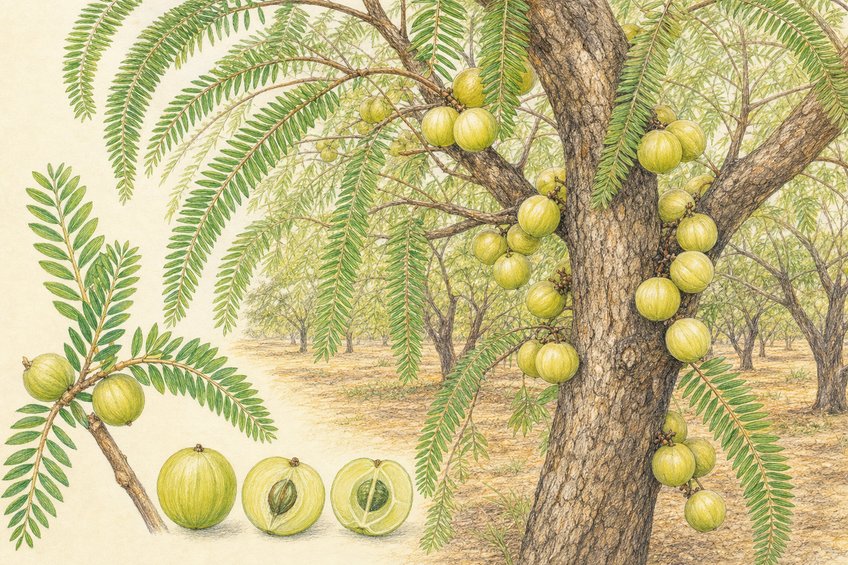
Amla is a modest deciduous tree, often 25 to 60 feet tall, with a crooked trunk and gray-brown bark that flakes in thin patches. From a distance, its branchlets look almost fern-like because the tiny, narrow leaves line up in neat rows along slender stems.
The flowers are small, greenish-yellow, and easy to miss. The fruits are the showstoppers: round, ribbed berries about the size of a large marble or small plum, with translucent yellow-green skin that seems to hold sunlight under wax.
Crush a fresh leaf and the scent is green and faintly resinous. Cut the fruit and a sharper fragrance rises - tart, mineral, and clean, like green apples rubbed with lemon peel.
The fruit people remember
The amla fruit is divided by six faint vertical lines, a handy field mark when comparing it with other small round fruits. Inside sits a hard, six-ridged stone that holds the seeds.
Fresh amla is famous for its changing taste. In Ayurvedic writing it is described as having five of the six classical tastes, with sourness speaking first and sweetness appearing after water is sipped.
Dried fruit pieces turn tan to brown and become wrinkled, firm, and intensely puckery. In many Indian kitchens, amla has appeared as pickle, preserve, candy, chutney, and dried pantry fruit.
From Sanskrit verses to British herbals
In Sanskrit, amla is often called amalaki. Another old name, dhatri, is commonly translated as nurse or sustainer, a tender clue to how highly the fruit was regarded in classical Indian household and herbal traditions.
The Charaka Samhita, one of Ayurveda's central texts, placed amalaki among valued plant materials in the rasayana category. That word belongs to a broad Indian tradition concerned with daily regimen, seasonal foods, and graceful aging, rather than a single modern meaning.
British colonial botanists later recorded the plant as Indian gooseberry, borrowing a familiar English fruit name for something botanically different. Country people in Britain had long joked that a tart expression was as sour as a gooseberry, and the phrase fits a fresh amla even better than the hedgerow fruit that inspired it.
Monastery gardens in medieval Europe often included true gooseberries for kitchen and physic-garden use. When English speakers met amla in India, that old garden vocabulary traveled with them, even though amla belongs to a different plant family.
Where amla grows best
Amla is native across much of the Indian subcontinent and is also found in Sri Lanka, Myanmar, Thailand, southern China, and parts of Southeast Asia. It grows in dry deciduous forests, open woodland, village groves, field edges, and cultivated orchards.
The tree handles heat, seasonal dryness, and a range of soils, including rocky or slightly alkaline ground. It dislikes waterlogged roots, which is why growers often plant it where monsoon rain drains away quickly.
In India, major cultivation areas include Uttar Pradesh, Gujarat, Rajasthan, Madhya Pradesh, and Tamil Nadu. Aonla orchards in the north may stand bare or thin-leaved in the dry season, then flush again after the rains.
Harvest in the cool months
Amla fruits usually mature from late autumn into winter, depending on region and variety. Pickers harvest them by hand or with careful shaking, then sort the firm fruits for fresh markets, drying, preserving, or seed saving.
Farmers' almanac style wisdom in amla-growing villages often follows the monsoon rather than a printed calendar: good flowering after the heat, clean drainage during heavy rain, and fruit that gains size as nights turn cooler. The old orchard eye watches clouds, soil cracks, and the color shift from hard green to yellow-green.
The tree is commonly propagated by budding or grafting onto seedling rootstock so growers can keep desirable fruit traits. Seedlings vary, which is charming in a forest and inconvenient in an orchard.
What chemists find inside the fruit
Amla fruit contains vitamin C, though the exact amount varies by variety, harvest time, storage, and processing. It also contains tannins, pectin, organic acids, amino acids, and minerals.
Several named tannins occur in the fruit, including emblicanin A, emblicanin B, punigluconin, and pedunculagin. Gallic acid and ellagic acid are also commonly reported in analyses of the fruit.
These constituents help explain amla's sharp taste, drying mouthfeel, and strong presence in dyes, inks, pickles, and traditional preparations. Tannins are the same broad class of plant compounds that give strong black tea its grip on the tongue.
Did you know?
- Amla fruits are ribbed in six sections, a detail easiest to see when the fruit catches side light.
- In parts of India, Amla Navami or Akshaya Navami is observed with reverence for the amla tree, especially in Vaishnava traditions connected with Vishnu.
- The fruit is one of the three ingredients in triphala, a classic Ayurvedic blend that also includes haritaki and bibhitaki.
- Although it is called Indian gooseberry in English, amla is not closely related to the gooseberries grown in British and North American gardens.
Folklore around a sour little fruit
Indian household lore treats amla with the kind of affection usually reserved for practical things: the winter shawl, the brass pot, the tree that gives fruit when other foods are scarce. Grandmothers preserved it in salt, jaggery, oil, or sun-dried slices, each kitchen leaving its own fingerprint on the fruit.
An old British garden saying warns that gooseberries can make a face before they make a pie. Amla carries that same puckering humor into South Asian kitchens, where the sourness is balanced with spice, sweetness, salt, or time.
In colonial-era plant lists, amla sometimes appeared under the name emblic myrobalan. Myrobalan was a trade word used for several tannin-rich fruits that moved through dyeing, tanning, and apothecary channels, so the name hints at old markets as much as old medicine chests.
A tree worth pausing under
An amla tree does not need large flowers to hold attention. Stand beneath one in fruiting season and the details gather slowly: ferny branchlets, mottled bark, yellow-green globes tucked close to the stems, and that unforgettable sour snap waiting inside a fruit no bigger than a plum.
References
- Kew Science. Plants of the World Online. Phyllanthus emblica L. Royal Botanic Gardens, Kew.
- USDA Agricultural Research Service. Germplasm Resources Information Network. Phyllanthus emblica L.
- Flora of China Editorial Committee. Flora of China, Vol. 11. Phyllanthus emblica L.
- Warrier, P. K., Nambiar, V. P. K., and Ramankutty, C. Indian Medicinal Plants: A Compendium of 500 Species. Orient Longman, 1994.
- Williamson, E. M. Major Herbs of Ayurveda. Churchill Livingstone, 2002.
- Gaire, B. P., and Subedi, L. Phytochemistry, pharmacology and medicinal properties of Phyllanthus emblica Linn. Chinese Journal of Integrative Medicine, 2014.