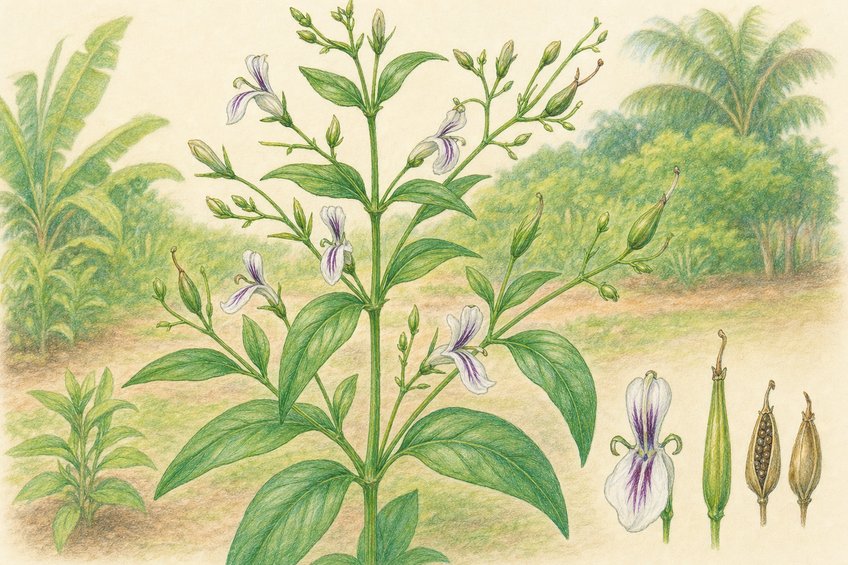
ANDROGRAPHIS - THE KING OF BITTERS IN THE HERB GARDEN
The old English phrase a bitter pill to swallow could have been invented for andrographis. Touch a fresh leaf to the tongue and the taste arrives like a green thunderclap - sharp, dry, and unmistakable - which explains its famous nickname, king of bitters.
Quick facts for a famously bitter herb
| Botanical name | Andrographis paniculata |
|---|---|
| Family | Acanthaceae, the acanthus family |
| Parts used | Aerial parts, especially leaves and flowering tops |
| Other names | King of bitters, green chiretta, creat, kalmegh, chuan xin lian, hempedu bumi |
| Native region | South Asia, with a long presence across tropical and subtropical Asia |
How to recognize green chiretta
Andrographis is a slender annual herb, usually 1 to 3 feet tall, with upright green stems that branch near the top. The leaves grow in opposite pairs, narrow and lance-shaped, with smooth edges and a clean, glossy surface.
In warm weather, the plant lifts loose sprays of small white flowers marked with purple streaks, as if someone touched each bloom with a fine brush. Later, slim seed capsules form along the airy flower stems and dry to a pale brown.
Crush a leaf between your fingers and the scent is green and faint, almost grassy. The taste is the memorable part: an immediate, mouth-coating bitterness that lingers long after the leaf is gone.
A bitter name in many languages
In India, Andrographis paniculata is widely known as kalmegh, a familiar name in Ayurvedic, Siddha, and Unani traditions. Herbal households prepared the leaves and tops as teas, powders, and decoctions, often treating the plant with the respect reserved for strong bitter herbs.
In Chinese materia medica, it appears as chuan xin lian, often translated as heart-piercing lotus, a name that nods to its penetrating taste rather than to the shape of the plant. In Malaysia and Indonesia, hempedu bumi is commonly translated as bile of the earth, another earthy compliment to its bitterness.
European monastery gardens had their own bitter allies, such as gentian, wormwood, and horehound. Andrographis did not belong to those cold cloister beds, but a medieval gardener who knew the value of bitter leaves would have understood this Asian herb at first taste.
Where the king of bitters grows
Andrographis favors heat, sun, and a season long enough to let it flower and set seed. It grows across India, Sri Lanka, Bangladesh, Myanmar, Thailand, southern China, Malaysia, Indonesia, and other warm regions where monsoon rains and bright light shape the growing year.
In its preferred places, it often appears in field margins, garden plots, open scrub, disturbed ground, and the edges of villages. It is not a showy plant from a distance; its power of recognition comes when you notice the narrow leaves, purple-marked flowers, and that unmistakable bitter bite.
The leafy tops people gather
The aerial parts are the portion most often collected: leaves, tender stems, and flowering tops. In the herbal trade, dried andrographis may be cut into small green-brown pieces, with fragments of leaf, stem, flower, and capsule mixed together.
The leaves carry much of the plant's character. Even after drying, they keep a stern bitterness that has made andrographis easy to identify in apothecaries and home herb cupboards.
What gives the plant its bite?
Andrographis contains a group of bitter compounds called diterpene lactones. The best known is andrographolide, joined by related compounds such as neoandrographolide and deoxyandrographolide.
The plant also contains flavonoids and other plant constituents that vary with growing conditions, harvest timing, and drying method. The chemistry explains why two batches may look similar yet differ slightly in aroma, color, and intensity of bitterness.
These compounds are discussed here as part of the plant's natural profile, much like the essential oils in mint or the tannins in oak leaves. Andrographolide is widely used as a marker compound in quality-control testing for andrographis raw material.
Growing it where summer lingers
Gardeners in warm climates grow andrographis as an annual herb from seed. It likes well-drained soil, steady moisture, and full sun to light shade, especially in regions where the afternoon heat can be fierce.
Seeds are small and appreciate warmth before sprouting. Farmers' almanac gardeners might say to sow leafy herbs as the moon is waxing, but the more practical rule is simpler: wait until nights are reliably warm and the soil no longer feels cool in the hand.
Harvest often happens as the plant begins to flower, when the leafy tops are well developed. The cut herb dries best in a shaded, airy place, where the leaves keep more of their green color and do not bake into a dull brown.
Folklore, sayings, and small surprises
Did you know?
Andrographis seed capsules split open when mature, releasing tiny seeds from dry, narrow pods. A plant that looks delicate in bloom can be quite efficient when it is time to scatter the next generation.
Appalachian mountain families had their own bitter traditions, often using local plants such as dandelion, yellowroot, and wild cherry bark in seasonal home preparations. Andrographis belongs to a different continent, yet it sits in the same human habit of paying attention to bitter taste.
The nickname king of bitters is more than a flourish. Among commonly handled herbs, few announce themselves so quickly, and even seasoned herbalists often remember their first taste of a fresh andrographis leaf.
A final look at a modest green plant
Andrographis does not dazzle like a hibiscus or perfume the path like jasmine. Its beauty is quieter: a lean green stem, paired leaves, small white flowers with purple markings, and a taste so bold that cultures across Asia named it with clouds, hearts, bile, and kings.
References
- Kew Science. Plants of the World Online: Andrographis paniculata (Burm.f.) Nees.
- Flora of China. Andrographis paniculata, family Acanthaceae.
- World Health Organization. WHO Monographs on Selected Medicinal Plants, Volume 2: Herba Andrographidis.
- Hanelt, P., editor. Mansfeld's Encyclopedia of Agricultural and Horticultural Crops. Springer, 2001.
- American Herbal Pharmacopoeia. Andrographis paniculata monograph and botanical standards.
Explore our Andrographis products in the HawaiiPharm store.