BLACK ELDERBERRY: FLOWERS, FOLKLORE, AND BERRIES
"The elder is the poor man's medicine chest," says an old English country saying, and few hedgerow shrubs have gathered more stories around their roots than black elderberry. In June, it lifts broad plates of creamy flowers into the air; by late summer, those same branches bow with purple-black berries that stain fingers like ink.
A quick look at black elderberry
| Botanical name | Sambucus nigra |
| Family | Adoxaceae |
| Parts used | Flowers and ripe berries; leaves, bark, and roots appeared in old herbals but are not common modern food uses |
| Other names | Black elder, European elder, elder tree, bourtree, pipe tree, elderflower |
| Native region | Europe, North Africa, and parts of western and central Asia |
The elder in flower and fruit
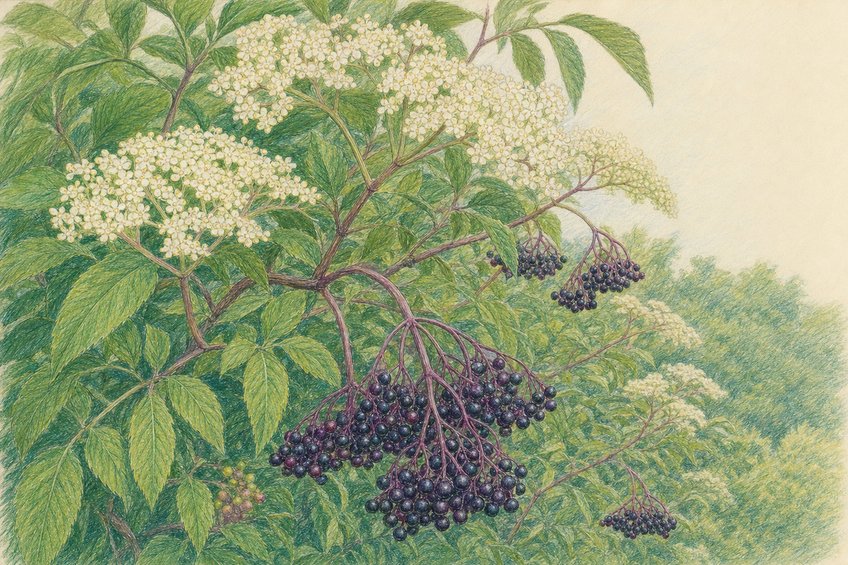
Black elderberry is usually a many-stemmed shrub or small tree, often 10 to 20 feet tall, with arching branches and soft, corky pith inside the stems. Its leaves grow opposite each other and are divided into pointed leaflets with toothed edges, giving the plant a ferny, open look from a distance.
The flowers arrive in flat, saucer-like clusters called cymes. Stand near one on a warm morning and the scent is unmistakable: honey, fresh hay, and a faint musky note that clings to your fingertips after touching the tiny cream-colored blossoms.
By late summer, the flower heads have turned into drooping clusters of small, glossy berries. They ripen to a deep purple-black, and the juice leaves a red-violet stain on baskets, hands, and the beaks of birds that get there first.
The bark is gray-brown and slightly ridged on older stems. Young twigs show pale lenticels, those little raised breathing pores that look like freckles scattered along the branch.
Where the hedgerow elder makes its home
Sambucus nigra is native across much of Europe, with a natural range reaching into North Africa and western Asia. It favors hedgerows, field margins, stream banks, woodland edges, old farm lanes, and disturbed ground where birds have dropped the seeds.
In Britain and Ireland, elder often appears near barns, cottage walls, and old stone boundaries. That habit helped create one of its folk reputations: a plant that seemed to choose human company, springing up where kitchens, compost heaps, and livestock yards enriched the soil.
European settlers in North America recognized familiar elder-like shrubs in the countryside, especially the closely related American elder, Sambucus canadensis. Today, black elderberry is cultivated in gardens and orchards in temperate regions, while its wild relatives continue to feed birds along fencerows and wet meadows.
Flowers first, berries later
The two best-known parts of black elderberry are its flowers and ripe berries, and they belong to different moments of the year. Elderflowers are gathered when the tiny blossoms have opened but before they brown; the best heads look creamy and fresh, with pollen still dusting the petals.
Ripe berries are collected when the whole cluster has darkened. Traditionally, the berries were cooked into syrups, wines, preserves, and country sauces; unripe berries and green plant parts were avoided in food preparations.
The leaves, stems, bark, roots, and unripe fruits contain naturally occurring cyanogenic glycosides, including sambunigrin. That is one reason old household instructions often called for careful sorting, removal of stems, and cooking of ripe berries.
Old stories from cottage doorways
Few European shrubs have a richer reputation in folklore. In parts of England and Scotland, country people once asked permission before cutting elder wood, believing an Elder Mother or tree spirit lived within it. One old rhyme warned, "Elder be the Lady's tree, burn it not or cursed ye'll be."
Another bit of British garden wisdom tied elder to the turning of the seasons: when elder flowers opened, summer had truly arrived; when the berries blackened, autumn was waiting at the gate. Farmers and hedgerow walkers watched it as closely as a calendar.
In the European monastery garden tradition, elder stood among the practical plants kept near infirmaries, kitchens, and brewing rooms. Medieval and Renaissance herbals, including John Gerard's 1597 "Herball," described elder in detail, reflecting how familiar the shrub was to household herbal practice in England.
Colonial families brought elderflower and elderberry lore across the Atlantic. In early American kitchens, related elder species were turned into wines, pies, and preserves, while dried blossoms often sat in the same pantry world as mint, yarrow, and chamomile.
Many Native communities also knew elder through North American species rather than Sambucus nigra. The Cherokee and Haudenosaunee, among others, used elder stems for practical items such as blowguns, flutes, and taps, taking advantage of the soft pith that could be pushed out to leave a hollow tube.
Did you know?
- The name Sambucus is often linked to the sambuke, an ancient stringed instrument said to have been made from elder wood.
- Elder stems contain a soft white pith, which children in parts of Europe once pushed out to make whistles and pop-guns.
- Birds spread elder readily; a single hedgerow shrub can owe its place to a blackbird or thrush that paused on a fence post.
What gives elder its color and scent?
The dark color of ripe elderberries comes largely from anthocyanins, especially cyanidin-based pigments such as cyanidin-3-glucoside and cyanidin-3-sambubioside. These are the same broad family of plant pigments that gives many berries their red, blue, and purple shades.
Elderflowers contain flavonols such as rutin, quercetin derivatives, and kaempferol derivatives, along with phenolic acids including chlorogenic acid. Their fragrance comes from a mix of volatile aroma compounds, which is why fresh elderflower can smell sunny and delicate one moment, then slightly earthy the next.
The plant also contains tannins, organic acids, sugars, and small amounts of essential oil components. In plain kitchen terms, this chemistry helps explain the tart berry flavor, the floral aroma, and the mouth-drying edge found in strongly prepared elderberry foods.
Growing elder in the garden
Black elderberry grows best in full sun to partial shade and likes soil with steady moisture. It is especially happy in fertile ground near ditches, ponds, and low areas, though it dislikes sitting in stagnant water for long periods.
Gardeners often prune older stems to encourage fresh growth, because younger wood tends to flower well. The shrub can be vigorous, and birds help it wander, so a gardener who plants one elder may later find seedlings along a fence line.
Harvest lore is full of seasonal timing. Old almanac-style wisdom placed elderflower gathering near midsummer, often around St. John's Day in late June in parts of Europe, while berry gathering belonged to the shortening days of August and September.
Flower heads are usually clipped on a dry morning after dew has lifted. Berry clusters are cut when fully ripe, then sorted carefully to remove stems, green berries, and leaves before traditional cooking methods are used.
A shrub worth slowing down for
Black elderberry rewards patient eyes: first the pale froth of flowers over a lane, then the green beadwork of forming fruit, then heavy purple clusters that bring birds in waves. The next time an elder leans over a hedgerow, notice the scent of the blossoms, the hollow twigs, and the way a whole season seems to hang from one arching branch.
References
- Plants of the World Online, Royal Botanic Gardens, Kew: Sambucus nigra L.
- European Medicines Agency. Assessment report on Sambucus nigra L., flos. Committee on Herbal Medicinal Products, 2018.
- Gerard, John. The Herball or Generall Historie of Plantes. London, 1597.
- Grieve, Maud. A Modern Herbal. London: Jonathan Cape, 1931.
- Charlebois, Denis. Elderberry as a medicinal plant. Issues in New Crops and New Uses, ASHS Press, 2007.
- Moerman, Daniel E. Native American Ethnobotany. Timber Press, 1998.
Explore our Black Elderberry products in the HawaiiPharm store.