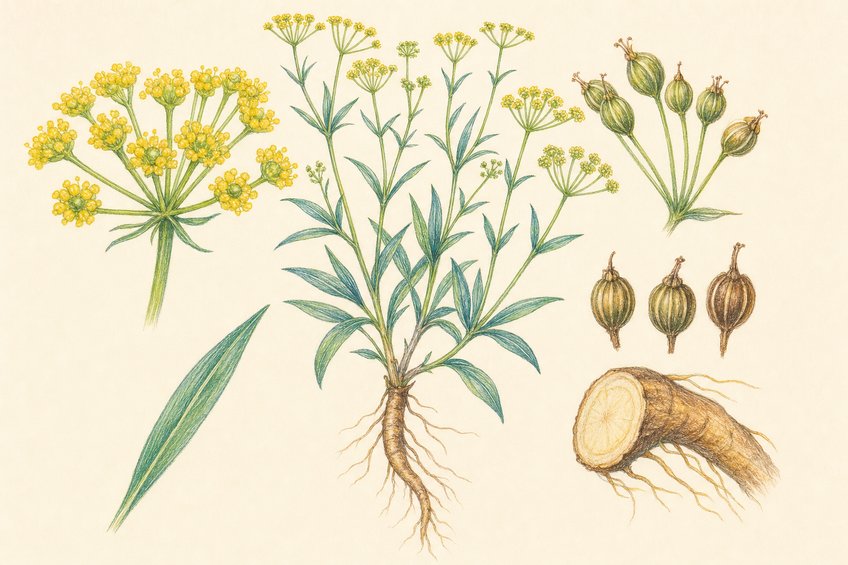
BUPLEURUM CHINENSE: CHAI HU ROOT AND YELLOW UMBELS
In old Chinese herb markets, a bundle of chai hu could look almost too humble to notice - thin roots, wiry stems, and a faint scent like dry straw, celery leaf, and clean earth. Yet this modest member of the carrot family earned a place in one of China's early materia medica texts, proof that quiet plants often travel with long stories.
Quick facts from the herbarium shelf
| Botanical name | Bupleurum chinense DC. |
|---|---|
| Family | Apiaceae, also called Umbelliferae |
| Parts used | Root, known in Chinese materia medica as Bupleuri Radix or chai hu |
| Other names | Chai hu, Chinese thorowax, hare's ear root |
| Native region | Northern and northeastern China, with related range records in nearby parts of East Asia |
A plant with umbrella-shaped flowers
Bupleurum chinense is a perennial herb with a slim, upright habit, often reaching about knee to waist height in the field. Its stems branch lightly, carrying narrow leaves that can look almost grasslike at first glance.
The flowers appear in small yellow umbels - little umbrella-shaped clusters that give the Apiaceae family its older name, Umbelliferae. In late summer, the plant has an airy look, with yellow points hovering above blue-green foliage like sparks over a dry meadow.
The leaves are smooth, simple, and lance-shaped, without the lacy cuts seen in parsley or carrot. Crush a fresh leaf and the scent is gentle rather than showy: green, slightly resinous, and faintly reminiscent of wild celery.
The root called chai hu
The root is the part most closely tied to Bupleurum chinense. It is slender, tapering, pale brown to tan on the outside, and lighter within when sliced.
Dried pieces can smell warm and grassy, with a bitter edge that herbalists often recognize before they know the plant by sight. In trade, roots are usually cleaned, cut lengthwise or crosswise, and dried until firm enough to snap.
Old root diggers in Appalachian country had a practical saying: "Dig roots when the top dies down." That bit of seasonal wisdom fits many perennial herbs, including bupleurum, because autumn growth often signals that the plant has sent stored materials below ground.
Where the wiry yellow umbels grow
Bupleurum chinense is native to China, especially northern provinces where open slopes, dry grasslands, field margins, and scrubby hillsides give it room to stand in full sun. It favors well-drained soils and does not appreciate sitting in soggy ground.
Today it is cultivated in parts of China for the dried root, and it appears in botanical collections far from its home range. Gardeners who know the carrot family will recognize its preference for sun, air movement, and soil that drains after rain.
Like many Apiaceae plants, it asks for careful identification. The family contains familiar kitchen herbs such as dill, fennel, and parsley, along with wild species that should never be guessed at by looks alone.
From Chinese classics to English field names
Chai hu appears in early Chinese herbal literature, including the tradition associated with the Shennong Bencao Jing, an important materia medica compiled from older knowledge. In Chinese herbal theory, it was described in relation to movement, harmony, and the Shaoyang pattern - language rooted in a medical system with its own map of the body.
The name chai hu is often translated loosely as "kindling hu" or left untranslated because the old wording is debated. Either way, the first character, chai, brings to mind brushwood and dry sticks, an image that suits the wiry dried stems and roots seen in herb markets.
Across Europe, other Bupleurum species gathered their own country names. In John Gerard's 1597 herbal, the European plant Bupleurum rotundifolium was described under names such as "thorow-wax," a reference to leaves that look as if the stem passes right through them.
Monastery gardens in medieval Europe often kept aromatic members of the carrot family - fennel, anise, angelica, and lovage among them. Bupleurum chinense was not a standard abbey garden plant, but it belongs to the same broad botanical clan that monks learned to watch closely for scent, seed, root, and form.
What is inside the root?
The root of Bupleurum chinense contains triterpenoid saponins known as saikosaponins, including saikosaponin a and saikosaponin d. Saponins are plant compounds named for their soaplike behavior in water, where some can form a light foam.
The root also contains polysaccharides, flavonoids, sterols, lignans, and small amounts of volatile constituents. These are chemical fingerprints, rather than promises; they help botanists and quality specialists distinguish the plant and understand how roots from different regions may vary.
Plant chemistry shifts with soil, weather, harvest age, drying method, and storage. A root dug from a dry hillside and one grown in rich cultivated soil may share a name while carrying slightly different aromatic and chemical notes.
Growing, harvesting, and drying
Bupleurum chinense can be grown from seed, though it may germinate slowly and unevenly. Fresh seed and a period of cool, moist conditions often improve results, a trick that echoes farmers' almanac advice to let winter do some of the work.
Plants prefer open sun and soil with good drainage. Once established, they send up branching stems and yellow umbels that attract small insects, especially the tiny flies and wasps that visit many umbrella-family flowers.
Cultivated roots are commonly harvested in autumn after one or more growing seasons, then washed and dried with care. The dried root should keep its firm texture and mild aromatic character rather than becoming musty or limp.
Did you know?
- The word "umbel" comes from Latin for a little shade or umbrella, a perfect description of bupleurum's flower clusters.
- In British country naming, "thorow-wax" referred to a European Bupleurum with clasping leaves that seemed pierced by the stem.
- Old almanac-style root lore often favored autumn digging, when perennial plants pull reserves below the soil line.
- Bupleurum chinense looks less feathery than many carrot-family herbs; its narrow, entire leaves are one of its quiet clues.
A last look at chai hu
Bupleurum chinense rewards close attention: a pale root with a bitter-earth scent, a wiry stem, a spray of small yellow umbrellas, and a name that has crossed mountains, markets, and herbals. On a dry hillside in late summer, it might be easy to walk past - until the sun catches those tiny yellow flower clusters above the grass.
References
- Flora of China Editorial Committee. Flora of China, Volume 14: Apiaceae through Ericaceae. Science Press and Missouri Botanical Garden Press.
- Royal Botanic Gardens, Kew. Plants of the World Online: Bupleurum chinense DC.
- Chinese Pharmacopoeia Commission. Pharmacopoeia of the People's Republic of China, 2020 edition: Bupleuri Radix.
- Bensky, D., Clavey, S., Stoger, E., and Gamble, A. Chinese Herbal Medicine: Materia Medica, 3rd edition. Eastland Press, 2004.
- Gerard, John. The Herball or Generall Historie of Plantes. London, 1597.
Where to Find Bupleurum
Explore our Bupleurum products in the HawaiiPharm store.