CHAMOMILE PLANT PROFILE: MATRICARIA CHAMOMILLA HERB
The old Greek name for chamomile means "ground apple," and anyone who has crushed a fresh flower head between finger and thumb understands why: a warm, sweet scent rises like apple peel in the sun.
A small daisy with an apple heart
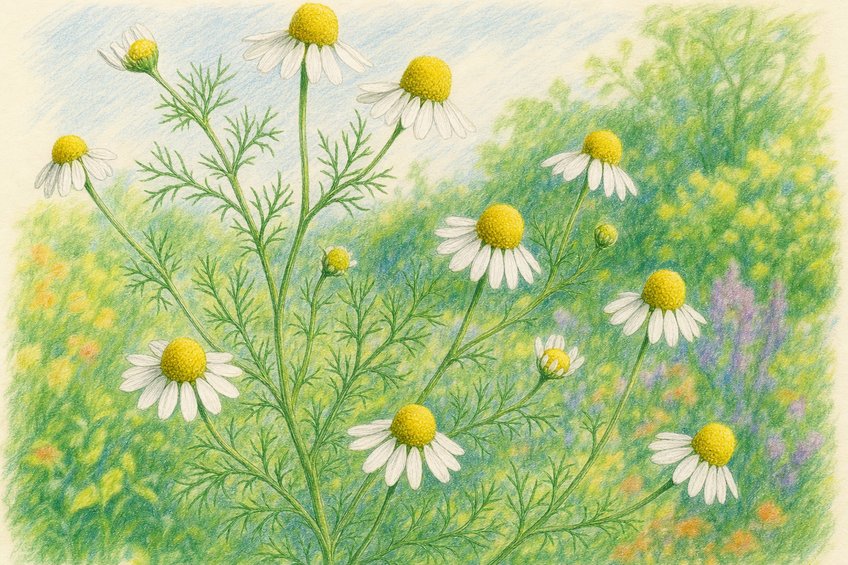
Chamomile, Matricaria chamomilla, is a modest annual with a farm-lane kind of beauty. Its white ray flowers bend back as the yellow center swells into a tiny cone, while the leaves look as fine as green lace.
The plant often stands 8 to 24 inches tall, with branching stems that carry many flower heads. If you slice a mature yellow center lengthwise, you find one of its best field marks: the cone is hollow inside.
That hollow golden button helps distinguish German chamomile from Roman chamomile, Chamaemelum nobile, which grows lower to the ground and has a solid flower receptacle. Both smell sweet, but German chamomile has the airy, upright habit of a summer annual.
Quick facts
| Botanical name | Matricaria chamomilla L.; often listed as Matricaria recutita |
|---|---|
| Family | Asteraceae, the daisy family |
| Parts used | Flower heads, fresh or dried |
| Other names | German chamomile, wild chamomile, scented mayweed, Hungarian chamomile, blue chamomile |
| Native region | Europe and western Asia; now cultivated and naturalized in many temperate regions |
Where chamomile feels at home
Matricaria chamomilla favors open, sunny ground with well-drained soil. In its native range across Europe and western Asia, it found room along field edges, paths, fallow places, and disturbed soil where taller plants had not yet taken over.
Today it grows in herb gardens from Nova Scotia to California and is cultivated on a large scale in parts of Eastern Europe, Egypt, Argentina, and India. In North America, escaped plants sometimes appear along roadsides and waste places, especially where soil has been turned.
Picture a June patch after rain: thin stems swaying, ferny leaves beaded with water, and dozens of white-petaled disks opening to the bees. The scent is soft until touched, then the whole plant seems to remember an orchard.
The flower head people gather
The part most often collected is the flower head, a daisy-like cluster made of many tiny florets. The white outer rays are sterile-looking petals to the casual eye, while the yellow center holds the packed disk florets that give the plant its cone shape.
Harvesters usually gather the flowers when the white rays are newly open or beginning to turn downward. At that stage the yellow centers are well developed, the aroma is bright, and the heads dry with their color and scent intact.
Once dried, good chamomile keeps a pale straw color with yellow centers and a clean apple-hay fragrance. Old or poorly dried material turns dull brown and loses the sweet top note that makes the plant so easy to recognize.
From monastery beds to pioneer cupboards
Chamomile traveled through European herb gardens with monks, midwives, and household gardeners. Medieval monastery gardens often included aromatic plants near paths, where brushing a hem against the leaves released their scent.
John Gerard wrote in his 1597 herbal that chamomile had a pleasant smell like apples, a detail that still reads like a field note. Nicholas Culpeper later placed it in the busy world of English household herbs, where plants were sorted by scent, season, and everyday use.
British country folk repeated a saying that Shakespeare used in Henry IV, Part 1: Though the camomile, the more it is trodden on, the faster it grows. The line likely refers to the old custom of planting chamomile in lawns or seats, where low-growing forms released fragrance underfoot.
Colonial American households brought familiar European herbs across the Atlantic in seeds, bundles, and memory. Dried chamomile flowers sat in pantry jars beside mint, sage, and elderflowers, ready for the evening kettle or the linen chest.
Farmers' almanac wisdom often placed small annual flowers under the care of the waxing moon, when old-time gardeners believed above-ground growth was favored. Chamomile seed is so fine that many gardeners still press it onto the soil surface rather than burying it, because light helps it germinate.
What gives chamomile its scent and color?
Chamomile flower heads contain essential oil, flavonoids, and other plant compounds. Key aromatic constituents include alpha-bisabolol, bisabolol oxides, and matricin.
One of chamomile's surprises appears during steam distillation. Matricin can transform into chamazulene, a deep blue compound that gives some chamomile essential oil its striking blue color, even though the fresh flowers themselves are white and yellow.
The flowers also contain flavonoids such as apigenin, luteolin, and quercetin, along with coumarins including herniarin and umbelliferone. These names sound like chemistry cabinet labels, but they are simply part of the plant's natural makeup.
Did you know?
The blue of distilled chamomile oil is not hiding as blue pigment in the petals. It forms during the distillation process, which is why a basket of fresh chamomile looks like daisies, while the oil may look like a drop of twilight.
Growing and gathering in the home garden
Chamomile grows readily from seed in cool spring weather. The seeds are tiny, almost dust-like, and they do best when sprinkled on prepared soil, pressed gently, and kept evenly moist until seedlings appear.
The plant prefers full sun, moderate fertility, and soil that drains well. Too much rich feeding can produce lush greenery with fewer flowers, while leaner garden soil often encourages the plant to bloom freely.
Flower picking is a slow, fragrant chore. Gardeners pinch or comb off the heads on a dry morning after dew has lifted, then spread them in a thin layer in shade with moving air.
As the flowers dry, they shrink and lighten, leaving behind a soft scent of apples, hay, and honeyed straw. Stored away from heat and light, they keep their character best when handled gently and kept whole.
Folklore tucked among the petals
In English garden lore, chamomile carried a reputation as a cheerful survivor because it tolerated clipping and foot traffic better than many delicate herbs. That is the root of the old trodden chamomile saying, a bit of plant observation turned into human advice.
Irish and British cottage gardeners sometimes planted aromatic herbs near doorways, where passing skirts and boots stirred their scent. Chamomile's apple fragrance made it a favorite for paths, turf seats, and small garden plots close to the house.
In parts of Appalachia, European herbs from settler gardens mixed with local plant knowledge. Chamomile became one of the familiar cupboard flowers, mild in flavor and easy to dry beside peppermint or catnip on a clean cloth near the stove.
A final look at the little apple-scented daisy
A chamomile plant is easy to overlook until the fingers find it: feathery leaves, white rays tipped back like tiny skirts, and a hollow yellow cone that opens to the scent of warm apple peel - then you understand exactly why the Greeks named it for an orchard.
References
- Royal Botanic Gardens, Kew. Plants of the World Online: Matricaria chamomilla L.
- Flora of North America Editorial Committee. Flora of North America: Matricaria recutita L.
- Gerard, John. The Herball or Generall Historie of Plantes. 1597.
- Grieve, Maud. A Modern Herbal. 1931.
- Wichtl, Max, editor. Herbal Drugs and Phytopharmaceuticals: A Handbook for Practice on a Scientific Basis.
Explore our Chamomile products in the HawaiiPharm store.