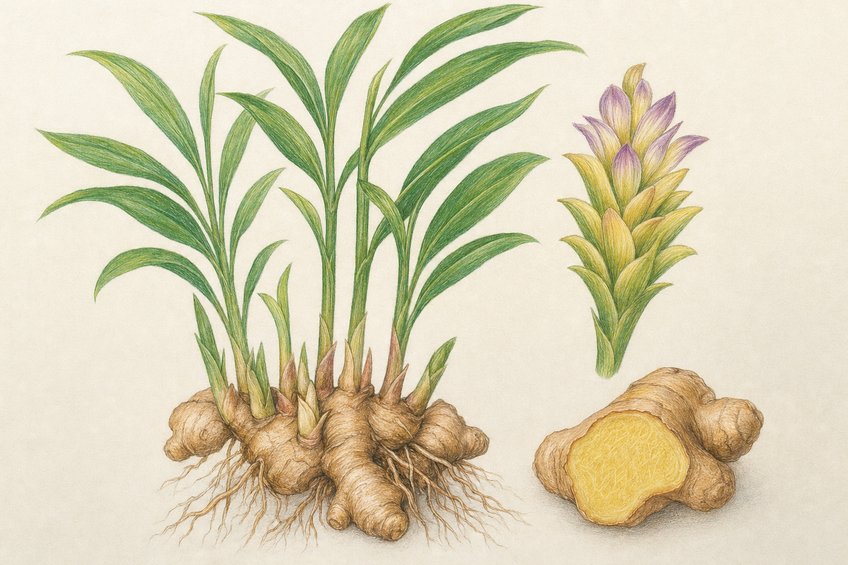
GINGER (ZINGIBER OFFICINALE): ROOT, SPICE, AND LORE.
To have plenty of ginger once meant to have spark, courage, and a little fire in the step. That old English turn of phrase fits the plant perfectly: crack open a fresh ginger rhizome and the air fills with lemony heat, peppery sweetness, and a clean green bite that seems to wake up the whole kitchen.
A quick look at ginger
| Botanical name | Zingiber officinale |
| Family | Zingiberaceae |
| Parts used | Rhizome, fresh or dried |
| Other names | Common ginger, garden ginger, jiang, adrak, sheng jiang |
| Native region | Probably Maritime Southeast Asia; known mainly as an old cultivated plant |
The underground stem with a golden bite
Ginger is often called a root, but the knobby piece used in kitchens and herbal traditions is a rhizome - a thick, horizontal underground stem. It branches like a pale tan hand, with rings, buds, and small fibrous roots trailing from its joints.
Slice it open and the inside glows cream to golden yellow, depending on the variety and age. The texture is crisp when young, fibrous when mature, and richly aromatic the moment a knife breaks the skin.
Above ground, ginger grows as a graceful tropical herb, usually 2 to 4 feet tall. Its narrow leaves clasp reedlike stems, and the plant may send up separate cone-shaped flower spikes with green, yellow, or purple-tinged bracts close to the soil.
Where ginger learned to travel
Botanists place ginger's probable home in Maritime Southeast Asia, though the truly wild ancestor is hard to pin down. People carried it so widely and so early that ginger now reads like a map of ocean trade, monsoon winds, caravan routes, and kitchen gardens.
It was cultivated in South and Southeast Asia long before written trade records began. From there it moved into China, India, the Middle East, East Africa, and the Mediterranean world, often as a dried spice tough enough to survive long journeys.
Today ginger grows in warm, humid regions around the world, including India, China, Indonesia, Nigeria, and parts of the Caribbean. In North America it can be grown outdoors in frost-free areas, while northern gardeners often raise it in pots and bring it inside when nights turn cold.
From spice routes to gingerbread
Ginger appears in early Chinese and Indian writing, and it was familiar to Greek and Roman authors through trade. The name Zingiber traces a long linguistic road, moving from Sanskrit forms such as srngavera into Greek zingiberis and Latin zingiber.
Confucius, writing in the world of the Chinese classics, was said to keep ginger at his meals, though he ate it in moderation. In that small detail, ginger looks less like an exotic rarity and more like a daily table companion.
European monastery apothecaries could not grow tropical ginger in their northern cloisters, but they kept dried ginger in jars beside cinnamon, pepper, and galangal. Medieval cooks folded it into sauces, spiced wine, and honeyed cakes, while monastery herbal writers recorded it among the warming spices of the pantry.
Colonial American households knew ginger well. Housewives kept powdered ginger for cakes, puddings, and preserves, and sailors and settlers prized it because the dried rhizome traveled better than many fresh plants.
Folklore in the pantry
British country speech gave us the phrase to ginger something up, meaning to add life or spirit. A spirited horse, a lively child, or a bold bit of speech could all be called full of ginger.
In Southern and Appalachian kitchens, gingerbread was a cold-weather food with a reputation for putting warmth back into the day. Molasses, ginger, and woodstove heat made a dark cake that smelled of winter gatherings, church suppers, and work-worn hands wrapped around a tin cup.
Farmers' almanac style garden wisdom often places tender tropical plants under the rule of heat, patience, and a long season. Ginger fits that old advice neatly: plant when soil has warmed, keep the bed damp but not soggy, and wait until the leaves yellow before lifting the mature rhizomes.
Did you know?
In medieval England, ginger could be costly enough to appear in records beside luxury goods. One often repeated historical note says a pound of ginger in the 14th century might cost about as much as a sheep, a reminder that a common spice jar once held a traveler from very far away.
The part people use
The rhizome is the treasured part of Zingiber officinale. Fresh young ginger has thin skin, juicy flesh, and a gentler snap, while older rhizomes develop tougher skin, more fiber, and a deeper heat.
Fresh ginger may be sliced, grated, candied, pickled, or dried. Drying changes its chemistry and aroma, turning some of the fresh rhizome's sharp compounds into warmer, more concentrated notes.
What gives ginger its scent and spark?
Ginger's character comes from a family of natural compounds in the rhizome. Fresh ginger contains gingerols, especially 6-gingerol, which give much of the fresh bite.
When ginger is dried or heated, some gingerols can change into shogaols, compounds with a sharper, drier heat. Cooking also brings out zingerone, a sweeter aromatic compound associated with the mellow scent of baked gingerbread.
The essential oil fraction contains sesquiterpenes such as zingiberene, along with beta-bisabolene, ar-curcumene, and smaller aromatic molecules. These are chemistry names, but the nose knows them as citrus peel, warm wood, pepper, and spice.
How ginger grows and how it is gathered
Ginger likes rich, loose soil, filtered sun, steady moisture, and warm air. Growers plant pieces of rhizome with living buds, sometimes called eyes, much as gardeners plant seed potatoes.
The plant rarely sets seed in cultivation, so division of the rhizome keeps the crop going. Shoots rise from the buds, leaves gather sunlight, and the underground stem thickens through the warm months.
Young ginger may be harvested after about 4 to 5 months, when the skin is thin and the flesh is tender. Mature ginger is often lifted after 8 to 10 months, when the leaves begin to yellow and the rhizome has stored more starch, fiber, and aromatic strength.
After harvest, rhizomes are washed, trimmed, and used fresh or cured for storage. Dried ginger may be sliced, whole, or ground, each form carrying a slightly different scent from the same branching stem.
A plant worth noticing
Ginger asks us to look below the leaf canopy, down where a quiet stem thickens in the dark and gathers a whole weather system of fragrance. The next time fresh ginger is cut on a board, notice the wet shine of the yellow flesh, the ringed skin, and the quick burst of citrusy heat rising from a plant that learned to travel by ship, garden, market, and memory.
References
- Kew Science, Plants of the World Online: Zingiber officinale Roscoe.
- Ravindran, P. N. and Babu, K. N., editors. Ginger: The Genus Zingiber. CRC Press, 2005.
- Grieve, M. A Modern Herbal. Jonathan Cape, 1931.
- Rosengarten, F. The Book of Spices. Pyramid Books, 1969.
- USDA Agricultural Research Service, Germplasm Resources Information Network: Zingiber officinale.
Where to Find Ginger
Explore our products in the HawaiiPharm store.