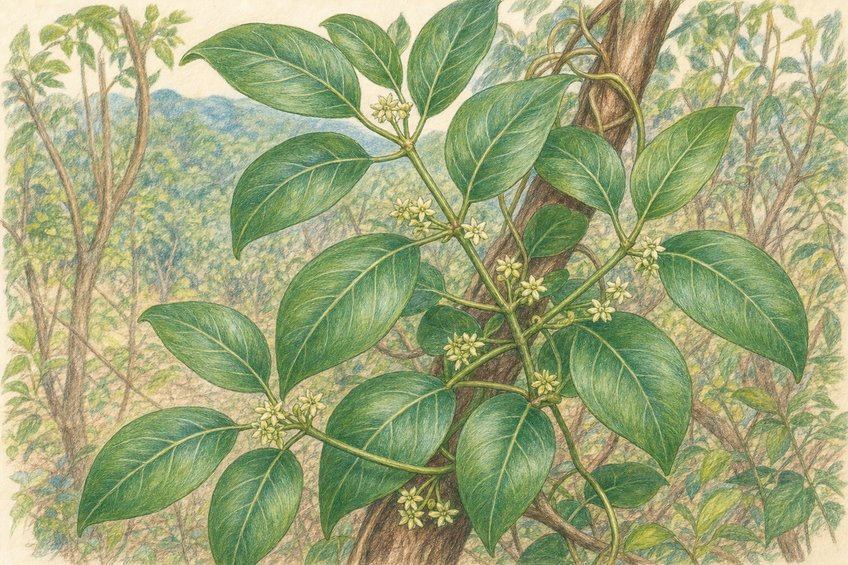
GYMNEMA SYLVESTRE: GURMAR VINE OF INDIA'S GREEN FORESTS
English speakers joke about having a "sweet tooth," but in the forests of India there grows a vine that can make sweetness seem to vanish from the tongue for a short while. Chew a fresh Gymnema sylvestre leaf, then taste a pinch of sugar, and the sugar may seem oddly flat - a bit like sand without its sparkle.
A quick look at gymnema
| Botanical name | Gymnema sylvestre |
| Family | Apocynaceae, the dogbane family |
| Parts used | Leaves, and sometimes young stems in traditional preparations |
| Other names | Gurmar, gudmar, madhunashini, Australian cowplant, periploca of the woods |
| Native region | India, Sri Lanka, and parts of tropical Asia |
The leaf that changes dessert
Gymnema sylvestre is a woody climbing vine with paired, oval leaves that taper to a neat point. The leaves are matte green, slightly leathery, and softly hairy when young, with pale veins that show best when held up to the light.
Its flowers are modest rather than showy - small, yellowish-green to pale cream, and clustered at the leaf joints. Up close they have the tidy, starry look common to many members of the dogbane family.
Crush a leaf between your fingers and the scent is green, faintly bitter, and a little haylike. The taste is stronger than the smell: leafy bitterness first, then the famous dulling of sweet flavor that gave the plant its Hindi name, gurmar, often translated as "sugar destroyer."
Where this forest climber makes its home
In the wild, gymnema scrambles through dry and moist deciduous forests, thickets, and hedges across India and Sri Lanka. It also grows in parts of Southeast Asia and has been introduced or cultivated in other warm regions.
The vine likes heat, bright filtered light, and soil that drains well after heavy rain. In its native range, it often twines through shrubs and small trees, using them as living ladders while keeping its own flowers half-hidden in the foliage.
By farmers' almanac logic, gymnema is a plant of season and timing rather than hurry. Growers watch the rains, the flush of new leaves, and the clearing of morning dew before cutting leafy stems for drying.
Ayurvedic names and colonial notebooks
In Ayurveda, gymnema was known by names such as meshashringi and madhunashini, both tied to the plant's bitter character and its curious relationship with sweetness. Practitioners traditionally prepared the leaves as part of bitter herbal formulas, and the plant kept a steady place in regional household knowledge.
European botanists encountered gymnema through Indian plant traditions and herb markets. The species was first published as Periploca sylvestris by the Swedish botanist Anders Jahan Retzius in 1781, then later placed in Gymnema as botanical classification changed.
Colonial American housewives filled their pantries with local bitters such as dandelion root and boneset, while British families living in India learned a different bitter leaf by the name gurmar. The old English proverb "enough is as good as a feast" fits gymnema's story rather well, because this vine became famous through the simple act of tasting.
The part people gathered: the leaf
The leaf is the main part used. Mature leaves are clipped from healthy vines, usually along with tender stem tips, then spread in thin layers so air can move through them.
Good dried gymnema leaves keep a muted olive-green color and a clean, bitter aroma. If the leaves turn black, smell musty, or crumble into dust at the lightest touch, they have likely been dried too slowly or stored in damp air.
In village practice, harvesting often followed the rhythm of the plant itself. Leaves were commonly gathered when the vine was full and leafy, before energy moved heavily into flowering and seed formation.
What gives gymnema its unusual taste trick?
Gymnema leaves contain a group of triterpene saponins called gymnemic acids. These compounds are best known for their remarkable interaction with sweet-taste perception on the tongue.
The plant also contains gurmarin, a small peptide studied for its effect on sweet-taste signaling in some animal models, along with flavonoids, tannins, and plant sterols. These constituents help explain why gymnema has attracted attention from chemists as well as herbal historians.
Did you know? The taste-changing effect is temporary. After a fresh leaf is chewed, sweet foods may seem strangely blank for a while, yet salty, sour, and bitter flavors remain much easier to recognize.
Growing gymnema in warm gardens
Gymnema grows best where winters are mild or absent. In North America, it is most at home in a greenhouse, sunroom, or frost-free garden with steady warmth.
The vine appreciates a trellis, bright light with some afternoon protection, and soil that stays evenly moist without becoming soggy. Gardeners in cooler regions usually treat it like a tropical container plant and move it indoors before nights turn cold.
Propagation is done by seed or semi-woody cuttings, though seeds can be slow and uneven to sprout. Once established, the vine rewards patience with a tangle of leafy stems and shy flower clusters tucked near the nodes.
Folklore, sayings, and small surprises
Appalachian-style kitchen wisdom has a saying: "Bitter to the tongue is sweet to the stomach." Gymnema belongs to that old herbal category of plants people respected because they tasted strong, green, and unmistakable.
In English garden lore, a plant that made you pause was often considered a plant worth remembering. Gymnema certainly does that; its leaf can turn a spoonful of sugar into something with texture but little sweetness.
The genus name Gymnema comes from Greek roots often interpreted as "naked thread," a reference to floral structures seen by botanists with a careful eye. The species name sylvestre means "of the woods," which suits a vine that prefers forest edges and shrubby cover.
Another surprise hides in the family tree. Gymnema belongs to Apocynaceae, the same broad family that includes milkweeds, oleander, and frangipani, though gymnema's small greenish flowers are far quieter than its showier relatives.
A closing note from the vine
Somewhere in a hot forest hedge, a plain green leaf can change the way a sweet fruit tastes, then fade back into the climbing tangle as if nothing unusual happened. Look for the paired leaves, the shy cream-green flowers, and the vine's habit of borrowing nearby shrubs for height.
References
- Kew Science, Plants of the World Online. Gymnema sylvestre (Retz.) R.Br. ex Schult.
- Khare, C. P. Indian Medicinal Plants: An Illustrated Dictionary. Springer, 2007.
- Yoshikawa, K., et al. Antisweet natural products. Structures of gymnemic acids. Chemical and Pharmaceutical Bulletin, 1989.
- Warrier, P. K., Nambiar, V. P. K., and Ramankutty, C. Indian Medicinal Plants: A Compendium of 500 Species. Orient Longman, 1994.
- India Biodiversity Portal. Species pages and field observations for Gymnema sylvestre.
Explore our Gymnema products in the HawaiiPharm store.