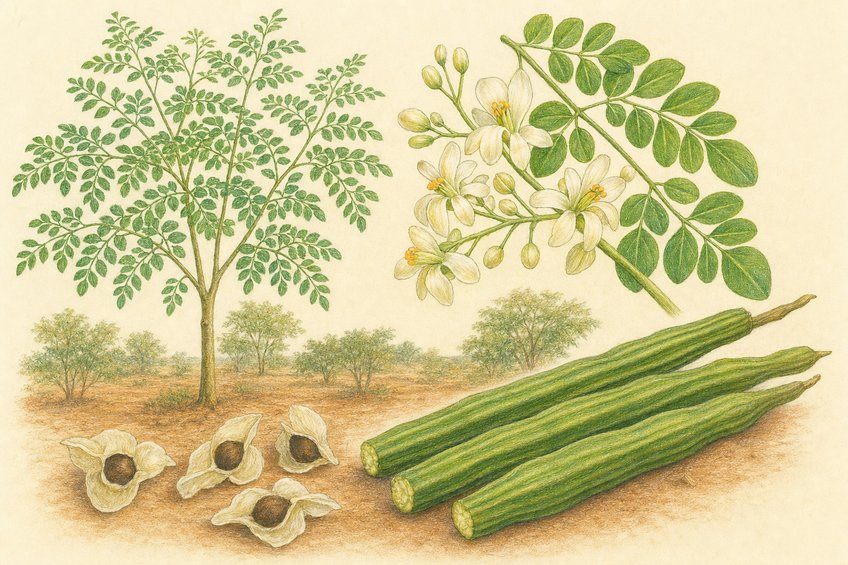
MORINGA OLEIFERA: THE DRUMSTICK TREE WITH AIRY LEAVES.
There is an old English saying, "a tree is known by its fruit," and moringa makes the saying easy to see. Its long green pods hang like drumsticks from a lacy crown of leaves, while the roots carry a sharp scent that once earned it another name: the horseradish tree.
A quick look at moringa
| Botanical name | Moringa oleifera Lam. |
| Family | Moringaceae |
| Parts used | Leaves, young pods, seeds, flowers, seed oil; root and bark were used traditionally with care |
| Other names | Drumstick tree, horseradish tree, ben oil tree, malunggay, murungai, shigru |
| Native region | Foothills of the Himalayas in northern India and nearby regions of South Asia |
The tree with feathery leaves and rattling pods
Moringa is a fast-growing, soft-wooded tree that often reaches 20 to 35 feet in warm climates, though growers may keep it pruned as a leafy shrub. Its pale gray bark looks almost corky on older trunks, and the branches can appear loose and open rather than dense.
The leaves are the first giveaway. They are divided again and again into tiny oval leaflets, giving the whole branch a fern-like look that flickers in the slightest breeze.
In bloom, moringa carries loose sprays of creamy white flowers touched with yellow at the throat. Lean in on a warm morning and the flowers may smell faintly sweet, a little like honey mixed with green almond.
The pods are hard to miss. They grow long, ribbed, and slender, sometimes more than a foot in length, and mature pods dry to a tan shell that rattles with round, winged seeds inside.
From Himalayan foothills to kitchen yards
Moringa oleifera is native to the dry tropical and subtropical edges of South Asia, especially the foothill regions of northern India. From there it traveled with cooks, traders, farmers, and colonial-era plant collectors into Southeast Asia, Africa, the Caribbean, and the warmer parts of the Americas.
In Tamil-speaking parts of India, the tree is known as murungai, and the tender pods are a familiar vegetable in sambar and other everyday dishes. In parts of Kerala, the pods also appear in avial, where their ridged green pieces sit among coconut, curry leaves, and other vegetables.
In the Philippines, malunggay leaves are stirred into soups and stews, often added near the end so the delicate leaflets keep their green color. Filipino home cooks have traditionally added the leaves to tinola, a chicken and green papaya soup often prepared in family kitchens for new mothers.
British residents in India helped spread the English names "drumstick tree" and "horseradish tree." The first points to the shape of the pods; the second comes from the pungent root, which releases a mustardy bite when cut.
The useful parts, from leaf to seed
Moringa is one of those plants that invites the old pioneer saying "waste not, want not." In many tropical kitchens, the leaves, flowers, young pods, and seeds each have a place, though different cultures use them in different ways.
The leaves are the most widely gathered part. Fresh leaflets feel soft and thin between the fingers, and when dried they crumble easily into a deep green powder with a grassy, faintly peppery scent.
Young pods are harvested while still tender, before the fibers toughen. The seeds inside mature pods can be pressed for a clear, stable oil called ben oil, a name linked to behenic acid, one of its fatty acids.
The root and bark have a much stronger character and were included in some traditional preparations, including Ayurvedic and Siddha materia medica. They are not treated like ordinary leafy greens in household food traditions.
What gives moringa its sharp green character?
Moringa leaves contain proteins, minerals, carotenoids, and a range of plant polyphenols, including quercetin and kaempferol glycosides. The leaves also contain phenolic acids such as chlorogenic acid.
Like mustard, cabbage, and other members of the broader mustard-flavored plant world, moringa contains glucosinolates. In moringa, a well-known glucosinolate is glucomoringin, which can form moringin, an isothiocyanate with a sharp, radish-like note.
The seeds are rich in oil, especially oleic acid, with behenic acid giving ben oil its old name. The same seeds also contain proteins that can bind small particles in cloudy water, a practical property studied in village water-treatment projects and agricultural research.
Did You Know?
The name "ben oil tree" appears in older trade records because moringa seed oil was valued for being slow to turn rancid. Watchmakers and perfumers prized clear, steady oils, and ben oil earned a place in those careful trades as well as in tropical kitchens.
Food lore, dooryard wisdom, and old names
In India, Sanskrit texts called the plant shigru, a name often translated as something quick or moving fast, a fitting match for a tree that can leap upward after the rains. Ayurvedic and Siddha practitioners recorded preparations from different parts of the tree, always with attention to the part used and the method of preparation.
The old kitchen-garden rule "pick early, pick often" suits moringa leaves. Regular cutting keeps the shoots tender, much like the way Southern gardeners kept collards, beans, and herbs close to the back steps for quick gathering before supper.
Another plain household maxim, "use it up, wear it out, make it do, or do without," fits the way many communities learned the tree. Leaves went to the pot, tender pods to curries and soups, mature seeds to oil, and dry pods to the seed basket for the next planting.
European monastery gardens had their own tidy way of thinking about useful plants. The ninth-century Plan of St. Gall set aside garden beds for kitchen and medicinal herbs; moringa would not have survived those northern winters, yet it fits that same habit of knowing a plant by its parts.
Farmers' almanac style advice suits moringa well: plant it when the soil has warmed and cold nights have passed. The old saying "make hay while the sun shines" belongs to hayfields, but moringa growers understand the mood of it when they dry tender leaves in warm shade with steady airflow.
Where the drumstick tree makes itself at home
Moringa likes sun, warmth, and soil that drains freely. It tolerates dry spells once established, which helps explain why it has become common in semi-arid tropical regions, from parts of East Africa to the Caribbean basin.
In North America, moringa grows outdoors year-round in frost-free areas such as South Florida, Hawaii, and parts of Southern California and the Southwest. Gardeners in colder regions sometimes grow it as a summer annual or keep young trees in large containers that can be moved indoors before frost.
The tree dislikes wet feet. In heavy clay or waterlogged soil, its soft roots are far less forgiving than its sun-loving leaves suggest.
Keeping moringa close to the kitchen door
Moringa can be started from seed or from woody cuttings. Seeds often sprout quickly in warm soil, and young plants may put on surprising height in their first season.
For leaf harvest, growers often prune the tree low and often, encouraging many tender shoots instead of one tall trunk. This keeps the leaves within reach and gives the plant a bushier shape.
Leaves are usually gathered while young and green, then used fresh or dried in shade with good airflow. Pods are picked young for cooking, while seed pods are left to dry on the tree until they turn brown and begin to split.
A closer look changes the whole tree
Stand beneath a moringa in late afternoon and it seems almost too light to be a tree: small leaflets, pale blossoms, dangling pods, and thin shadows moving over dry soil. Then a dry pod taps the branch, splits along three seams, and drops a winged seed built for its next patch of warm ground.
References
- Plants of the World Online, Royal Botanic Gardens, Kew: Moringa oleifera Lam.
- National Research Council. Lost Crops of Africa: Volume II: Vegetables. National Academies Press, 2006.
- Olson, M. E. and Fahey, J. W. Moringa oleifera: A multipurpose tree for dry tropical regions. Revista Mexicana de Biodiversidad, 2011.
- Fahey, J. W. Moringa oleifera: A review. Trees for Life Journal, 2005.
- Leone, A. et al. Cultivation, genetic, ethnopharmacology, phytochemistry and pharmacology of Moringa oleifera leaves: An overview. International Journal of Molecular Sciences, 2015.
Explore our Moringa (alc or no-alc) products in the HawaiiPharm Moringa store.