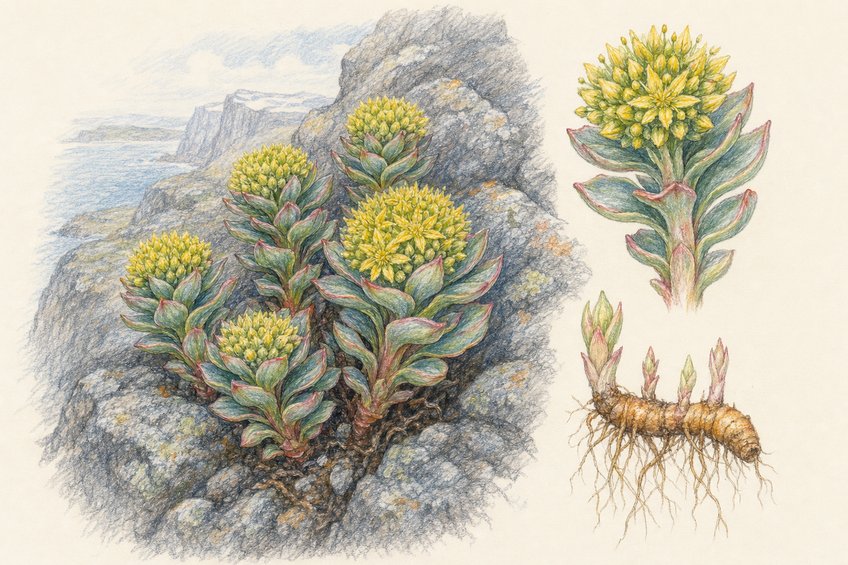
RHODIOLA ROSEA - ROSEROOT OF COLD CLIFFS
Old herbalists liked the phrase "the root of the matter," and Rhodiola rosea takes it almost literally. Slice its thick rhizome and a soft rose scent rises from the cut surface, a surprising perfume from a plant that spends its life clinging to cold cliffs, sea rocks, and wind-polished mountains.
A quick look at Rhodiola
| Botanical name | Rhodiola rosea |
| Family | Crassulaceae |
| Parts used | Root and rhizome; young leaves have also been used as food in some northern regions |
| Other names | Roseroot, golden root, Arctic root, rose root, king's crown |
| Native region | Cold and subarctic regions of Europe, Asia, and North America |
The rose-scented root in the rocks
Rhodiola is a sturdy perennial succulent, usually low to the ground, with upright stems rising from a thick, knobby rhizome. Its leaves are fleshy, blue-green to gray-green, and slightly waxy, as if the plant has dressed itself for wind, glare, and salt spray.
Run a fingertip over a fresh leaf and it feels cool, smooth, and padded, more like a tiny spoonful of stored water than a paper-thin garden leaf. Some leaves show small teeth near the tip, and in exposed places they may take on red edges after cold nights.
In late spring or summer, the plant forms tight clusters of small starry flowers. They may be yellow, greenish-yellow, or flushed with red, and a clump seen from above can look like a little crown set among lichen-dark stones.
Crush a fresh leaf and the scent is green and faintly sharp, but the root is the memorable part. When freshly cut or dried, it can smell softly of roses, with an earthy note underneath, which explains the name rosea.
As summer fades, the aboveground stems often lose their brightness and sink back toward the stones. The rhizome remains tucked in the rock pocket, holding the plant's next season in a firm, aromatic knot.
Where cold air suits it best
Rhodiola rosea belongs to the far north and the high country. It grows in Scandinavia, Iceland, Greenland, the British Isles, Russia, Central Asia, the Himalayas, Alaska, Canada, and northern parts of the United States where the habitat is cool enough.
Look for it, in the wild, in rocky crevices, mountain scree, damp cliffs, tundra, riverbanks, and sea cliffs washed by cold air. It does not ask for rich garden soil; it asks for drainage, sun, and a climate that does not hurry spring.
In Britain and Ireland, roseroot has long been a plant of cliffs and northern uplands. In Scotland, where sea wind can taste of salt and rain, its succulent leaves help it keep water when the rock around it dries.
What people noticed first
The name Rhodiola comes from Greek roots connected with the rose-like fragrance of the root. The Greek physician Dioscorides described a plant called rhodia riza, or "rose root," in the first century, and later European herbals kept the old scent-based name alive.
John Gerard included roseroot in his 1597 Herball, part of the same European physic-garden tradition that ran through monasteries, apothecaries, and kitchen gardens. Monks and early herbal gardeners paid close attention to scent, season, and storage quality; a root that kept a rose note after drying was easy to remember.
In Scandinavian and Russian folk practice, golden root was associated with hard northern living. Families in parts of Siberia reportedly prized the root as a household botanical, and in some Altai traditions it was given as a wedding gift, a wish for a sturdy home rather than a showy bouquet.
Ethnobotanical records from Alaska note that some Native Alaskan communities, including Inupiat and Yup'ik people, used young roseroot leaves as a spring green when available. That food use makes sense in a place where edible fresh plants can be brief and seasonal.
The root and rhizome up close
The main part traditionally collected is the underground rhizome with its attached roots. It is thick, branching, and often golden-brown on the outside, with a firm interior that releases the plant's rose-like aroma when cut.
Fresh rhizomes are tough and moist, more like a succulent storage organ than a dry woody root. Dried pieces become hard, aromatic, and slightly resinous to the nose.
Young leaves have been eaten in some northern regions, but the root is the part that gave the plant its best-known names. "Golden root" refers as much to its valued place in northern households as to its yellow-brown surface.
Inside the golden root
Rhodiola rosea contains a group of compounds that botanists and phytochemists use to help identify the plant. The best known include rosavin, rosin, rosarin, salidroside, and tyrosol.
The root also contains flavonoids, tannins, organic acids, and aromatic constituents such as rosiridol and related scent compounds. These molecules help shape the root's flavor, fragrance, color, and chemistry.
Rosavins are especially associated with Rhodiola rosea and are often used as marker compounds when researchers compare it with other Rhodiola species. That matters because the genus contains many look-alike mountain plants.
Did you know?
Many Rhodiola rosea plants are dioecious, meaning male and female flowers usually grow on separate plants. On a bare alpine ledge, that quiet separation matters for seed-making because pollen has to reach the right neighbor.
Older books often placed roseroot in the stonecrop genus Sedum, so a reader may find it under names such as Sedum rosea in old herbals and floras. Taxonomy changed, but the rose-scented root kept giving the plant away.
The name king's crown makes the most sense from above. The flower clusters sit at the stem tips in tight yellow-green heads, like small coronets pressed close to stone.
Almanac wisdom for a slow mountain plant
Rhodiola grows slowly, which is exactly what one would expect from a plant of short summers. Gardeners who cultivate it usually give it full sun, gritty well-drained soil, and cool conditions rather than rich compost and pampering.
Seed can be slow and uneven to germinate, and young plants may take several years before the rhizome is large enough to study or harvest. Commercial growers often wait four or more years before lifting roots.
Old farmers' almanacs often placed root digging in the waning part of the year, after flowering and as the tops began to fade. With Rhodiola, that autumn timing also leaves the summer flowers for pollinators and seed set.
Wild Rhodiola has faced heavy collection in some parts of Europe and Asia. Cultivation and careful harvest, with crowns or plants left behind, help keep rocky slopes from being stripped bare.
Folklore from cliffs, cottages, and cold roads
British and Irish country names often begin with what the senses notice first, and roseroot is a fine example. The old saying "the nose knows" fits this plant neatly: a root that smells like a rose but grows on a sea cliff feels like a small joke from the plant world.
In northern Europe, people sometimes called it king's crown because of the flower clusters at the stem tips. The name fits best when the plant is seen from above, its blossoms arranged like a tiny coronet on stone.
Russian herbal tradition gave Rhodiola the name golden root, and Siberian stories sometimes treated it as a special mountain find. The saying "good things come in small packages" suits this plant well: the aboveground stems may be modest, while the rhizome carries the scent, storage, and story.
Another piece of garden wisdom applies neatly here: "Right plant, right place." Rhodiola proves the point on a cliff ledge, where its thick leaves, low habit, and tight roots make more sense than any lush meadow strategy.
The Native Alaskan use of young leaves as food adds a different kind of folk knowledge, one rooted in season and observation. When the snow retreats and green things are scarce, a small succulent leaf can become part of the spring table.
A final look at the cliff edge
Rhodiola rosea is easy to miss until you kneel beside it: waxy leaves tucked against stone, small yellow flowers catching a brief northern summer, and a root that smells faintly of roses under a sky that may still hold snow on the ridge. It rewards close looking in places where the growing season is measured in weeks and a crack in the rock can hold an entire plant.
References
- Plants of the World Online, Royal Botanic Gardens, Kew: Rhodiola rosea.
- USDA Natural Resources Conservation Service PLANTS Database: Rhodiola rosea L.
- Flora of North America Editorial Committee. Flora of North America North of Mexico, Vol. 8.
- Dioscorides. De Materia Medica, translated by Lily Y. Beck, 2005.
- Gerard, John. The Herball or Generall Historie of Plantes. 1597.
- Jones, Anore. Nauriat Niginaqtuat: Plants That We Eat. University of Alaska Press, 2010.
- Ager, Thomas A., and Lynn Price Ager. Ethnobotany of the Eskimos of Nelson Island, Alaska. Arctic Anthropology, 1980.
- European Medicines Agency. Assessment report on Rhodiola rosea L., rhizoma et radix. Committee on Herbal Medicinal Products, 2012.
- Brown, Robert P., Patricia L. Gerbarg, and Zakir Ramazanov. Rhodiola rosea: A phytomedicinal overview. HerbalGram, 2002.
Where to Find Rhodiola
Explore our Rhodiola products in the HawaiiPharm store.