SAFFRON (CROCUS SATIVUS): FLOWER, SPICE, AND LORE
"Worth its weight in gold" may be an old saying, but saffron nearly makes it literal. Each autumn flower of Crocus sativus offers only three red stigmas, and every thread must be lifted by hand while the purple petals are still fresh with morning coolness.
A small crocus with a costly secret
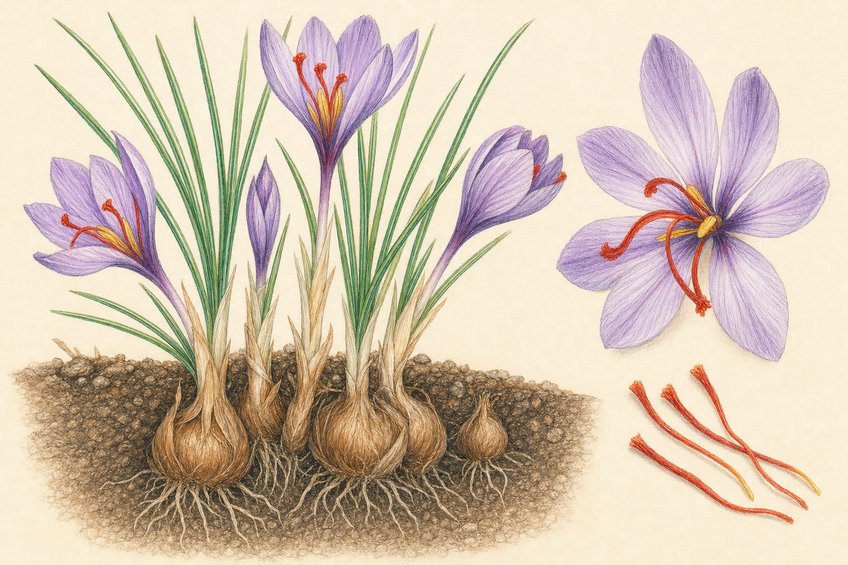
Saffron looks modest at ground level: a low autumn crocus with narrow, grasslike leaves and goblet-shaped blossoms. Then the flower opens, and the secret appears - three long, red-orange stigmas curling from the center like tiny flames.
Crush a saffron thread between your fingers and the scent rises slowly: warm hay, honey, dry earth, and something faintly metallic. In water or broth, the color loosens into deep gold, the shade that made cooks, dyers, monks, and merchants guard it carefully.
Quick facts
| Botanical name | Crocus sativus L. |
|---|---|
| Family | Iridaceae, the iris family |
| Parts used | Dried stigmas, often called saffron threads |
| Other names | Saffron crocus, autumn crocus, kesar, zafran, azafran |
| Native region | Believed to have been domesticated in the eastern Mediterranean, likely from wild relatives in Greece and nearby regions |
The flower that cannot live without gardeners
Crocus sativus is a triploid plant, which means it produces little to no fertile seed. Saffron survives because people divide and replant its corms, the rounded underground storage organs that look a bit like small brown onions wrapped in papery tunics.
Its leaves are thin and upright, usually with a pale stripe down the center. The flowers emerge in fall, often before the foliage has fully stretched, with six lavender to lilac tepals surrounding yellow anthers and the prized red stigmas.
Did you know? A single pound of dried saffron can require well over 70,000 flowers, depending on growing conditions and thread size. That explains why even honest saffron has always traveled with stories of careful weighing, locked chests, and watchful merchants.
The part used: three threads from one bloom
The used part of saffron is the stigma, the receptive tip of the flower's female structure. In Crocus sativus, the style branches into three red stigmas, each one slightly trumpet-shaped at the end.
Harvesters pick the whole flower, then separate the stigmas by hand. The threads are dried gently, and this drying step shapes the aroma as much as the field does.
The yellow stamens are not the same as saffron, though they sit beside the red threads in the flower. True saffron consists of those red stigmas, sometimes with a small bit of the pale style attached.
From Minoan walls to Pennsylvania kitchens
One of the most famous early images of saffron appears in Bronze Age art from the Aegean world. Frescoes at Akrotiri on the island of Thera show crocus gatherers bending among flowers, a scene that still feels familiar to anyone who has watched a saffron harvest at dawn.
Greek, Persian, Arab, and Indian cultures all gave saffron a place in food, fragrance, dyes, and ceremony. In Kashmir, saffron fields near Pampore have long been associated with autumn markets and the deep color of festive rice dishes.
Medieval European monastery gardens also kept saffron in the company of culinary and dye plants. Monks copied herbals, tended bulbs, and understood the practical value of a plant that could color parchment, cloth, and feast-day foods with only a pinch.
Colonial American cooks knew saffron too, especially in communities with German and English roots. Pennsylvania Dutch saffron buns and broths carried the spice into farmhouse kitchens, where a little jar of threads could be treated as carefully as the good silver.
Folklore in the golden threads
In old English kitchen lore, saffron was tied to cheer and prosperity, and the phrase "saffron in the pot, gold in the house" captures how people connected color with good fortune. The saying was less a rule than a wink from cooks who knew the spice was expensive enough to notice.
In Cornwall and parts of the West Country, saffron cakes became linked with holidays, fairs, and special baking days. A pale loaf was everyday fare; a golden one meant somebody had planned ahead.
Farmers' almanac-style wisdom often placed bulb and corm planting in the cooling days of late summer or early fall. Some old gardeners preferred a waning moon for underground crops, though modern saffron growers pay closer attention to drainage, dry dormancy, and cool autumn nights.
Where saffron grows today
Saffron prefers a Mediterranean rhythm: dry summers, well-drained soil, and autumn moisture that wakes the corms into bloom. It dislikes soggy ground, and heavy clay can rot the corms before flowers ever appear.
Today, major saffron-growing regions include Iran, India, Spain, Greece, Morocco, Italy, and parts of Afghanistan. Smaller farms also grow it in North America, including areas of Pennsylvania, Vermont, Washington, and Ontario where growers can give the corms sharp drainage and a warm summer rest.
The plant goes quiet in summer. Its leaves wither, the corm rests underground, and then the first cool signals of fall bring up the flowers, sometimes so suddenly that a bare bed seems to bloom overnight.
Growing and harvest in the saffron bed
Growers plant saffron corms in late summer, usually several inches deep, with space for each corm to multiply. Sandy loam, raised beds, or a sloped site can help keep water from sitting around the roots.
Flowers are gathered soon after opening, often in the morning. The work is quiet and close to the soil: fingers part the petals, lift the red stigmas, and leave behind a soft pile of purple blooms.
After drying, saffron is usually stored away from light and air. Freshly dried threads can smell sharp at first, then mellow as their haylike aroma settles over the following weeks.
Color, aroma, and plant chemistry
Saffron's golden color comes mainly from crocin, a water-soluble carotenoid pigment. Crocetin is closely related, and together these compounds help explain why a few threads can tint an entire dish.
Picrocrocin gives saffron its gentle bitterness. During drying and storage, some of it breaks down into safranal, one of the main aroma molecules behind saffron's warm, haylike fragrance.
The plant also contains flavonoids such as kaempferol. These names may sound like chemistry-lab language, but they describe the same sensory traits cooks recognize at the stove: color first, then aroma, then a dry, lingering taste.
A look-alike worth knowing
Saffron crocus should not be confused with Colchicum autumnale, often called meadow saffron or autumn crocus. That plant belongs to a different family and has different botanical features, including six stamens instead of the three found in true crocuses.
Garden names can be slippery. When identifying saffron, the combination to look for is Crocus sativus, fall bloom, narrow leaves, three stamens, and those three red stigmas rising from the flower's center.
Small threads, wide travels
Saffron has followed trade routes, migrations, feast days, and family recipes. It has colored rice in Persian kitchens, sweets in Indian celebrations, breads in British baking, and broths in early American homes.
For all its fame, the plant remains low to the ground and easy to miss until autumn opens its cups. Kneel beside a blooming saffron crocus, and the grand history of caravans and monastery gardens narrows to three red threads in one purple flower.
References
- Royal Botanic Gardens, Kew. Plants of the World Online: Crocus sativus L.
- Negbi, M., editor. 1999. Saffron: Crocus sativus L. Harwood Academic Publishers.
- Zohary, D., Hopf, M., and Weiss, E. 2012. Domestication of Plants in the Old World. Oxford University Press.
- Caiola, M. G. and Canini, A. 2010. Looking for saffron's parent. Functional Plant Science and Biotechnology.
- McGee, H. 2004. On Food and Cooking: The Science and Lore of the Kitchen. Scribner.
Explore our Saffron products in the HawaiiPharm store.