SCHISANDRA CHINENSIS: FIVE-FLAVOR BERRY PLANT GUIDE"
In China, Schisandra is called wu wei zi, the "five-flavor fruit" - a berry said to hold sweet, sour, salty, bitter, and pungent tastes in one ruby-red bead. Bite one fresh berry and the story makes sense: the skin is tart, the flesh is faintly sweet, the seed turns sharp and resinous, and the finish lingers like citrus peel and pine.
A vine with five flavors
Schisandra chinensis is a woody climbing vine native to cool forests of northeastern Asia. It threads itself through shrubs and small trees, using nearby branches as a living ladder rather than clinging with tendrils.
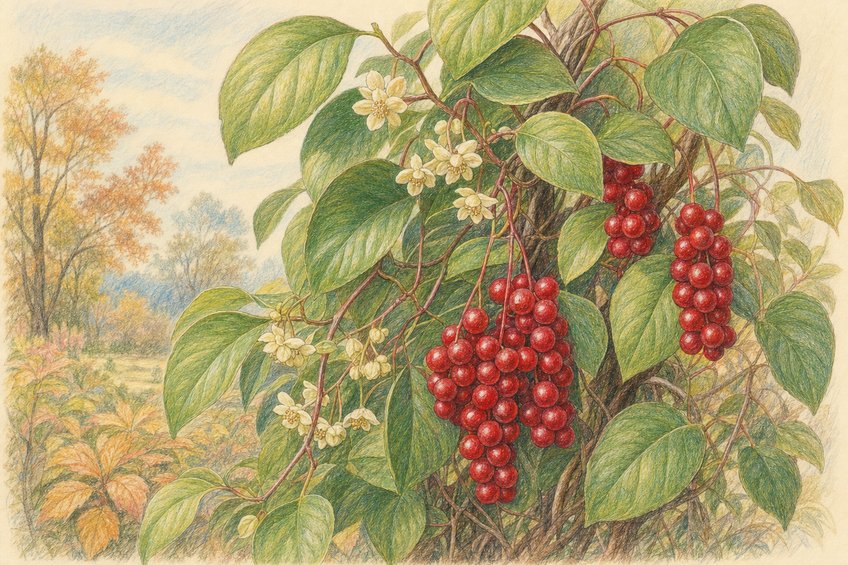
In late spring, small waxy flowers appear along the vine. They are cream to pale pink, lightly fragrant, and easy to miss until the fruit forms in drooping clusters that glow red against green leaves in early autumn.
Crush a leaf between your fingers and it gives off a faint green, lemony scent. The ripe berries feel smooth and taut, while the seeds inside are hard, glossy, and aromatic when cracked.
Quick facts
| Botanical name | Schisandra chinensis |
| Family | Schisandraceae |
| Parts used | Ripe berries and seeds |
| Other names | Wu wei zi, five-flavor berry, magnolia vine, Chinese magnolia vine |
| Native region | Northeastern China, Korea, the Russian Far East, and parts of Japan |
How to recognize it in the wild garden
Schisandra is deciduous, so it drops its leaves when cold weather settles in. During the growing season, its leaves are oval to slightly heart-shaped, with fine teeth along the edges and reddish leaf stalks.
The plant usually grows 10 to 25 feet when it has support. Left unsupported, it sprawls as a loose shrub, but with a trellis or woodland edge it climbs in a graceful, twisting habit.
Male and female flowers may appear on separate plants, though some cultivated forms bear both. Gardeners often plant more than one vine to encourage fruit set, a practical detail hidden behind those romantic red berry chains.
The berry and seed up close
The ripe fruit is the part most often collected. Berries are gathered when fully red, then dried whole so the pulp and seed remain together.
The seed carries much of the berry's resinous aroma - the part that stays on the palate longest. When dried berries are crushed, the scent shifts from tart fruit to warm spice, with a slightly woody note.
Where this forest vine makes its home
Schisandra chinensis grows naturally in cool mixed forests, along stream edges, and in mountain thickets. It likes dappled light, steady moisture, and soil rich with leaf litter.
Its native range stretches through northeastern China, Korea, the Russian Far East, and nearby parts of Japan. In cultivation, it has traveled into North American and European gardens, especially in regions with cold winters and mild summers.
The vine is hardy, but it dislikes hot, dry exposure. In a garden, it often looks happiest where morning sun gives way to afternoon shade, the same kind of place where ferns keep their green color deep into summer.
Old names, old trade routes, and a berry with a reputation
In Chinese materia medica, wu wei zi appeared in written herbal works at least as far back as the Shennong Bencao Jing, a classical text compiled in the early centuries of the Common Era. The name points directly to its unusual flavor, which Chinese tradition connected with the five phases and five organ systems of classical theory.
Early twentieth-century accounts from the Russian Far East describe Nanai hunters carrying dried Schisandra berries as compact trail food during long days in the forest. The berries were valued for their strong taste, the kind that wakes up the mouth on cold mornings.
Unlike the horehound, yarrow, and sage that colonial American housewives kept in their pantries, Schisandra did not belong to early North American medicine chests. It reached Western gardeners later, through botanical exchange and the growing curiosity about hardy Asian vines.
Folklore in a handful of red berries
The old American saying "good things come in small packages" fits Schisandra better than most fruits. A single berry can move across the whole tongue, from tart to sharp to faintly sweet, like a tiny tasting lesson.
Gardeners have their own vine proverb: "The first year it sleeps, the second year it creeps, the third year it leaps." Schisandra often follows that rhythm, spending its early seasons building roots before sending long stems up a support.
Farmers' almanac style wisdom favors harvesting many fruits after cool nights deepen their color. Schisandra berries are no exception in appearance: autumn chill turns the clusters a clearer red, and the leaves begin to yellow behind them.
European monastery gardens did not grow Schisandra in the medieval period, but their physic garden tradition shaped how later Western botanists received plants like it. Monks labeled, dried, and compared herbs carefully, a habit that carried into botanical gardens where Asian vines were studied as living specimens.
What is inside the five-flavor fruit?
Schisandra berries contain a group of plant compounds called lignans. The best known include schisandrin, schisandrol, schisantherin, and gomisin compounds, many of which are concentrated in the seed.
The fruit also contains organic acids that help create its tart taste, along with small amounts of essential oil, pigments such as anthocyanins, and polysaccharides. These compounds help explain why the berry tastes and smells so layered compared with sweeter table fruits.
The five flavors are more than poetry. Sourness comes forward first, bitterness appears in the seed, and the pungent, resin-like quality stays on the palate after the fruit is gone.
Growing, tending, and gathering
Schisandra prefers humus-rich, well-drained soil that stays evenly moist. A woodland edge, fence, arbor, or sturdy trellis gives the vine the support it needs to climb.
Young plants appreciate mulch made from leaves or composted bark, which keeps the root zone cool. In very warm regions, afternoon shade helps prevent leaf scorch.
Harvest usually comes in late summer to early autumn, when the berries are fully red and slightly soft. Growers cut whole clusters, handle them gently, and dry them with good airflow until the berries wrinkle into dark red, chewy beads.
Seeds saved for propagation often need a period of cool, moist rest before sprouting. Like many woodland plants, Schisandra keeps its own calendar underground before anything green appears above the soil.
A closer look at its relatives
Schisandra belongs to the family Schisandraceae, a small family of aromatic woody plants. Its relatives include other Schisandra species and Kadsura vines, many with glossy leaves and unusual flowers.
The common name "magnolia vine" reflects a resemblance in flower form, not family closeness - Schisandraceae sits in its own order, Austrobaileyales, well away from true magnolias on the tree of flowering plants. The flowers have a spare, waxy simplicity - the male stamens sit in separate whorls rather than fused into a central column, the structural quirk the genus name encodes in Greek.
Did you know?
- Schisandra berries are often dried whole, so a single dried fruit contains both the pulp and the aromatic seed.
- The Chinese name wu wei zi translates as "five-flavor seed" or "five-flavor fruit."
- The genus name Schisandra comes from Greek roots meaning "split" and "man," referring to the separated structure of the flower's male parts.
- Some Schisandra plants bear mostly male or mostly female flowers, so fruiting can vary from year to year and plant to plant.
A final look at the vine
Schisandra rewards close attention: a pale flower tucked under a leaf in spring, a twisting stem finding its way through shade, a red fruit cluster brightening as the air cools. The dried berries keep that layered flavor for years in a sealed jar, with pulp and seed still packed together in each small red bead.
References
- Flora of China. Schisandra chinensis species account. Missouri Botanical Garden and Harvard University Herbaria.
- Upton, R., editor. American Herbal Pharmacopoeia: Schisandra Berry, Schisandra chinensis. American Herbal Pharmacopoeia, 1999.
- World Flora Online. Schisandra chinensis (Turcz.) Baill. taxonomic record.
- Panossian, A. and Wikman, G. "Pharmacology of Schisandra chinensis Bail.: An overview of Russian research and uses in medicine." Journal of Ethnopharmacology, 2008.
- Chinese Pharmacopoeia Commission. Pharmacopoeia of the People's Republic of China, entry for Wuweizi.
Where to Find Schisandra
Explore our Schisandra products in the HawaiiPharm store.