SELFHEAL (PRUNELLA VULGARIS): FOLKLORE AND BOTANY
"He needs neither physician nor surgeon that has self-heal and sanicle," ran an old English herbal saying - a bold bit of hedgerow folklore for a plant that often stands no taller than a thumb. John Gerard listed selfheal in his 1597 Herball, and anyone who has found its purple buttons blooming after a lawn mowing can see why country people remembered it.
Quick facts about selfheal
| Botanical name | Prunella vulgaris L. |
|---|---|
| Family | Lamiaceae, the mint family |
| Parts used | Flowering aerial parts, especially leaves and flower spikes |
| Other names | Heal-all, all-heal, common selfheal, carpenter's herb, brunella |
| Native region | Temperate regions of Europe, Asia, North Africa, and North America |
A purple button in the grass
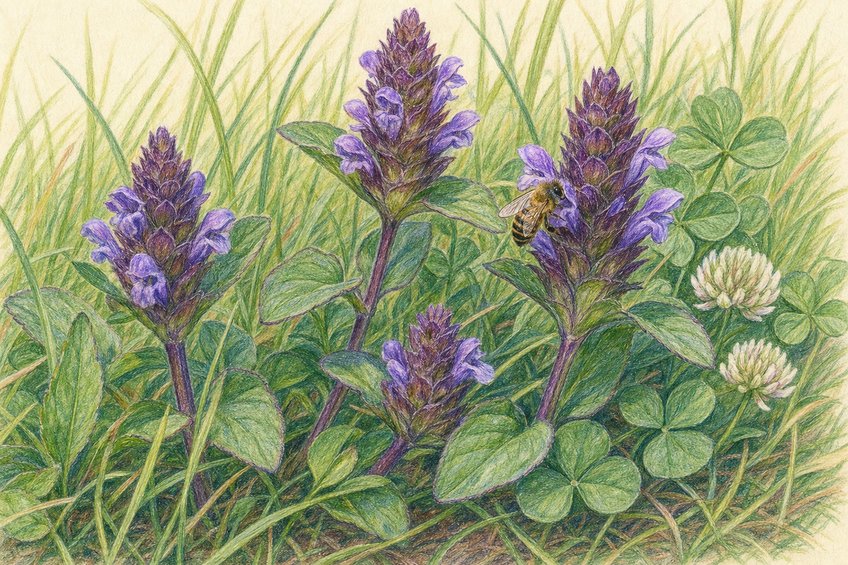
Selfheal is a low perennial mint with square stems, opposite leaves, and short flower heads that look like tiny purple pinecones. The leaves are oval to lance-shaped, softly toothed, and usually deep green, though cool weather can tint them bronze.
Crush a fresh leaf between your fingers and the scent is mild, green, and faintly minty, without the sharp perfume of peppermint. The flower head feels firmer than it looks because each little blossom sits among stacked, papery bracts.
In bloom, the plant sends up violet, lavender, or blue-purple two-lipped flowers. The upper lip forms a hood, while the lower lip opens like a tiny landing pad for bees.
Where this little mint feels at home
Selfheal grows throughout much of the temperate northern hemisphere, from the British Isles across Eurasia and across large parts of North America. It also appears in other temperate places where people, livestock, and seed have helped it travel.
Look for it in lawns, moist meadows, woodland edges, pasture paths, stream banks, and open ground where the soil holds some moisture. A patch may show as a flush of purple dots in a yard shortly after the grass grows back.
Selfheal spreads by short creeping stems and also sets small nutlets after flowering. It enjoys sun in cool climates and a little afternoon shade in hot regions, especially where summer soil dries quickly.
The flowering tops herbalists gathered
The part traditionally gathered is the aerial portion of the plant, especially the leafy stems and flower spikes collected when the purple heads are fresh. Older herbals often spoke of the whole herb rather than separating leaf from blossom.
In household practice, gatherers cut the stems above the crown so the plant could regrow. The old almanac rule for leafy herbs fits selfheal well: wait until the morning dew has dried, then cut before the strong afternoon sun has wilted the leaves.
Drying is usually done in a thin layer with moving air and shade. When dry, the flower spikes turn brown-purple and the leaves crumble easily between the fingers.
Old herbals, cottage shelves, and country memory
The old line "He needs neither physician nor surgeon that has self-heal and sanicle" belonged to English herbal folklore, where selfheal and sanicle were paired as trusted green companions of lanes and pastures. The saying tells us how highly country people regarded familiar plants close at hand, rather than offering a modern promise.
John Gerard included selfheal in his 1597 Herball, where it appeared among the practical plants of English fields and gardens. Nicholas Culpeper, writing in The English Physician in 1653, praised it in the language of his day as a plant for the home herb chest.
That old reputation traveled with settlers across the Atlantic. Colonial housewives and later pioneer families often kept familiar European plants near the dooryard, guided by the plain household maxim "make do and mend" when stores were far away.
The Cherokee people are also part of selfheal's North American story. Daniel E. Moerman recorded that Cherokee people used Prunella vulgaris in traditional plant preparations; that note deserves respect, because community knowledge is more than a line in a reference book.
In British and Irish country speech, selfheal was grouped with green allies such as betony, plantain, and yarrow - plants that followed people into pastures, lanes, and kitchen gardens. The name carpenter's herb hints at workshop folklore, where handy plants were valued for being close enough to gather quickly.
Monastery gardens also shaped the memory of plants like selfheal. Medieval monks copied herbals, tended physic beds, and kept close watch on small mints, woundworts, and other aromatic greens that could be dried for the infirmary shelf.
What is tucked inside selfheal?
Selfheal contains several well-known plant constituents, including rosmarinic acid, caffeic acid derivatives, tannins, flavonoids, triterpenes, and polysaccharides. Rosmarinic acid is named for rosemary, though it occurs in many members of the mint family.
The tannins help explain the slightly puckery taste of the leaves. Flavonoids such as rutin and quercetin-related compounds contribute to the plant's chemistry, while triterpenes such as ursolic acid and oleanolic acid are common in waxy leaf surfaces of many herbs.
These compounds are part of the plant's own life: they help shape flavor, color, texture, and the way leaves respond to sun, grazing, and weather. In a patch of selfheal, chemistry begins with a square stem no higher than your shoe.
Growing selfheal in a wilder garden
Selfheal is easygoing when given average soil, steady moisture, and room to creep. It can be started from seed, divided from an established clump, or allowed to move naturally through a meadow-style lawn.
Gardeners who welcome pollinators often let it bloom before mowing. Bumblebees, small native bees, and other insects visit the short purple heads, sometimes bending the tiny flower lips as they press inside.
In a tidy herb bed, selfheal may need edging because the stems root where they touch damp soil. In a meadow, that same habit helps it knit into the green mat with clover, violets, and low grasses.
Did you know?
- Selfheal belongs to the mint family, but it does not have the strong scent many people expect from mints.
- The genus name Prunella may come from old European names linked to the plant's brownish flower heads after bloom.
- After the purple flowers fade, the stacked bracts often remain upright into fall, looking like tiny brown cones in the grass.
- A mower may cut selfheal down, but the plant often blooms again on shorter stems close to the ground.
A small plant worth kneeling for
Selfheal rewards close looking. The next time a lawn or meadow shows little purple knobs among the clover, kneel down and you may find square stems, hooded blossoms, papery bracts, and a bee working a flower no wider than a pea.
References
- Flora of North America Editorial Committee. Flora of North America North of Mexico, Vol. 17: Prunella vulgaris.
- Royal Botanic Gardens, Kew. Plants of the World Online: Prunella vulgaris L.
- USDA NRCS PLANTS Database. Prunella vulgaris L., common selfheal.
- Gerard, John. The Herball or Generall Historie of Plantes. 1597.
- Culpeper, Nicholas. The English Physician. 1653.
- Moerman, Daniel E. Native American Ethnobotany. Timber Press, 1998.
- Duke, James A. Handbook of Phytochemical Constituents of GRAS Herbs and Other Economic Plants. CRC Press, 1992.
Where to Find Selfheal
Explore our Selfheal products in the HawaiiPharm store.