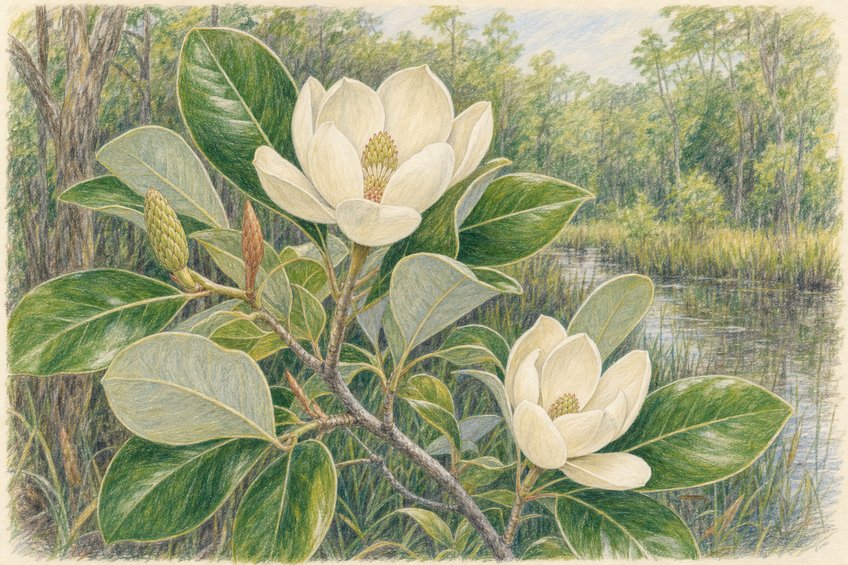
SWEETBAY MAGNOLIA: MAGNOLIA VIRGINIANA HERBAL GUIDE
Southern gardeners have a saying: give sweetbay magnolia wet feet and a sunny face, and it will perfume the whole yard. On a warm June evening, Magnolia virginiana opens creamy white blossoms that smell of lemon peel, vanilla, and clean rain rising from the marsh.
A quick introduction to sweetbay magnolia
| Botanical name | Magnolia virginiana L. |
|---|---|
| Family | Magnoliaceae |
| Parts used | Bark in traditional preparations; leaves and flowers for their aromatic character |
| Other names | Sweetbay, sweetbay magnolia, swamp magnolia, laurel magnolia, beaver tree |
| Native region | Eastern and southeastern North America, especially the Atlantic and Gulf Coastal Plain |
The silver-backed tree of the wet woods
Sweetbay magnolia is a small to medium tree, often 10-35 feet tall in gardens and sometimes taller in the deep South. In colder parts of its range it may behave like a large shrub, while in mild coastal places it can keep many of its leaves through winter.
The leaves are one of its best field marks: glossy green above, pale and silvery underneath, with a soft flash when the wind turns them. Crush a fresh leaf and you may catch a faint spicy-green scent, quieter than the flowers but still unmistakably magnolia.
The flowers appear from late spring into summer. They are cup-shaped, ivory to creamy white, and usually 2-3 inches across, with thick petals that look almost carved from wax.
After flowering, the tree forms cone-like fruits that split to show bright red seeds dangling on fine threads. Birds often notice those red seeds before people do.
A very old family with a modern name
Magnolias belong to one of the older flowering plant lineages on Earth. Their blossoms evolved before bees became the main flower visitors, which helps explain their sturdy petals and beetle-friendly structure.
The genus Magnolia honors Pierre Magnol, a French botanist and physician who worked in Montpellier in the late 1600s. Magnolia virginiana was formally named by Carl Linnaeus in 1753, though European plant collectors had already been admiring it for decades.
Did you know? Sweetbay magnolia was among the first North American magnolias cultivated in England. By the late 1600s, plants and seeds were moving through transatlantic gardening circles connected with collectors such as John Banister and Bishop Henry Compton.
Where it grows when left to its own choosing
Magnolia virginiana is native from the coastal Northeast down through Florida and west along the Gulf states into eastern Texas. It favors wet pine woods, swamp edges, stream banks, pocosins, and acidic lowlands where the soil stays damp.
In the northern part of its range, including places such as New Jersey and Massachusetts, sweetbay may be deciduous and modest in size. In Florida, Louisiana, and other mild coastal regions, it can become taller, greener through winter, and more tree-like.
Its roots tolerate wet ground better than many ornamental trees. That is why gardeners sometimes choose it for rain gardens, pond margins, and low spots where drier-loving trees sulk.
Bark, leaves, flowers, and the fragrant heart of the plant
The bark is gray to brown, smooth on young stems, and lightly fissured with age. In traditional herbal records, bark from twigs, stems, or roots received the most attention, while the leaves and flowers were valued for scent and identification.
The flowers carry their fragrance in thick, pale tepals rather than delicate paper-thin petals. Their scent can shift with the hour: brighter and lemony in warm daylight, creamier and softer toward evening.
The leaves have a leathery texture that helps them hold up in humid woods. Their pale undersides give the tree one of its folk charms: from a distance, a breeze can make a sweetbay look as if little silver fish are turning in the branches.
What people carried in memory and medicine chests
Ethnobotanical records from the southeastern United States note that Cherokee and Choctaw communities knew sweetbay as a useful bark tree and prepared it according to local tradition. These records are fragments of much larger living knowledge systems, and they should be read with respect for the people who kept that knowledge.
Colonial American households also noticed the tree. Settlers in the coastal South sometimes dried aromatic barks from local trees for home preparations, and sweetbay appeared in that practical world of pantry jars, bark bundles, and handwritten receipts.
In British gardens, sweetbay carried a different kind of meaning. It was an elegant American curiosity, a swamp-born tree that could be coaxed into flowering near brick walls and sheltered estates, where gardeners learned the old rule: cool roots, open sky.
Appalachian and Southern garden wisdom still gives sweetbay plain advice rather than ceremony. Folks may say a magnolia likes its feet wet and its shoulders warm, which is a tidy way to describe moist acidic soil with enough sun for flowers.
The plant chemistry behind the perfume
Sweetbay magnolia contains aromatic volatile oils, especially in its flowers and leaves. These oils include terpenes, the same broad family of fragrant compounds that gives many herbs, conifers, and citrus peels their characteristic scents.
Magnolia species also contain phenolic compounds and alkaloids, including compounds in groups such as lignans and aporphine alkaloids. In plain language, these are plant-made molecules that help create flavor, aroma, color changes, and the chemical fingerprint botanists use to compare related species.
Magnolia chemistry varies by species, plant part, season, and growing place. A flower gathered on a humid Gulf Coast evening will not be chemically identical to bark sampled from a young northern shrub in early spring.
Growing sweetbay without asking it to be a dry-land tree
Sweetbay magnolia grows best in acidic, moist soil with good organic matter. It can take full sun where the ground stays damp, and it also accepts part shade, especially in hotter regions.
Gardeners in colder areas often plant it where winter winds are softened by other trees, a fence, or the side of a house. In warm coastal gardens, it may grow faster and keep a fuller evergreen look.
When collecting for study or traditional craft, leaves and fallen flowers can be gathered lightly without harming the tree. Bark collection asks for restraint: stripping bark around a trunk can kill a woody plant, so ethical harvesters avoid girdling and take only small amounts from pruned twigs when appropriate.
Seeds can be collected when the fruit opens and the red seed coats show. In nature, birds help move those seeds from wet thickets to new muddy edges.
Did you know?
- One old name for sweetbay is beaver tree. The name likely comes from its wetland habitat and from reports that beavers used or investigated its roots and stems around waterways.
- Mark Catesby, the English naturalist who traveled through the American Southeast in the early 1700s, illustrated many plants and animals of the region, including magnolias that fascinated European gardeners.
- Sweetbay flowers are built for beetle visitors as well as other insects. Their firm floral parts can handle a little rough handling from early pollinators.
- The silvery underside of the leaf can help distinguish Magnolia virginiana from many other magnolias when the tree is not in bloom.
A last look at the silver leaves
Sweetbay magnolia is easiest to love when you meet it in its own kind of place: damp soil underfoot, green shade overhead, and a white flower sending lemony sweetness into heavy summer air. Watch the leaves turn in the wind, and the tree gives away its name without a label.
References
- Flora of North America Editorial Committee. Flora of North America, Magnolia virginiana L. Magnoliaceae treatment.
- Kew Science. Plants of the World Online. Magnolia virginiana L.
- Lady Bird Johnson Wildflower Center. Native Plants Database: Magnolia virginiana.
- North Carolina State Extension. Extension Gardener Plant Toolbox: Magnolia virginiana.
- Moerman, Daniel E. Native American Ethnobotany. Timber Press, 1998.
- Catesby, Mark. The Natural History of Carolina, Florida and the Bahama Islands. 1731-1743.
Explore our Magnolia products in the HawaiiPharm store.