TRIBULUS TERRESTRIS: GOATHEAD, BURRS, AND OLD LORE
A plant that rarely rises above your shoelaces can stop a bicycle in its tracks. Tribulus terrestris, better known across much of the American West as puncturevine or goathead, makes a seed burr so hard and sharp that it has earned more curses from bare feet, bicycle tires, and dog paws than many taller weeds.
Quick facts from the goathead patch
| Botanical name | Tribulus terrestris |
| Family | Zygophyllaceae |
| Parts used | Fruit, aerial parts, and sometimes root, depending on tradition |
| Other names | Puncturevine, goathead, caltrop, small caltrops, cat's head, gokshura, bai ji li |
| Native region | Likely warm parts of the Mediterranean region, southern Europe, North Africa, and western to central Asia |
A creeping plant with armored fruit
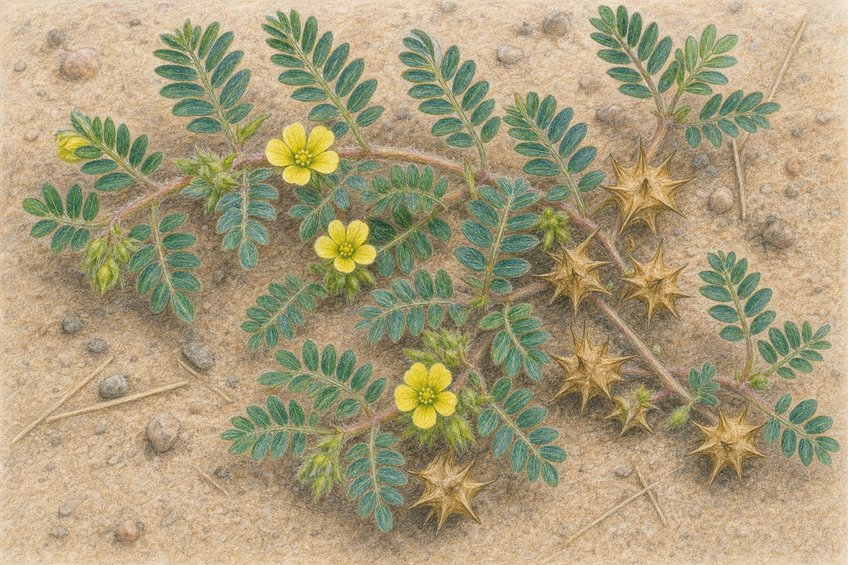
Tribulus grows as a low annual, spreading outward in flat, sun-hugging stems that can form a mat across dry soil. The leaves sit opposite each other and are divided into many small leaflets, giving the plant a feathery, almost delicate look before the burrs appear.
In summer, small five-petaled yellow flowers open close to the ground, bright as butter against dust and gravel. Crush a fresh leaflet between your fingers and the scent is green, faintly earthy, and plain rather than sweet - a smell more like a warm roadside after rain than a garden herb.
The fruit is the giveaway. It breaks into five hard wedge-shaped nutlets, each armed with sharp spines set at angles, so at least one point usually faces upward when the burr falls to the ground.
Why the name sounds like a weapon
The Latin word tribulus was used for a caltrop, a spiked device scattered on roads and fields to stop horses and foot soldiers. The plant earned the comparison honestly: a dry goathead burr looks like a tiny medieval trap built by a botanist with a mischievous streak.
English herbalist John Gerard recorded land caltrops in The Herball in 1597, carrying forward a European name that connected the plant to both prickly seed and old military hardware. Nicholas Culpeper also included caltrops in The English Physician in 1652, showing how firmly the old English plant name had settled into herbal writing.
In ranch country of the American West, goathead is a name with no need for explanation. The two long spines on a nutlet can resemble little horns, and the practical fence-line lesson in Western roadside vernacular is simple: pull it green, or meet it later in your boot.
Old herbal trails across Asia and Europe
Tribulus has a long record in Old World materia medica. In Ayurveda, it is known as gokshura, a Sanskrit name often interpreted as cow's hoof, a nod to the shape people saw in the fruit.
Chinese materia medica has listed the fruit as bai ji li. Those traditions described plants through taste, texture, season, and preparation, long before modern plant chemistry gave names to saponins and flavonoids.
Because tribulus is an Old World plant that spread widely in North America after European settlement, it does not hold the same long-recorded place in Navajo, Hopi, or Pueblo ethnobotany as many native desert plants. That absence tells its own story: not every familiar plant in a dry wash is an ancient neighbor.
Where it grows now
Tribulus favors heat, open ground, and disturbed soil. Roadsides, barnyards, vacant lots, dry fields, ditch banks, sandy paths, and trail edges all give it the sun and loosened soil it likes.
Today it grows through many warm and temperate regions of the world, including large parts of the United States and Canada. In the American West, it is especially well known in dry valleys, irrigated edges, and places where bare soil waits for summer rain.
Several states list puncturevine as a troublesome weed because the burrs spread easily on tires, shoes, animal fur, and equipment. A single plant can produce many burrs, and the seeds may wait in soil for several years before sprouting.
The fruit, the leaf, and the root
The fruit receives the most attention because it is so unmistakable. When mature, it dries from green to tan or brown, hardens, and splits into sections with spines strong enough to pierce thin rubber.
The aerial parts - the leaves, stems, flowers, and young fruiting tops - have also been gathered in some herbal traditions. The root is a narrow taproot, built for a quick annual life in hot soil rather than long storage like a carrot or burdock.
Harvesters handle mature tribulus with gloves and thick bags, since the burrs can pierce cloth and skin. Green material is far gentler to collect, but once the fruit sets, the plant becomes a small hazard field.
What plant chemists find inside
Tribulus contains steroidal saponins, a group of soap-like plant compounds. Protodioscin, tribulosin, and related saponins were documented in a 2008 study in Phytochemistry by Dinchev et al., though their amounts vary widely by plant part, growing region, and harvest stage.
The plant also contains flavonoids such as quercetin and kaempferol glycosides, along with phenolic acids, tannins, and small amounts of nitrogen-containing compounds. These names can sound distant from the living plant, yet they are part of the same creeping stems and prickly seed heads found along a hot roadside.
One useful lesson from tribulus chemistry is variation. A fruit gathered in Bulgaria, a leaf sample from India, and a plant growing in New Mexico may share a botanical name while carrying different proportions of the same chemical families.
Growing, spreading, and gathering
Tribulus grows fast from seed in warm soil. It likes full sun, tolerates drought once established, and often appears where other plants struggle to cover the ground.
The old English-language garden proverb "One year's seed makes seven years' weed" fits puncturevine better than many plants, because missed burrs can linger in soil. With tribulus, open ground near gates, driveways, corrals, and paths should be watched after summer showers.
Gardeners who remove it usually do so before the burrs harden. Pulling young plants after rain is easier because the taproot releases from softened soil, while mature plants demand gloves, care, and a close look for fallen burrs left behind.
Did you know?
A burr built to travel
The goathead burr is shaped so one spine points upward when it rests on the ground. That small bit of geometry helps it catch passing feet, hooves, tires, and paws.
A plant with many local reputations
In one place, tribulus may be treated as a materia medica plant. In another, it is simply the reason cyclists carry patch kits and dog walkers check paws after crossing a dry lot.
A medieval name on a roadside weed
The caltrop connection gives tribulus one of the more dramatic names in botany. A weed no taller than a playing card carries the memory of iron spikes once used on battle roads.
A closer look changes the story
Tribulus is easy to dislike when a burr finds a tire or a tender heel, yet kneel beside it on a summer morning and another picture appears: tiny yellow flowers close to the dust, paired leaflets folded slightly in heat, and seed capsules built with remarkable precision.
References
- Plants of the World Online, Royal Botanic Gardens, Kew: Tribulus terrestris.
- USDA Natural Resources Conservation Service PLANTS Database: Tribulus terrestris L.
- Flora of North America: Tribulus terrestris, Zygophyllaceae.
- CABI Invasive Species Compendium: Tribulus terrestris, puncture vine.
- John Gerard, The Herball or Generall Historie of Plantes, 1597.
- Nicholas Culpeper, The English Physician, 1652.
- Dinchev, D. et al. Distribution of steroidal saponins in Tribulus terrestris from different geographical regions. Phytochemistry, 2008.
Explore our Tribulus products in the HawaiiPharm store.