HORSE CHESTNUT: CONKERS, CANDLES, AND BALKAN ROOTS
In a British schoolyard, a shiny brown horse chestnut seed is rarely just a seed. It is a conker, a pocket treasure, a playground champion, and by supper time it may be hanging from a shoelace, ready for a friendly autumn duel.
Quick facts from the conker tree
| Botanical name | Aesculus hippocastanum |
|---|---|
| Family | Sapindaceae, the soapberry family |
| Parts used | Seed, bark, and leaf in historical herbal writing; seed in modern pharmacognosy |
| Other names | Horse chestnut, European horse chestnut, conker tree |
| Native region | Mountain forests of the Balkan Peninsula, especially parts of Greece, Albania, North Macedonia, and Bulgaria |
A tree with candles in May and treasure in October
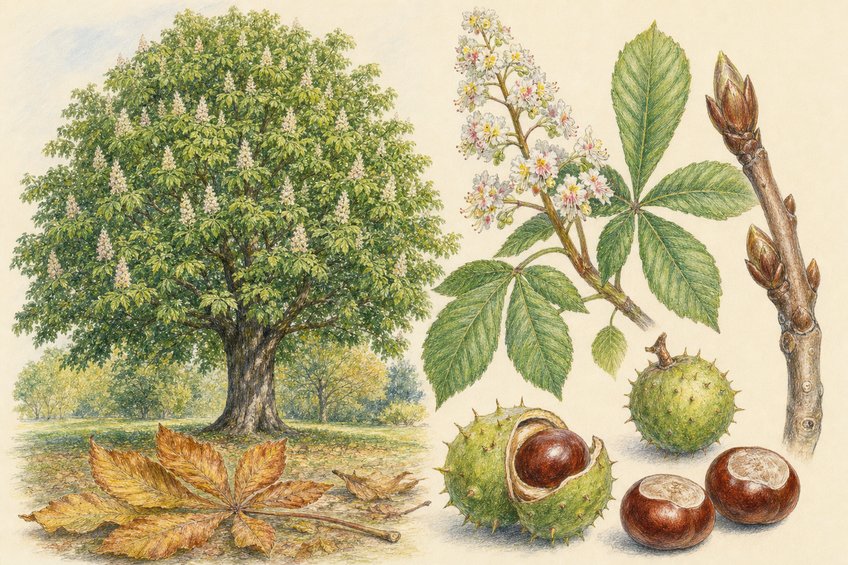
Horse chestnut is a grand, rounded tree that can reach 50 to 75 feet tall, with a heavy trunk and broad branches that make deep summer shade. Its leaves are easy to spot: each one spreads like an open hand, usually with five to seven toothed leaflets meeting at a single point.
In spring, the buds are fat, brown, and sticky with resin. Break one open and your fingers catch a faint balsamic scent, sharp and green, while the emerging leaves feel folded and soft, almost like damp paper fans.
By May, upright clusters of white flowers rise above the leaves like candles on a green altar. Each blossom carries small yellow marks that often turn pinkish-red as the flower ages, a quiet signal to visiting insects that the bloom has changed.
Autumn brings the part most people remember. Round green capsules, armed with soft-looking spines, split open to reveal polished mahogany seeds with a pale scar, or eye, on one side.
Not a chestnut for the roasting pan
The name can fool a hungry forager. Horse chestnut is not the same as the edible sweet chestnut, Castanea sativa, which belongs to the beech family and has a different leaf, a different bur, and a very different place in the kitchen.
Horse chestnut seeds are bitter and contain compounds that make the raw seed unsuitable as food. The old rule is simple: conkers are for pockets, games, study, and careful processing by trained manufacturers, not for roasting over a fire.
Sweet chestnut burs are packed with many fine, needle-like spines and usually hold several edible nuts. Horse chestnut capsules are chunkier, greener, and more widely spaced with blunt spines, often holding one large glossy seed.
From Balkan ravines to city boulevards
Wild horse chestnut has a surprisingly narrow native home. It grew naturally in cool, moist mountain woods of the Balkans, often near streams and shaded ravines where summer heat softens under tall trees.
The tree traveled west through Ottoman and Central European plant networks. Charles de l'Ecluse, better known as Clusius, recorded horse chestnut in Vienna in the late 1500s, and John Gerard described it in his 1597 Herball after it reached English gardens.
Once gardeners saw its huge leaves and spring flower spikes, horse chestnut became a favorite of parks, estates, and formal avenues. In North America, it settled into campuses, town greens, and old neighborhoods where a single mature tree could shade half a sidewalk.
The seed, bark, and leaf up close
The seed is the best-known part: smooth, hard, round, and so glossy when fresh that it looks varnished. That shine fades after a few weeks in a coat pocket, turning the conker dull brown and slightly wrinkled.
Historical herbals also mentioned the bark and leaves. The bark is gray-brown and becomes scaly with age, while the leaves are large enough that a child can hide most of a face behind one in June.
Collectors who gather the seeds for botanical study usually wait until the capsules fall and split on their own. The green husks may look soft, but their spines still prick the fingertips on a cold October morning.
What is inside a conker?
Horse chestnut seeds contain a group of triterpene saponins known collectively as aescin, sometimes spelled escin. Saponins are plant compounds that can foam in water, which is why some members of the soapberry family have a long association with washing and lather.
The tree also contains coumarin glycosides, including aesculin. Aesculin has a charming laboratory trick: under ultraviolet light, it can glow blue, a fact that still delights students seeing plant chemistry with their own eyes.
Flavonoids such as quercetin and kaempferol derivatives, tannins, starches, and fatty materials are also present. These constituents help explain why horse chestnut became important in pharmacognosy, the study of useful natural materials, while remaining a plant that calls for respect and careful handling.
Conkers, charms, and old garden timing
In Britain and Ireland, horse chestnut is woven tightly into the game of conkers. Children bore a hole through the seed, thread it on a string, and take turns striking an opponent's conker until one cracks; the World Conker Championships in Northamptonshire began in 1965 after a rainy fishing day turned into a village contest.
Old English garden talk often calls the spring flower clusters 'candles.' Country gardeners watched those candles as a seasonal cue, much like almanac readers watched lilacs and oak leaves, using the tree's bloom as a rough sign that late spring had truly arrived.
There is also pocket folklore. In parts of Britain, a conker carried in the coat was treated as a lucky charm for steady steps through winter, and in the American South and Appalachia, people carried the related native buckeye seed for luck in much the same way.
The name 'horse chestnut' may come from stable lore in the Ottoman world, where the seeds were associated with horses, or from the horseshoe-shaped leaf scar left on the twig after a leaf falls. Look closely at a winter twig and you can often see tiny marks like nail holes around that scar.
Did you know?
A horse chestnut flower can change its color signal. The yellow marks on fresh flowers often turn reddish after pollination, helping bees spend their time on blooms that still offer a reward.
Another surprise sits in the family tree. Horse chestnut is closer to maples and soapberries than to true chestnuts, even though the seed's polished brown coat looks like something from a holiday roasting basket.
Growing a tree with room to stretch
Horse chestnut prefers deep, fertile, well-drained soil that stays reasonably moist. It grows best in full sun to light shade, with enough space for a broad crown and a generous fall of leaves, flowers, and seed capsules.
Fresh seeds can sprout after a cold, moist winter period, much as they would on a forest floor. Gardeners often plant them soon after they fall, because conkers lose vigor when they dry out too much.
In city plantings, horse chestnut has shown both grace and limits. It tolerates park life and broad lawns better than cramped pavement pits, and in parts of Europe and North America its leaves may brown early from leaf miners, drought, or tree ailments.
Harvest for study or seed saving is simple but seasonal: wait for the capsules to fall, gather only sound seeds, and keep them cool and slightly moist if planting is planned. A fresh conker has a weight and shine that no wooden bead can quite imitate.
A closing look under the autumn tree
Stand beneath a horse chestnut in October and the ground tells the whole story: palmate leaves turning gold at the edges, split green husks, and brown seeds shining in the grass like small polished stones. It is a tree that rewards a slow walker, especially one willing to kneel down and turn a conker over in the palm.
References
- Royal Botanic Gardens, Kew. Plants of the World Online: Aesculus hippocastanum.
- Royal Horticultural Society. Aesculus hippocastanum plant profile and cultivation notes.
- Gerard, John. The Herball or Generall Historie of Plantes. 1597.
- Grieve, Maud. A Modern Herbal. 1931.
- Mabberley, D. J. Mabberley's Plant-book. Cambridge University Press, 2017.
- Bruneton, Jean. Pharmacognosy, Phytochemistry, Medicinal Plants. Lavoisier, 1999.
Explore our Horse Chestnut products in the HawaiiPharm store.